Health
WHO prioritises clinical trials for Bundibugyo Ebola treatments, vaccines


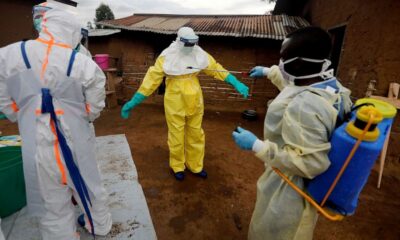
Health experts have advised that all candidate treatments and vaccines for Ebola disease caused by the Bundibugyo virus should be used exclusively within clinical trials to ensure safe, ethical, and effective research.
A statement made available on Thursday said that the experts were convened by the World Health Organisation (WHO).
According to it, the recommendation comes in response to the current outbreak in the Democratic Republic of the Congo, with additional cases reported in Uganda, and follows assessments by multiple WHO experts and advisory groups.
“WHO convened meetings with its Research and Development (R&D) Blueprint technical advisory groups on candidate vaccines and therapeutics for Bundibugyo Virus Disease (BVD) to evaluate options for both prevention and treatment.
“In parallel, the Strategic Advisory Group of Experts on Immunisation and its Ebola vaccine working group reviewed the potential role of licensed Ebola vaccines during BVD outbreaks,” it said.

The statement said that there are currently no licensed therapeutics or vaccines specifically approved for the prevention and treatment of BVD, though several candidate products were identified as promising enough to prioritise for clinical trial evaluation.
It noted that for treatment of confirmed BVD cases, independent experts recommended prioritising three candidates: the monoclonal antibodies MBP134 and Maftivimab®, and the antiviral remdesivir.
“Combination therapy using a monoclonal antibody and remdesivir was also recommended for evaluation in research settings.
“For prevention, the oral antiviral obeldesivir was identified as a priority candidate for post-exposure prophylaxis among contacts of confirmed and probable cases,” it said.
According to it, experts noted that post-exposure prophylaxis with obeldesivir depends on effective contact tracing, which remains operationally challenging in some affected areas of the DRC.
It said the most promising vaccine candidate is the single-dose rVSV Bundibugyo vaccine being developed by the International AIDS Vaccine Initiative, though it is expected to require 7–9 months before it is ready for clinical trial assessment.
It said that another candidate, ChAdOx1 Bundibugyo from Oxford University and the Serum Institute of India, could potentially be available within two to three months for efficacy testing, pending additional animal data.
“Experts suggested a single-dose approach for contacts of cases, while a two-dose strategy might be considered for high-risk but unexposed populations such as health-care workers and frontline responders.
READ ALSO: Ebola: WHO says conflict, mistrust hindering response as suspected cases top 900 in DRC
“The groups also reviewed Ervebo, the only licensed Ebola vaccine, which is approved for outbreaks caused by the most common Ebola virus in Africa but is not licensed for BVD and lacks conclusive evidence of cross-protection,” it said.
The statement said that the WHO recommended that Ervebo should not be used outside carefully designed research settings to allow its performance against BVD to be properly assessed.
“WHO, the governments of the DRC and Uganda, Africa CDC, ANRS Emerging Infectious Diseases, and other partners are now working to develop protocols for clinical field trials.
“While continuing to rely on established Ebola response measures like surveillance, contact tracing, isolation, testing, community engagement, and safe burials to stop transmission,” it said. (NAN)





The World Health Organisation (WHO) has warned that gaps in routine immunisation are leaving Nigerian children vulnerable to preventable diseases, urging the government to increase domestic health financing and strengthen disease surveillance and outbreak preparedness.
Pavel Ursu, the WHO representative in Nigeria, raised the concern on Tuesday during the organisation’s Health Diplomacy Dialogue in Abuja, which brought together diplomats and health officials to discuss health security, disease outbreaks, global health financing and antimicrobial resistance.
Mr Ursu said Nigeria continued to face challenges in containing vaccine-preventable diseases, including measles and circulating vaccine-derived poliovirus, despite support from international partners.
He said the country’s immunisation programme must reach approximately eight million additional children annually, placing increasing pressure on the health system.
“If we want to maintain the same level of performance, we have to invest more,” he said.
Mr Ursu acknowledged support from Gavi, the Vaccine Alliance, and other partners in providing vaccines and related commodities but stressed the need for Nigeria to progressively increase domestic financing and assume greater responsibility for protecting its population.

He also highlighted changes in global health cooperation, including declining development assistance for health and ongoing discussions about reforming the global health architecture.
He said African countries needed to strengthen domestic financing, improve health system resilience, expand digital health services and promote local manufacturing of health commodities.
Mr Ursu said the dialogue was established to provide a platform for the WHO and diplomatic missions to exchange strategic information on public health developments, emerging threats and international health policy, including for embassies without dedicated development cooperation programmes.
He called for stronger international cooperation, including timely information-sharing and coordinated responses to outbreaks that could cross national borders.
Outbreaks expose gaps in health security
Speaking on health security, Alex Chimbaru, the WHO emergencies adviser, said Nigeria’s disease outbreaks reflected persistent weaknesses in immunisation coverage, disease surveillance and access to safe water and sanitation.
He said more than 700 children had been disabled by circulating vaccine-derived poliovirus in previous years, warning that the actual number could be higher.
Mr Chimbaru also highlighted cholera as a major public health concern, citing inadequate water, sanitation and hygiene infrastructure, insecurity and population displacement as factors complicating prevention and response efforts.
He said Borno State accounted for 96 per cent of cases in the affected area discussed during his presentation, highlighting the need to prioritise interventions in vulnerable communities.
According to him, the WHO, other United Nations agencies, Médecins Sans Frontières (MSF) and other partners supported the response through surveillance, logistics, case management, vaccination, risk communication and infection prevention and control.
Mr Chimbaru called for sustained investment in water and sanitation, functional public health emergency operations centres, rapid response teams and stronger cross-border coordination to prevent and contain outbreaks.
He also urged development partners to reinforce government-led health systems rather than establish parallel structures, stressing that sustainable financing and stronger primary healthcare services were essential to health security.
Abuja to host global conference on antimicrobial resistance
The dialogue also featured discussions on Nigeria’s preparations to host a global conference on antimicrobial resistance (AMR) in Abuja from 6 to 8 December.
Mary Bartuo, the WHO team lead for universal health coverage and life course, said the conference would seek to translate international commitments into measurable action, stronger accountability and sustainable financing.
READ ALSO: Non-communicable diseases caused 74% of global deaths in 2023 – WHO
She said AMR was associated with about one million deaths annually in the African Region and posed growing threats to food security, livestock production and economic development.
Ms Bartuo said priorities under the proposed Abuja Compact included responsible AMR use, infection prevention and control, vaccination, water and sanitation, equitable access to medicines and diagnostics, research, local manufacturing and sustainable financing.
She urged diplomatic missions to participate in the conference and support efforts to strengthen national and international responses to AMR.
The WHO officials called for sustained investment and stronger collaboration among governments, diplomatic missions and development partners to improve health security and strengthen countries’ capacity to prevent, detect and respond to public health threats.
Discover more from Premium Times Nigeria
Subscribe to get the latest posts sent to your email.

The Coordinating Minister of Health and Social Welfare, Muhammad Pate, has said the livestock sector uses more antibiotics than the human health sector.
Mr Pate noted that the responsible use of the drugs in livestock could help reduce the pressure driving antimicrobial resistance (AMR) that can affect humans.
He made the statement on Monday in Abuja at a joint One Health ministerial briefing ahead of the fifth Global High-Level Ministerial Conference on AMR.
Explaining the need for a multi-sectoral approach to AMR, the minister said antimicrobial use in livestock is an important part of the resistance problem.
“The livestock sector uses more antibiotics than the human health sector. So if they are used better, then there’s less pressure for antimicrobial resistance to develop that can affect people,” he said.
Mr Pate said antimicrobial resistance could move between humans, animals and the environment, emphasising the need for collaboration across sectors.
“Much of the zoonotic disease and AMR can come from animal health to humans,” he said, adding that the use of antimicrobials in animal health and human health could have consequences for the wider population.
Prevention before treatment
The minister said efforts to control AMR should not focus only on the treatment of infections but also on preventing diseases that require antimicrobial medicines.
He identified vaccination, hygiene, biosecurity, infection prevention and control, and improved diagnostics as important measures.
“If you can prevent the disease, then you don’t need to use the antimicrobial,” Mr Pate said.
He also urged Nigerians to avoid using antibiotics unnecessarily, noting that not every cough or catarrh requires antibiotic treatment.
“It’s not every cough that needs to use antibiotics. It’s not every catarrh that needs to use antibiotics, please consult a doctor,” he said.
Livestock practices
The Minister of State for Agriculture and Food Security, Aliyu Abdullahi, said AMR also poses a threat to agriculture and food security.
Mr Abdullahi said inappropriate or excessive use of antimicrobials and agrochemicals could undermine disease control, food safety, trade and livelihoods.
According to him, the agriculture sector is prioritising responsible use of antimicrobials, farmer education, extension services, good agricultural practices and biosecurity.
One Health approach
The Minister of Environment, Balarabe Lawal, said AMR cuts across human, animal and environmental health.
READ ALSO: CSOs demand disclosure of JBS $2.5bn Nigeria deal, warn of livestock expansion risks
“Resistance does not respect boundaries. It cuts across sectors. It moves from people to animals, from farms to food, and through water, soil, and waste systems,” Mr Lawal said.
The ministers’ meeting is part of preparations for the fifth Global High-Level Ministerial Conference on AMR, which will be held in Abuja from 6 to 8 December.
The conference is the first global high-level ministerial conference on AMR to be held in Africa, with the theme, “One Healthcare: Advancing global AMR commitments to local action.”
Discover more from Premium Times Nigeria
Subscribe to get the latest posts sent to your email.
-
News4 days ago
Inside INEC’s AI and cybersecurity plans to secure Nigeria’s 2027 Elections – Technology Times
-

 News3 days ago
Petra Power looks to modernize energy for data centers and defense vehicles
-
News3 days ago
EuroMatch NPFL: Ikorodu City Return to Winning Ways as Salami, Ikechukwu Sink Kwara United in Lagos
-
News3 days ago
Microsoft’s Satya Nadella says AI models need an ‘emergency brake’