Business
Unitrust CEO Arowojolu Advocates Youth-Driven Transformation in Insurance Industry

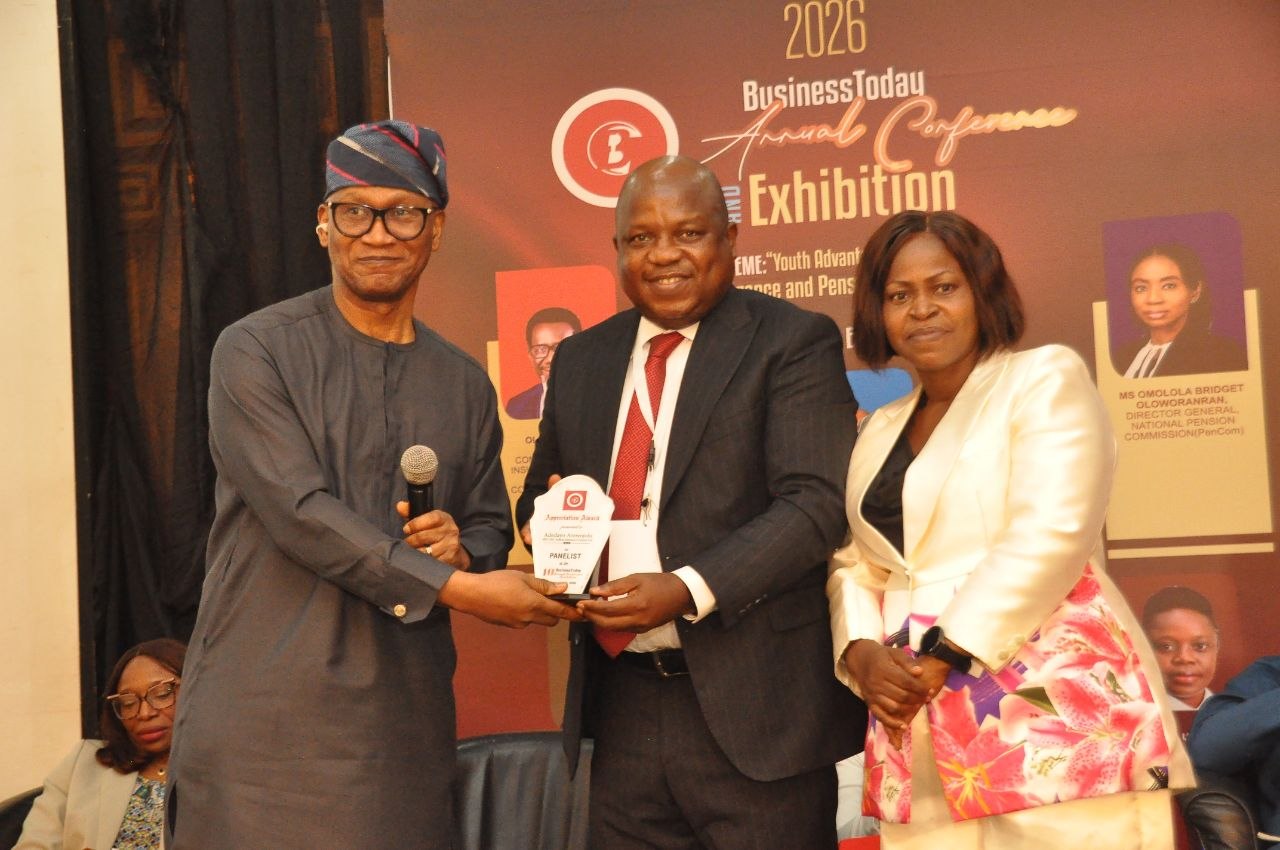
From right: Managing Director/Chief Executive Officer of Unitrust Insurance Company Limited, Adedayo Arowojolu, receiving appreciation award plague from Dr Julius Odede, Head of Lagos Operations at National Insurance Commission,( NAICOM), at the just concluded 2026 BusinessToday Annual Conference and Exhibition on Insurance and Pensions held in Lagos , with the Convener of the conference, Mrs. Nkechi Naeche-Esezobor.
BY NKECHI NAECHE-ESEZOBOR —-The Managing Director/Chief Executive Officer of Unitrust Insurance Company Limited, Adedayo Arowojolu, has called for increased youth participation in Nigeria’s insurance industry, emphasizing the need to reposition the sector to align with the expectations of a younger generation.
Arowojolu made this known while speaking as a panelist at the 2026 BusinessToday Annual Conference and Exhibition on Insurance and Pensions held in Lagos, themed “Youth Advantage: Redefining Insurance and Pensions for a New Era.”
According to him, the insurance industry must deliberately attract young people, noting that many youths do not naturally consider insurance as a preferred career path.
“If we take a poll among students today on their preferred industries, insurance will likely rank low, behind sectors like oil and gas, fintech, and banking,” he said.
He admitted that his own entry into the industry was accidental, but described the sector as one filled with opportunities and long-term value.
“I found myself in insurance by chance, but since joining, I have discovered what I would have missed if I had not worked in the industry,” he added.
Arowojolu explained that insurance, by its nature, offers future value, which may not immediately appeal to a generation that prioritizes instant rewards. However, he stressed that changing economic realities now allow young people to earn and build wealth earlier, making financial protection more relevant than ever.
“Many young people today are earning income—even as students—through digital platforms and content creation. The question is: what do you do with that income? Insurance helps secure that value and protect the future against unforeseen risks,” he said.
He further highlighted ongoing efforts within the industry to drive transformation, including a 10-year Nigerian Insurance Industry Transformation Framework focused on growth and human capital development, particularly among youth.
Addressing strategies to engage young people, Arowojolu identified two key approaches: converting them into customers and attracting them as professionals.
On customer engagement, he emphasized the need for increased advocacy, product innovation, and youth involvement in product development.
“We cannot continue to sell the same products and expect different results. Young people should be part of designing products that meet their needs,” he noted.
He also underscored the importance of rebuilding trust in the industry, particularly through prompt claims settlement. He commended regulatory efforts to ensure accountability, noting that insurance companies are now required to regularly justify outstanding claims or face penalties.
In addition, he stressed the importance of leveraging technology, including fintech and insurtech platforms, to make insurance products more accessible and engaging for younger audiences.
“Everyone uses a mobile phone today. Insurance products must be integrated into these platforms to remain relevant,” he said.
On attracting youth as professionals, Arowojolu noted that insurance companies are increasingly improving remuneration and workplace culture to compete with other industries.
He revealed that Unitrust Insurance has, in recent years, deliberately recruited young talent to inject fresh ideas and innovation into the organization.
However, he emphasized that recruitment alone is not enough.
“The key challenge is retention. Organizations must create environments that resonate with young people,” he said.
He highlighted initiatives such as flexible work arrangements, hybrid work models, and support for professional development as critical factors in attracting and retaining young talent.
“For instance, we operate a hybrid system with three days of physical presence weekly, allowing employees time for personal pursuits while maintaining productivity,” he explained.
Arowojolu concluded by encouraging young people to consider insurance both as a means of financial security and as a viable, rewarding career path.
The post Unitrust CEO Arowojolu Advocates Youth-Driven Transformation in Insurance Industry appeared first on Business Today NG.

GCR Ratings has upgraded Fidelity Bank Plc‘s national-scale long-term issuer rating to A Plus (NG) from A (NG), while affirming its short-term issuer rating at A1 (NG). The outlook remains stable.
The upgrade reflects Fidelity Bank’s significantly strengthened capital position following the addition of NGN227.0 billion to its total core capital. GCR also recognised the bank’s strong domestic market position, stable funding base and healthy liquidity profile.
Fidelity Bank’s competitive position remains a key rating strength, supported by its strong domestic franchise and nearly four decades of operating experience. With total assets of NGN10.5 trillion and an estimated 8.0 per cent share of the banking industry’s gross loans as of December 2025, the bank ranks as Nigeria’s sixth-largest bank.
The bank also plans to leverage its international banking licence to enter three additional African markets over the medium term. The expansion is expected to diversify its country exposure and further strengthen its competitiveness among rated peers.
Fidelity Bank raised NGN227.0 billion in additional equity capital in 2025, enabling it to fully comply with the revised capital requirement for its licence category. The capital was officially recognised as the core capital in 2026.
Consequently, the bank’s GCR core capital ratio increased substantially to 29.4 per cent at the end of March 2026, from 17.2 per cent in December 2025. Its stage three loan loss reserve coverage also remained strong at more than 100.0 per cent.


GCR expects the bank’s core capital ratio to remain above 20.0 per cent over the outlook period, supported by good earnings retention. The rating agency also noted that Fidelity Bank’s exposure to the oil and gas sector is diversified across the upstream, downstream and services segments. Foreign currency exposure is further moderated through natural hedging.
Fidelity Bank’s funding profile remains positive, underpinned by a large and stable deposit base. Customer deposits grew by 16.1 per cent as of December 2025 and by a further 7.1 per cent as of March 2026, reaching NGN7.4 trillion.
Customer deposits accounted for 89.5 per cent of the bank’s total funding base in March 2026. Approximately 90 per cent of these deposits were held in relatively inexpensive current and savings accounts, providing a strong foundation for sustainable funding.
READ ALSO: Fidelity Bank gets extension to publish H1 2026 audited results
The bank also maintained a robust liquidity position, supported by a substantial portfolio of liquid assets. Its liquid assets-to-customer deposits ratio stood at 56.9 per cent in March 2026, while liquid assets covered wholesale funding by 4.8 times.
The stable outlook reflects GCR’s expectation that Fidelity Bank will maintain a strong financial profile, with its core capital ratio remaining above 20.0 per cent, supported by stable funding, strong liquidity and resilient asset quality indicators.
Discover more from Premium Times Nigeria
Subscribe to get the latest posts sent to your email.
Business
FG Continues NEMSAS Rollout, Strengthens Emergency Care and Hospital Infrastructure in Bauchi
-

 Business2 days ago
Lingzhi Global, NACOFTAN Announce 2026 Coffee Festival in Cross River
-
Events2 days ago
Peace Walk: WOPPI Urges Plateau Citizens to Invest in Peace Every Day
-
Business4 days ago
Tinubu reacts as Nigeria wins arbitration against Sunrise Power
-
News4 days ago
Why I refused to join APC – Seriake Dickson