Business
FidBank UK broadens investment pathways for Nigerians into UK market

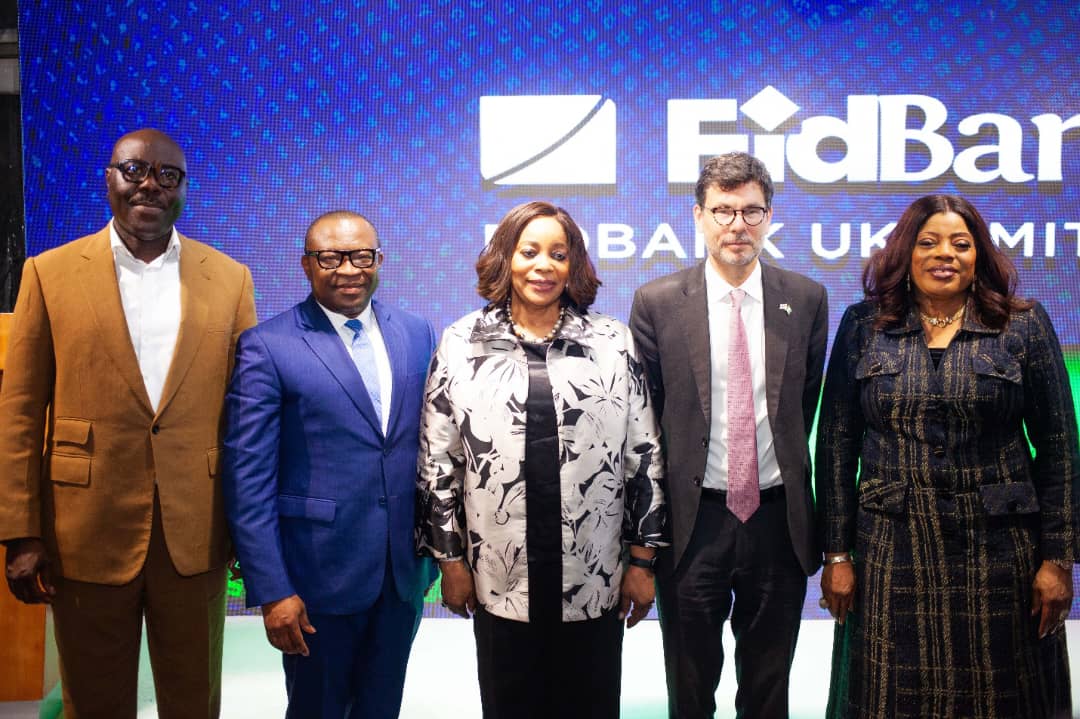

Leading financial institution, Fidelity Bank Plc’s international subsidiary, FidBank UK Limited, has announced a commitment to support Nigerians – both individuals and corporations – in acquiring properties in the United Kingdom.
Fidbank UK, which provides a comprehensive suite of financial services, including trade finance, personal and business banking, treasury services, commercial lending, and private banking, is set to deliver tailored financial solutions for high-net-worth individuals (HNIs) seeking to invest in the UK real estate market through its FidBank Buy-to-Let product.
This announcement was made at an exclusive product showcase hosted by the British Deputy High Commissioner, Jonny Baxter, at his residence in Lagos on Tuesday.
The event was attended by a select audience comprising captains of industry and corporate leaders.
Highlighting the significance of the event, the Managing Director/Chief Executive Officer of FidBank UK Ltd, Johnson Enemadu, said: “This event is about showcasing to the market and our customers that there is something exciting in the market and we are able to take them along in this journey, supporting their businesses by bringing capital both in the financial institutions and corporate space and also for our high networth inidividuals. It is a total experience.

“Today’s event is also taking place against the backdrop of strengthened bilateral relations between Nigeria and the United Kingdom, highlighted by the recent state visit of the President of the Federal Republic of Nigeria to the UK. This renewed engagement between both countries continues to unlock new pathways for trade, investment, and financial collaboration; and FidBank UK is pleased to play a leading role in driving this.”
In his welcome remarks, the British Deputy High Commissioner in Lagos, Jonny Baxter said:
“The United Kingdom remains firmly committed to deepening its economic partnership with Nigeria, with a clear focus on driving inclusive, sustainable investment, trade and economic growth. London’s position as a leading global financial centre is central to this, supported by robust financial infrastructure that enables efficient trade flows and seamless cross-border transactions between our markets.
It is therefore encouraging to see institutions such as FidBank UK advancing financial service offerings that not only expand investment opportunities in the UK, but also strengthen the financial systems supporting growing commercial ties. We welcome and support efforts that continue to enhance liquidity, facilitate trade, and drive sustainable UK-Nigeria economic connections.”
READ ALSO: Fidelity Bank Plc appoints new non-executive director
The well-attended event also featured art exhibitions by two of Nigeria’s leading visual art talents -Femi Morakinyo and Oswald Chukwunyeremugo – who displayed their latest works to the admiration of the guests.
Also speaking at the event, the Governor of Lagos State, Babajide Sanwo-Olu, represented by the Honourable Commissioner for Finance, Abayomi Oluyomi, lauded the initiative as it aligned with the administration’s T.H.E.M.E.S. Agenda, saying:
“FidBank UK offers a private banking relationship grounded in regulatory rigour and institutional trust. This is not a catalogue of products, it is a comprehensive financial architecture built for people who live, work and invest across the Nigerian-UK corridor”.
Operating from the heart of the City of London since 1983, FidBank UK provides a comprehensive range of banking services to customers doing business from and into Nigeria and other West African countries, including trade finance, personal banking, business banking, treasury services, commercial lending and private banking.
The bank is authorised by the Prudential Regulation Authority and regulated by the Financial Conduct Authority and Prudential Regulation Authority and subscribe to the Financial Services Compensation Scheme.





Martha Kandawa-Schulz, Namibia’s Cartagena Protocol National Focal Point, died in Yerevan, Armenia, while participating in the ongoing United Nations Biodiversity Conference (CBD COP17).
Ms Kandawa-Schulz, a professor, died on 23 October, according to a statement the Convention on Biological Diversity (CBD) Secretariat issued Sunday evening.
She was serving as Co-Chair of the Contact Group on Risk Assessment and Risk Management of Living Modified Organisms at the conference.
In a message to delegates, the Secretariat described her as a highly respected colleague whose dedication, expertise, and leadership contributed significantly to the Convention and its Protocols, as well as to the global biosafety community.
It said her commitment and collegiality had earned her the respect and appreciation of colleagues who had the privilege of working with her.
The Secretariat extended its condolences to her family, friends, colleagues, and the Government and people of Namibia.

It also expressed sympathy to the African Group and others mourning her death.
“The Presidency and the Secretariat are working closely together to support her family and the Namibian delegation on site, and to facilitate the necessary arrangements,” the statement said.
The Secretariat also announced that a book of condolences would be available to delegates from 13:00 on Monday at Entrance 2, near the Asia-Pacific Room, for those wishing to pay their respects.
It urged delegates to honour Ms Kandawa-Schulz’s memory and recognise her contributions to the shared objectives of the Convention.
ALSO READ: CBD COP17: Nigeria, six others each win $50,000 grant for biodiversity projects
The circumstances surrounding her death were not stated, although reports indicate that she collapsed during her engagement in the working group meeting on Friday.
CBD COP17 is taking place in Yerevan, Armenia, bringing together governments and other stakeholders to deliberate on global biodiversity conservation and the implementation of the Convention and its associated protocols.
Government representatives, delegates, scientists, civil society representatives and researchers, among others, from nearly 196 countries are participating in the conference.
Discover more from Premium Times Nigeria
Subscribe to get the latest posts sent to your email.
-

 News3 days ago
Obi, Kwankwaso to hold Middle Belt Youth, Village Hall Meeting in Jos
-
News4 days ago
Handball President Jibril Saidu Ojih Explains Reasons Behind Introduction Of Transfer Fees For Nigerian Players
-
Entertainment4 days ago
FOGMMON PLATEAU CONGRATULATES EJIDIKE UGOCHUKWU (𝙈𝙞𝙣𝙨𝙩𝙧𝙚𝙡 𝙅𝙞𝙙) ON HIS APPOINTMENT AS NATIONAL PRESIDENT
-
News2 days ago
Plateau Activates Ebola Preparedness Measures, Urges Residents to Observe Safety Guidelines