Health
SPECIAL REPORT: Inside Sokoto’s fight against polio vaccine hesitancy


Little Karima held her father, Muhammad Nasiru’s arm, struggling to keep pace with him. Her flowing gown obscures her uneven gait –the way she swings one leg and limps with the other.
The father raised her gown as they walked some more, exposing her dusty legs from knee to ankle. One of Karima’s legs is stiff and bent.
Until mid-last year, Karima’s legs were straight, and she already walked well at one year and six months old. But her gait began to change. One of her legs had become stiff, and the little girl was limping.

At the time, the Surveillance Focal Person at the Primary Healthcare Centre, Kajiji, Shagari Local Government Area (LGA), Sokoto State, Mubarak Umar, suspected a case of polio. He took the girl’s samples –faeces and urine– and those of other children in the neighbourhood and sent them to the Ibadan National Polio Laboratory (Ibadan NPL) for a test.
Karima’s result came back positive for circulating Vaccine-Derived Poliovirus type 2 (cVDPV2), a strain of the Wild Polio Virus (WPV) currently endemic in Nigeria. The cVDPV2 is found among populations with low herd immunity. It has caused more polio cases annually than the wild poliovirus since 2017, according to the World Health Organisation (WHO).

Sokoto’s Polio burden
Although Nigeria had been declared polio-free since 2020, the country has battled the spread of the cVDPV2 variant in the North-west states, including Kebbi, Sokoto and Zamfara. The situation has persisted due to low routine immunisation coverage, population movement and vaccine hesitancy.
Mr Nasiru insisted all of his children, including Karima, were vaccinated and didn’t know how his daughter contracted the disease. But multiple sources, including immunisation officers and traditional rulers in the community, said Mr Nasiru’s household was known for rejecting vaccinations. Karima’s test results, seen by our reporter, indicate ‘unknown’ for all other vaccines she ought to have taken at that age.
The refusal of vaccines remains one of the biggest challenges facing the eradication of polio, the Sokoto State’s Immunisation Officer (SIO), Bashar Garba, told PREMIUM TIMES.
Although there have been more suspected cases in other LGAs, Mr Garba said vaccine hesitancy is more prevalent in metropolitan areas, comprising three LGAs — Sokoto North, Sokoto South and Wamakko. They have recorded the highest level of non-compliance in polio vaccine administration.
“There was a campaign we implemented in Kano and other northern states, and Arkilla Ward in Wamakko LGA emerged as the leading ward with the highest number of rejections and non-compliance,” he said, explaining how much of a problem the situation poses.
Vaccine hesitancy isn’t without a consequence. Last year, Sokoto recorded at least 20 cases of the cVDPV2. At least six of them were recorded in the Kajiji ward of Shagari LGA.
Community vanguards to the rescue
However, government- and citizen-led initiatives, including UNICEF-employed Volunteer Community Mobilisers (VCMs), traditional rulers, and other volunteers, have formed a line of defence in communities, helping to track and identify unvaccinated children and report suspected polio cases.

In Shagari LGA, for instance, Routine Immunisation (RI) providers have now increased immunisation outreaches to nearby villages from once to twice a week.
Abdullahi Liman, an RI provider at PHC Kajiji, said they used to administer routine immunisation at the hospital on Tuesdays and conduct outreach once a week.
However, since cases of cVDPV2 surged last year, all 28 providers covering over 200 settlements in Shagari LGA now conduct at least two outreach visits a week.
Another challenge is the manpower shortage, which Mr Garba said the state government was already addressing. According to him, some health workers were recently hired but have yet to be posted to health centres.
The RI providers also work with community leaders to ensure vaccine acceptance, sometimes setting up shop at the community leaders’ palaces.
One official who supervises immunisation data told PREMIUM TIMES that adding one more weekly outreach visit helped increase coverage in Shagari to 88 per cent last year, a feat he said would be impossible if they conducted only one outreach visit a week.
House-to-house campaign
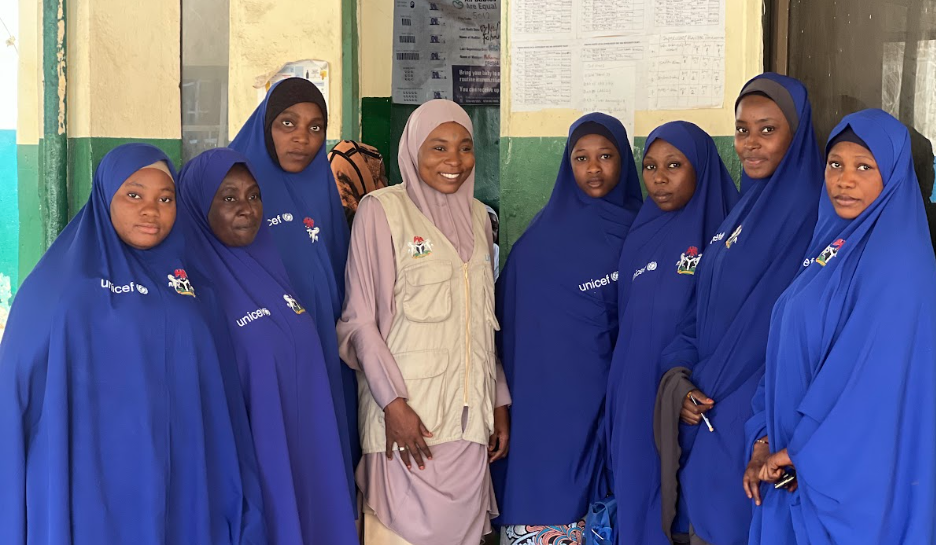
One Friday morning in February, a group of women draped in blue Hijabs that carry inscriptions of Nigeria’s coat of arms on the left and UNICEF on the right, clutched vaccine carrier boxes, and marched through communities in Sokoto North LGA, in search of newborns and their mothers.
Their first stop was the Fakon Idi area, where they spread a mat under a tree and set up to attend to mothers and infants.
A mother, Asmau Adamu, presented her five-day-old, wrapped in several layers of clothes, to one of the women known as VCMs, an inscription boldly written at the back of their blue hijabs.

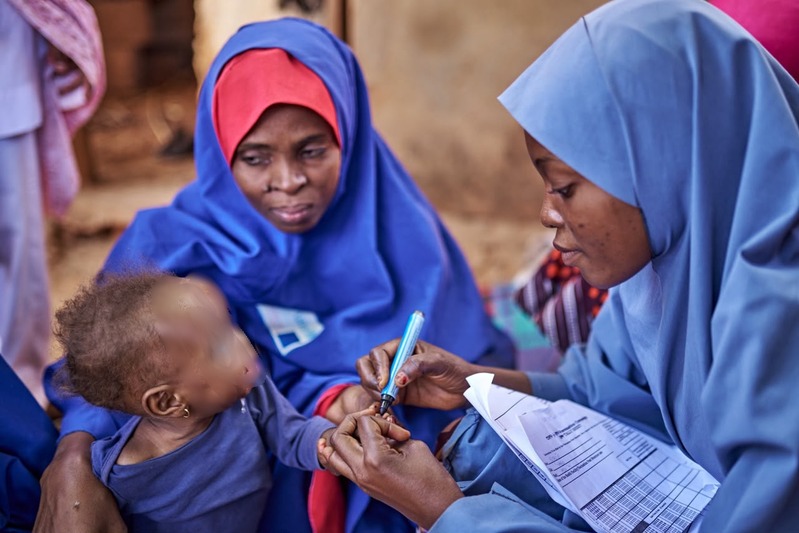
An RI service provider, Hafsat Isa, unlocked the vaccine carrier box, drew up doses into an injection and inserted it into the arm of Mrs Adamu’s child. She then opened the child’s mouth and dropped doses of another vaccine on his tongue. Before returning the child, another VCM scribbles something into a card presented by the mother.
Mrs Adamu collected her child and stood from the mat as another mother, Asmau Mustapha, took her place, presenting her own child to the VCM for a similar routine.
“They explained that the vaccines would prevent the child from having polio and other diseases,” Mrs Adamu told PREMIUM TIMES.
The VCMs are employed by UNICEF to help improve health outcomes, particularly on polio eradication and routine immunisation. They go house to house to enquire about the newborn, educate mothers on how to care for their children and check immunisation cards to tell parents when to take their children for another round of immunisation. On some days, like this Friday, they follow RI service providers for outreach to the communities.
Track, Report, Engage
Across Sokoto State, the VCMs and RI providers work with community leaders and influential figures to identify and track households that refuse vaccines.

Ms Isa, who works at the Primary Healthcare Centre Kofar Rini, Sokoto North LGA, said the VCMs are instrumental in tracking households that haven’t brought their newborns for vaccinations. They also note households that refuse vaccines and report them to community leaders.
“When we talk to them (the traditional leaders) and give them the names of the parents, they will go to the house and tell them to bring their children for vaccination,” she told PREMIUM TIMES. “Even when they want to reject vaccines, he’ll encourage them to do it.”
“Just days ago, there was someone who was reported to me for refusing the Polio vaccine for his children,” the district head of Fakon Idi, Aminu Muhammad, narrated. “When I met him and explained the importance of the vaccines, he succumbed and allowed the vaccination.”
Cash-for-vaccines
At PHC Kofar Rini, Tuesdays are now a beehive at the immunisation unit. New Incentives, a Non-Governmental Organisation (NGO), offers cash to mothers who bring their children for vaccination at the hospital or during outreaches.
“Every time my child gets a vaccine, I receive N1,000,” said Mrs Adamu, during an outreach at Fakon Idi.
When the children completed their doses, the mothers received an additional N6,000 as a lump sum.
“Since New Incentives came, the population has increased,” said Ms Isa, the official in charge of immunisation at the hospital.
“I used to hold Waziri B and C wards, and I get to immunise about 70 babies a day when New Incentives is around, but I didn’t get that much before.”
Ms Isa explained that the cash incentives are to help the mothers with transportation, in case that is a barrier to taking the vaccine.
But that too has its challenges. This cash-for-vaccine initiative also faces some criticisms, as some push the narrative that they are being paid to ‘sell their children’.
“We explain to them that it is to help them with transportation, because some people have spread false information about it,” said Ms Isa.
Why do they reject polio vaccines?
Vaccine hesitancy has a long history in Nigeria, particularly in the northern part of the country. One of the most notable causes of it was the 1996 Pfizer Trovan drug trial conducted in Kano during a meningitis outbreak. The trial failed and left close to a dozen children dead and many others permanently disabled. The episode would later serve as a fodder for a boycott of the polio vaccine campaign in the region a few years later.
The misinformation spread about the polio vaccine as containing ingredients that cause infertility or reduce populations have failed to die in 2026. Not only did the situation lead to a resurgence of polio cases at a time Nigeria was already making progress, but the mistrust sown continues to remain. In Sokoto, those who refuse the vaccines offered similar reasons, ranging from religious and personal beliefs to political reasons.
“Some will say the vaccines make children stubborn, and others will say the ingredients were made with monkeys’ blood and other things that are not lawful for a Muslim to eat,” said Mr Umar, the surveillance focal person in Kajiji.

A resident of Kajiji, Liman Jabi, now 65, said he also got sceptical and refused polio vaccination for his child at one point, even though his older children had received them.
“We started hearing that it causes infertility. Honestly, at the time, we got scared,” he recalled. “But I was able to dismiss that thought because all of my children who took the vaccine now have children of their own, and they are all healthy.”
In the course of his advocacy within the community, the community leader in Kajiji, Umar Umar, said some wondered why they were never given free drugs when they were sick, but had vaccines taken to their doorsteps.
“Some will say when the government is sharing things, it never gets to them except this vaccine,” he said.
Although Abubakar Sahabi now works alongside Mr Umar and other elders in the community to ensure every child is immunised, he too used to reject the vaccine.
“I used to turn the outreach officials back whenever they got to our doorsteps,” he admitted. “We were told it has ingredients that cause infertility.”
The last time the vaccine was rejected at his home, he was summoned to the community leaders’ palace for a meeting. “When I got there, they told me that the vaccines help prevent polio in children and that it doesn’t have any side effects. They did a lot of explaining,” he said.

“They even brought clerics to talk about it, not contradicting the teachings of Islam. They gave me an example of how vaccines were used to eradicate an illness that used to be prevalent among our grandparents. They told me that the only way to eradicate polio in our society is through vaccination.”
Now, Mr Sahabi is one of those who receive reports of households that refuse the vaccine and talk them into accepting it.
Challenges here, progress there.
“Though we are not there yet, the quality of our campaign has improved,” said Mr Garba, the state immunisation officer.
READ ALSO: INTERVIEW: Old narratives surrounding polio vaccines still haunt eradication initiatives in Sokoto – Official
He said the challenge has helped the state become better prepared and develop more effective ways of handling cases.
According to him, the digitisation of the state records is one of the biggest wins, as it eases the process of monitoring progress.

But some challenges, particularly about data quality, remain. Mr Garba said some of the immunisation officers, despite the rigorous process of hiring and training them, fail to report households rejecting the vaccines and sometimes even collude with them to report false positives.
“They will go to the households, collude with caregivers who refuse vaccination, finger-mark them with the assumption that anybody can just show them that we vaccinate,” he said.
“We need to have a very serious mindset change for people to understand that they need to tell the truth, just to help the community.”
However, at the community level, volunteers are winning souls for the polio campaign.
“These days, people are so aware that anyone calls me or the Disease Surveillance and Notification Officer (DSNO),” said Mr Umar, the Surveillance Focal Person in Kajiji
“There’s an uncle of mine who doesn’t allow polio vaccines, but I was able to convince him to allow it, and he agreed,” said Mr Sahabi, himself a polio vaccine reformist.





Gavi, the Vaccine Alliance, says 9.5 million children in 57 supported countries received no routine vaccine in 2025, despite gains in global immunisation.
The figure, described as the number of “zero-dose” children, was contained in Gavi’s 2025 Annual Progress Report, which reviewed the alliance’s 2021-2025 strategic period.
Gavi defines zero-dose children as infants who have not received the first dose of a diphtheria, tetanus and pertussis-containing vaccine by the end of their first year.
Number falls from 2021 peak
According to the report, the number of zero-dose children in 2025 was 600,000 lower than in 2024 and 25 per cent lower than the peak recorded in 2021 following disruptions to routine immunisation caused by the COVID-19 pandemic.
However, the figure remained four per cent above the 2019 baseline, partly because of continued growth in the number of children being born.
Gavi said children living in fragile, conflict-affected and humanitarian settings remain among those most likely to be missed by immunisation programmes.

Nigeria remains one of the countries with the highest number of zero-dose children. UNICEF estimated that about 2.2 million Nigerian children had never received a routine vaccine in 2025, the highest number in Africa.
Nigeria records gains in targeted areas
The report highlighted Nigeria, Ethiopia and Pakistan among countries where emerging data showed stronger immunisation coverage gains in sub-national areas that received greater Gavi focus and investment during the 2021-2025 period.
Gavi said the findings underscored the value of targeted, equity-focused investments in reaching communities that are being missed by routine immunisation.
The report also identified Nigeria among countries covered by Gavi’s Zero-Dose Learning Hubs, which examined what works and what does not in identifying and reaching zero-dose and under-immunised children.
The findings from Nigeria, Bangladesh, Mali and Uganda highlighted several issues, including gender-related barriers to immunisation.
73m children immunised in 2025
Despite the number of zero-dose children, Gavi said more than 73 million children were immunised through routine programmes with its support in 2025.
More than 351 million children were immunised during the 2021-2025 strategic period, “exceeding Gavi’s target of 300 million children.”
“By end 2025, Gavi-supported countries had immunised more than 1.3 billion unique children with Gavi support since 2000, exceeding our Investment Opportunity 2021-2025 commitment of more than 1.1 billion children immunised by 2025,” it noted.
Gavi said vaccination averted more than 2.2 million future deaths in 2025, bringing the total number of future deaths averted through its supported vaccination programmes to more than 7.8 million during the 2021-2025 period.
Generated economic benefits
The report said immunisation programmes generated more than $30 billion in economic benefits for Gavi-supported countries in 2025, the highest amount recorded in a single year.
The benefits were calculated from the costs of illness averted, including medical and associated costs, caretaker wages and productivity losses resulting from disability or death.
Gavi said the programmes generated more than $104 billion in economic benefits between 2021 and 2025 and more than $308 billion between 2000 and 2025.
Countries also contributed a record $301 million towards the co-financing of Gavi-supported vaccines in 2025, an 18 per cent increase from 2024.
About 80 per cent of the contribution came from domestic resources, while “approximately 20 per cent from low-interest loans from the World Bank.”
Gavi said countries had contributed a total of $2.2 billion towards vaccine co-financing since the policy was introduced in 2008.
More children
For its 2026 to 2030 strategic period, Gavi said it aims to protect another 500 million children through immunisation and avert between eight million and nine million future deaths.
READ ALSO:New TB vaccines could save 7.3m lives by 2050 – Gavi
The Alliance also targets more than $100 billion in economic benefits during the period. Gavi said it would place greater emphasis on reaching zero-dose and under-immunised children while strengthening the sustainability of national immunisation programmes.
In her comments, Gavi Chief Executive Officer, Sania Nishtar, said the results showed that immunisation generates benefits beyond preventing disease. “However, when it comes to immunisation we know that the return on investment extends far beyond health to supporting sustainable, inclusive economic growth,” Ms Nishtar said.
WHO Director-General, Tedros Ghebreyesus, also said immunisation delivers massive gains in lives saved and diseases prevented, but also in terms of economic benefits.
“Countries understand that the cost of failing to vaccinate is far too great, while the benefits extend across families, communities, economies and future generations,” Mr Ghebreyesus was quoted to have said.
Discover more from Premium Times Nigeria
Subscribe to get the latest posts sent to your email.

A military cardiologist, Life Ajemba, has warned that hypertension, prolonged stress, and inadequate sleep could increase the risk of cardiovascular disease among serving military personnel and veterans.
Mr Ajemba, a major-general, said hypertension remains one of the most common cardiovascular conditions among serving personnel and military retirees.
Speaking in an interview with the News Agency of Nigeria on Wednesday in Abuja, he urged military personnel and veterans to prioritise their heart health through regular medical checks, physical exercise, healthy diets and adequate rest.
He cited studies which showed that hypertension accounted for 15.31 per cent of cases treated among mainly military retirees between 2015 and 2020.
He also referenced another study which found a hypertension prevalence of 34.3 per cent among military personnel.
He noted that major risk factors included alcohol consumption, tobacco smoking, family history of cardiovascular disease and being overweight.
According to him, the demanding nature of military service could also increase cardiovascular risks due to physical stress, psychological trauma, irregular schedules and inadequate sleep.
“Military duties affect heart health through a combination of extreme physical stress, psychological trauma and environmental exposures that increase the risk of cardiovascular disease,” he said.
The military cardiologist explained that prolonged stress could increase the release of hormones such as adrenaline and cortisol, leading to increased heart rate and blood pressure.
He added that sleep deprivation, anxiety and other psychological pressures could further increase the risk of hypertension, coronary artery disease, heart attack and stroke.
Mr Ajemba stressed the importance of regular medical screening among military personnel, saying early detection could help identify silent conditions such as high blood pressure, abnormal cholesterol levels and elevated blood sugar.
He said routine medical checks could include blood pressure and heart rate monitoring, blood tests, lipid profiles, electrocardiograms (ECGs), chest X-rays, and echocardiography where necessary.
READ ALSO: PT Health Watch: How Pregnancy-Induced Hypertension puts mother, baby at risk
“Early detection ensures that soldiers receive treatment while remaining fit for duty, preventing medical evacuation and safeguarding their long-term health,” he said.
He also encouraged military personnel to maintain regular physical exercise, saying fitness helped reduce blood pressure, improve heart efficiency and increase resistance to operational fatigue.
Mr Ajemba, however, advised personnel to combine physical fitness with healthy eating, adequate rest and avoidance of smoking and excessive alcohol consumption.
He said maintaining a healthy lifestyle could help military personnel reduce cardiovascular risks and remain fit both during active service and after retirement.
(NAN)
Discover more from Premium Times Nigeria
Subscribe to get the latest posts sent to your email.
-

 News4 days ago
2027: El-Rufai’s detention could hurt APC, generate sympathy – SEDSAC director, other analysts express views
-
News3 days ago
Lucid Motors’ EV output falls to lowest level in almost 2 years
-
Business4 days ago
NAIPE 11th Annual Conference Moves to 12 Noon as 28 Stakeholders Back Event
-
News2 days ago
Mirror Particle is building a ‘world model’ of human behavior