Business
Nigeria, AfDB sign agreement to operationalise $7bn aviation transformation programme

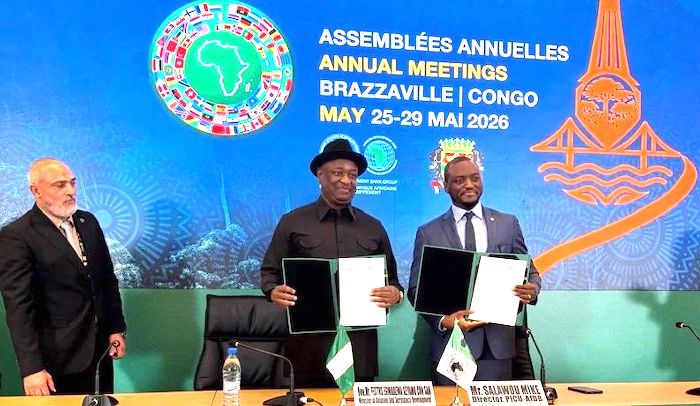

Minister of Aviation and Aerospace Development, Festus Keyamo, on Thursday in Brazzaville, Congo, signed a Letter of Intent (LOI) between the African Development Bank (AfDB) and the Federal Republic of Nigeria to advance the implementation of the Integrated Aviation Transformation Programme (IATP), a $7 billion initiative designed to modernise Africa’s aviation sector.
This was disclosed in a statement by the minister’s Special Adviser on Media and Communications, Tunde Moshood.
Mr Keyamo participated in a high-level dialogue session with the president and governors of the AfDB, where he presented the opportunities embedded in the programme and Nigeria’s role in driving its implementation.
According to him, the IATP offers a strategic pathway to unlock aviation investment across Africa, with Nigeria positioned as a key beneficiary through ongoing sector reforms and policy alignment.
He also unveiled President Bola Tinubu’s Renewed Hope Agenda for the aviation sector, describing it as a framework that could serve as a model for other African countries seeking to develop their aviation industries.

Mr Keyamo said Nigeria had already taken key preparatory steps to position itself for the successful take-off of the initiative.
“including domesticating the Cape Town Convention, updating its IDERA and reworking its aviation insurance policies to meet global industry standards,” he said.
He noted that these reforms were necessary to build investor confidence and align Nigeria’s aviation framework with international best practices.
The minister also highlighted the newly approved Nigeria Aircraft Leasing Company, saying it would play a critical role in improving access to aircraft financing and expanding airline operations in the country.
ALSO READ: Nigeria improves in aviation safety rating to 91.4% after ICAO audit
He added that the African Development Bank was being engaged to mobilise capital in support of the initiative, given its potential to transform aviation financing across the continent.
The statement added that the President of the AfDB, Sidi Ould Tah, expressed satisfaction with the presentation and pledged the bank’s commitment to supporting the successful implementation of the IATP across Africa, particularly in Nigeria.
Following the dialogue session, Mr Keyamo unveiled the Country Compact for Nigeria’s aviation sector and then signed the Letter of Intent between the AfDB and Nigeria, formally marking a commitment to deepen cooperation in aviation development.






OpenAI has notified SpaceX of its intention to terminate its contract to provide OpenAI models to Cursor, citing concerns over compliance with its terms of service.
The AI company said in a statement on Friday that it intends to wind down the contract by 12 November, giving SpaceX the maximum notice period permitted under the agreement.
The notice to end the contract followed Elon Musk-owned SpaceX’s acquisition of Anysphere, the developer of AI coding platform Cursor, for about $60 billion, despite OpenAI having worked with Cursor for nearly four years.
OpenAI said the decision followed concerns that SpaceX may not use its technology in accordance with its terms of service, citing what it described as previous contract violations involving companies owned by Mr Musk.
“This decision was incredibly tough, as we care deeply about our models being broadly available for developers.
“We are making this choice because we cannot be confident that SpaceX will use our technology within our terms of service, based on our experience with Elon Musk’s companies violating contracts,” OpenAI said.
Agreements
The company said its agreements with large partners typically include customised provisions designed to ensure compliance with its terms of service and safety requirements.
According to OpenAI, after Mr Musk acquired Twitter, now known as X, the social media company breached the terms of its contract with OpenAI, alongside contracts with other companies.
OpenAI also cited an admission by Mr Musk under oath earlier this year that xAI, which OpenAI said is now part of SpaceX, had violated its terms of service.
The company said its custom agreement with Cursor contains a limited period within which it can terminate the contract following a change of control.
OpenAI said the advancement of AI capabilities had also increased its responsibility to ensure that its forthcoming model, Astra, is deployed in accordance with its terms.
“As AI capabilities advance, we also have a new level of accountability to ensure our upcoming model, Astra, is being used in accordance with our terms,” the company said.
OpenAI said it had decided to allow the contract to remain in place until the latest possible termination date while withholding future models from Cursor.
It acknowledged that developers who rely on OpenAI models through Cursor would be most affected by the decision and said it was prepared to provide additional support during the transition.
The termination will affect Cursor’s access to OpenAI models, although the coding platform also offers models from other AI companies.
Rivalry
Meanwhile, responding to the proposed contract termination, Mr Musk said he was indifferent to the decision and described OpenAI’s leadership as “untrustworthy.”
The rivalry between Mr Musk and OpenAI’s leadership dates back to 2018, when Mr Musk left the company’s board following disagreements over its direction.
ALSO READ: OpenAI admits its system autonomously hacked another company
Mr Musk was a co-founder and early backer of OpenAI, which was established in 2015 as a nonprofit focused on developing artificial intelligence for the benefit of humanity.
After ChatGPT launched in November 2022, Mr Musk warned that “we are not far from dangerously strong AI.”
OpenAI launched its paid ChatGPT Plus subscription in February 2023, while the company had already established a for-profit entity in March 2019 as part of its efforts to raise capital for AI development.
In 2024, Mr Musk sued OpenAI, CEO Sam Altman, and President Greg Brockman, alleging that they had abandoned the company’s nonprofit mission by pursuing a for-profit structure.
However, a federal jury in May 2026 rejected his claims after finding that he had waited too long to bring the lawsuit; the judge subsequently accepted the jury’s decision and dismissed the claims.
Discover more from Premium Times Nigeria
Subscribe to get the latest posts sent to your email.

MTN Nigeria Communications Plc has announced the exit of Eyitope Kola-Oyeneyin, an Independent Non-Executive Director on its board.
MTN Nigeria disclosed this in a statement released on the Nigerian Exchange Limited (NGX) and signed by Uto Ukpanah, the company’s secretary, on Friday.
The telecommunications giant noted that Mrs Kola-Oyeneyin’s exit will take effect from 31 August, although MTN did not state the reason for her exit in the regulatory filing.
She joined the company’s board in December 2024.
The company extolled Mrs Kola-Oyeneyin’s contributions to the board and wished her success in her future endeavours.
“The Board extends its appreciation to Mrs. Kola-Oyeneyin for her invaluable service and wishes her the best in her future endeavours,” the company said.
Profile
Mrs Kola-Oyeneyin is a systems change leader and transformation expert with over 20 years of global experience as a senior adviser, operating executive, and policymaker across multiple African countries.
She is the Managing Partner of Augmentum Advisory, where she advises senior leaders on growth and value creation through digital transformation, policy innovation, and large-scale programme execution.
The outgoing independent director is also experienced in digital financial services and has extensive knowledge of the financial services landscape in Sub-Saharan Africa.
In July, the federal government approved her appointment as Chairperson of the Nigerian Investment Promotion Commission (NIPC).
Mrs Kola-Oyeneyin previously served as Head of First Bank’s International Banking business and as a Partner and inaugural co-lead of McKinsey’s Payments and Fintech Practice for Eastern Europe, the Middle East and Africa.
READ ALSO: MTN warns customers against fake promo
She has worked with players across Africa’s financial services value chain and led the development of initiatives including Cashless Lagos and the Shared Agent Network Expansion Facilities (SANEF) agent banking programme, which contributed to efforts to expand financial inclusion in Nigeria.
MTN Nigeria, which began operations in the country in 2001, is one of Nigeria’s largest telecommunications providers, serving more than 92 million people across the country and operating in 19 markets in Africa.
Discover more from Premium Times Nigeria
Subscribe to get the latest posts sent to your email.
-

 News4 days ago
Nigerian Teenage Stars Raheem Salaudeen, Fawas Adeleke Spark UK Scholarship Interest After Stunning Trial
-
Health3 days ago
Malaria kills German airport worker in rare outbreak
-
News4 days ago
MTN faces pressure as 95% network runs on diesel in Nigeria, CEO says – Technology Times
-
News3 days ago
SEC proposes ₦2bn capital requirement for Nigeria’s digital-asset firms – Technology Times