Connect with us

News

Smart glasses maker Even Realities hits $1B valuation with $150M funding led by Meituan, Tencent

info

Published

on

Even G2 and R1 with HUD.jpeg

Meta and Snap rolled out new smart glasses last month, the latest sign that the industry is racing to put a camera and an AI assistant onto users’ faces. As the fast-growing market heats up, upstarts like Even Realities are muscling in on the giants.

Even Realities, a three-year-old Shenzhen-headquartered startup, has raised $150 million in a pre-Series B round led by Meituan and previous backer Tencent; the round valued the startup at $1 billion valuation. Founder and CEO Will Wang told TechCrunch that while rivals chase camera-equipped devices built around content capture and AI, his company is betting on display-first glasses that beam information straight into the wearer’s line of sight without giving up privacy.

Even’s earlier backers are mostly high-profile China names including Sequoia China.

Even was started by ex-Apple engineers in 2023. CEO Wang worked on the Apple Watch and iPhone; other co-founders came from tech, and two came from luxury eyewear companies, including Lindberg. The startup moved quickly, launching its first product, Even G1, in 2024 as what Wang calls the lightest waveguide smart glasses then on the market.

Even blew past its own 10,000-unit target to become the first company in the category to sell more than 10,000 pairs, according to the company CEO. It raised money faster than expected, and swelled from 30–40 staff in 2024 to 300–400 today.

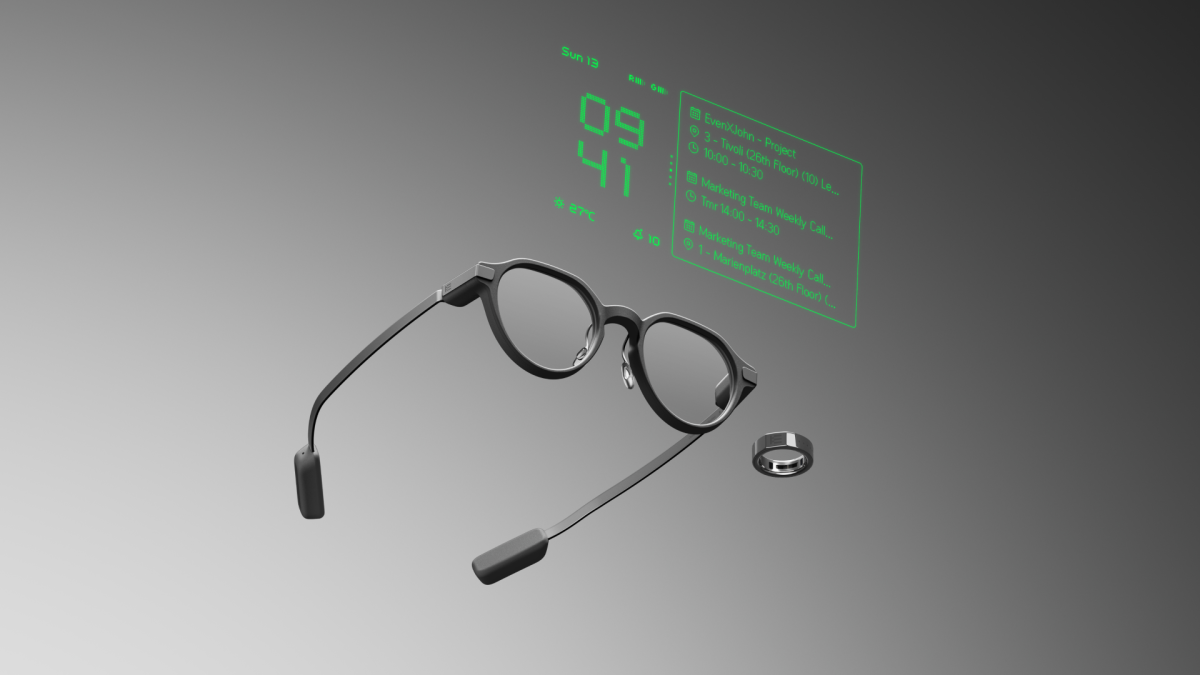
The startup’s latest flagship, Even G2, hit the market last November and skips the camera entirely. Instead, a heads-up display built into the frames feeds information to the wearer, controlled by a companion ring, the Even R1, that users tap and swipe to navigate.

Removing the camera is an important part of Even’s privacy philosophy, though not the entire story, Wang continued. Smart glasses, he said, are probably the most personal computing device people will ever wear. Worn on the face all day, they have to feel comfortable to both the wearer and those around them, so privacy is designed into both the hardware and the software. Voice features like translation transcribe audio into text rather than storing recordings; user data is encrypted, and the infrastructure is built to meet Europe’s strict privacy standards, Wang added.

Even’s power users lean hard on Conversate, a copilot that reads a conversation in real time, explaining unfamiliar jargon or feeding follow-ups on the fly, then syncing a summary to their phone.

Still, Even has invested most heavily in optics (the display and overall optical performance), which Wang says is what separates smart glasses from other consumer electronics.

“With a phone or a watch, the display is just a conventional OLED or LCD screen. Smart glasses are the first product category to rely on optical displays, which require an entirely different technology stack; you have to design the microchip, the optics, and the waveguide together. That’s where we’ve invested the most,” Wang said.

The company developed a proprietary optical technology called Even HAO, or Holistic Adaptive Optics, an end-to-end design that integrates the microchip, waveguide and prescription support from the start, rather than combining components designed separately.  

More than half of Even’s users sit in the U.S. — its fastest-growing market — and so does the bulk of its developer community. The company doesn’t sell in China yet, even though it manufactures there across several factories; its main markets are the U.S., Japan, South Korea, the Middle East, and Europe. “The demand there is significant, so we want to make sure we’re prepared first,” Wang said.

Even sells near the top of the category on price and still moves real volume, making it a profitable player in the space, Wang said. “Most of our customers are male professionals between 30 and 50 years old. We ran a survey and found that about a third of our users are company executives,” he added. The frames retail for $599 before tax; prescription lenses or the ring tack on another $200–$300, pushing the average order to roughly $1,000.

This article has been updated with information on previous investors from the company. 

When you purchase through links in our articles, we may earn a small commission. This doesn’t affect our editorial independence.

Continue Reading
Click to comment

Leave a Reply

Your email address will not be published. Required fields are marked *

News

ADC aspirant drags party to court over alleged exclusion from primary election

info

Published

on

By

Legborsi Nwiabu .jpg

An aspirant of the African Democratic Congress, ADC, for the Rivers State House of Assembly, Khana Constituency I seat, Legborsi Nwiabu, has taken his party before a Federal High Court sitting in Port Harcourt, alleging that he was excluded from the party’s last primary election.

Also named as respondents in the suit are the ADC’s declared candidate for the Khana Constituency I seat in the 2027 general election, Bright Nulee, and the Independent National Electoral Commission (INEC).

When the matter came up for hearing on Friday, counsel to the ADC, Emenike Ebete, informed the court that a committee had been set up to resolve issues arising from the disputed primary and orally sought the court’s leave to allow the parties to settle the matter out of court.

The application was not opposed by counsel to the second and third respondents.

However, counsel to the plaintiff, Felix Beragbara, opposed the request, telling the court that his client had not been informed of any such committee.

The presiding judge, Justice Muhammed Turaki, after hearing submissions from both sides, granted leave for the parties to pursue an out-of-court settlement and adjourned the matter until August 12, 2026, for a report on the settlement or, alternatively, for hearing of the suit.

Addressing journalists outside the courtroom, Beragbara explained the circumstances that prompted his client to seek redress in court, adding that his client remained prepared to return to court should the committee fail to deliver justice in the matter.

“My client was cheated out of the primaries of his party, which were scheduled to be conducted on the 21st day of May 2026.

“You must be aware that almost all the political parties conducted their primaries in May 2026. My client’s political party, the African Democratic Congress (ADC), also conducted its primaries, and my client was an aspirant seeking the party’s nomination for the House of Assembly seat for Khana Constituency I in Khana Local Government Area of Rivers State.

“That election was scheduled to be held nationwide on the 21st of May 2026.

“Unfortunately, the election could not be held on that date. It was rescheduled—or purportedly rescheduled—to the next day, May 22, 2026. My client mobilised his supporters, sent his field agents, and deployed them to all the voting centres across the 11 wards that make up Khana Constituency I.

“My client and his supporters, who are members of the ADC, waited from the morning, when accreditation was scheduled to commence, until nightfall.

“They did not see a single ADC official who came to conduct the election. They also did not see any monitoring officer from the third defendant in this suit.

“So the first defendant, my client’s political party, failed to conduct the primaries. My client then petitioned the appeals committee, stating that the election did not hold and asking them to conduct another election so that the party could have a legitimate candidate.

“They ignored my client’s complaint. What my client later heard was that they had declared the second defendant, Mr Bright Nulee, as the party’s candidate and forwarded his name to the third defendant, INEC, without conducting the election.

“That is why my client is in court to challenge the purported primary that produced the purported candidate. That is why we are here today.”

Meanwhile, counsel to the ADC, Emenike Ebete; counsel to the second respondent, B. F. Opara; and counsel representing INEC all declined to comment on the court proceedings.

Continue Reading

Health

Niger investigates suspected infectious disease after child’s death

info

Published

on

By

Niger.png

MTN ADVERT

The Niger State government has launched an investigation into a suspected infectious disease following the death of a child and reports that other members of the same family have fallen ill.

The state Director of Public Health, Ibrahim Idris, disclosed this in a statement issued in Minna on Thursday by the Ministry of Information and Orientation.

Mr Idris said the Ministry of Health responded after a father shared videos on social media alleging that a strange illness had affected members of his household.

He said the swift response demonstrated the state’s commitment to protecting residents through prompt public health action.

He said the prompt intervention reflected the commitment of the Governor Umaru Bago-led administration to safeguarding the health and well-being of residents across the state through timely public health responses.

PT WHATSAPP CHANNEL

According to him, every unexplained death deserves a thorough investigation, while every suspected outbreak must be treated with urgency to prevent possible transmission and protect public health.

The director said the affected children had been evacuated to a health facility for comprehensive medical evaluation and treatment as health authorities intensified efforts to determine the cause.

He said preliminary clinical findings suggested that the illness might not be a strange disease but one familiar to medical experts, with diphtheria among the conditions being considered.

“At this stage, no definitive conclusion can be made until laboratory investigations are completed,” he said.

“The samples collected will help determine the exact cause of the illness and guide the response.”

Mr Idris said public health officials had commenced contact tracing in the affected community and in the schools attended by the children to identify similar cases and contain any possible transmission.

He advised parents and caregivers to ensure their children completed all recommended routine immunisation schedules, noting that many life-threatening illnesses could be prevented through vaccination.

The director urged residents to seek prompt medical attention whenever unusual symptoms were observed, stressing that early detection and treatment remained critical to disease control efforts.

Also, Junaidu Inuwa, executive director of the Niger State Primary Health Care Development Agency (NSPHCDA), said preliminary findings showed the deceased child had received only partial immunisation.

He said some of the surviving children were either partially immunised or had not completed their vaccination schedules, exposing them to vaccine-preventable diseases and associated health complications.

ALSO READ: Niger Assembly has no website, limiting residents’ access to information

According to him, the development underscores the critical importance of routine immunisation in protecting children against vaccine-preventable diseases and reducing childhood mortality across communities.

Mr Inuwa said health officials also visited the isolation centre at the General Hospital, where affected family members had been placed on appropriate antibiotic treatment and were receiving care.

He said health authorities would continue to provide timely updates as investigations progressed and would intensify surveillance, contact tracing, and other interventions if the illness was confirmed to be infectious.

He reiterated that complete immunisation remained the safest and most effective protection against vaccine-preventable diseases and urged parents to utilise vaccination services available across the state. (NAN)


Continue Reading

Trending