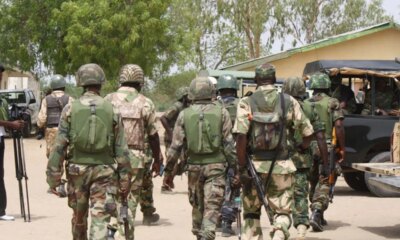
A confrontation between local vigilantes and armed bandits has reportedly left scores dead in Dutsen Zaki, a forested area in Wase Local Government Area of Plateau State.
The clash, which began on Saturday and lasted several days, involved a coordinated offensive by over 300 vigilantes supported by soldiers, targeting bandit hideouts in the dense forest region. The area, surrounded by communities such as Zurak, Aduwa, Kinashe, and Odare in the Bashar district, has witnessed repeated attacks in recent months, forcing many residents to flee their homes.
According to Abdullahi Hussaini, a leader of the vigilante group, the operation resulted in the deaths of over 80 suspected bandits, including some of their female accomplices. He also confirmed that four vigilantes, including a commander, were killed during the confrontation, while 16 others sustained injuries and are currently receiving treatment at the Federal Medical Centre (FMC) in Wase and another facility in Bauchi State.
“We started the fight since Saturday,” Hussaini told Daily Trust. “People in the Bashar axis are no longer safe. Armed men have made life unbearable with daily attacks, killings, and kidnappings. That is why we took the fight to them in the forest. This time, we gained control.”
He added that the forest, which has served as a safe haven for the criminals, is now under the vigilantes’ control, although many of the fleeing bandits could still pose a threat.
Shapi’i Sambo, a youth leader in Wase, confirmed the deaths of the four vigilantes, including their commander, and said a new commander has been appointed to continue the operation.
Also speaking, Abdullahi Bin Umar, a resident of one of the affected villages, said residents living near the forest have abandoned their homes for fear of reprisal attacks.
“People are genuinely scared about what may follow,” he said. “With the number of bandits reportedly killed, residents fear that surviving members may retaliate.”
As of the time of filing this report, the spokesperson for Operation Safe Haven, Major Samson Zhakom, had not responded to requests for comment.
The latest incident comes barely two weeks after security forces and vigilantes killed five suspected bandits in Kadil Masudu village, also in Wase LGA, as authorities and local groups intensify efforts to secure the area from escalating violence.
Nigeria’s preparations for the 2026 IFAF Flag Football World Championships have received another significant boost, with the National Football League (NFL) reaffirming its commitment to supporting the country’s flag football development through the Nigeria Federation of American Football (NFAF), while the Nigerian men’s and women’s national teams are already in Nairobi, Kenya, for their next phase of international preparations.
The two national teams arrived in Kenya this week ahead of the NFL Adult Flag Football Tournament, scheduled for July 9–10, where they will compete against some of Africa’s leading sides as part of their build-up to the World Championships in Düsseldorf, Germany, next month.
The tournament comes just weeks after Nigeria successfully hosted the Team Nigeria Showcase in Lagos, where the men’s and women’s national teams played friendly matches against All-Star selections as part of preparations for their historic World Championship debut.
The Kenya tournament is another major investment by the NFL in Nigeria’s development, with the league covering international travel, hotel accommodation and all on-ground tournament expenses for both the men’s and women’s national teams. Nigeria is responsible only for travel documentation, including passports, visas and required vaccinations.
The invitation was extended in an official letter signed by Osi Umenyiora on behalf of the National Football League, inviting Nigeria to participate with both male and female national teams in Nairobi.
Earlier this year, the NFL also invited the Nigeria Federation of American Football to participate in the NFL Flag Africa Championships in South Africa, another flagship development initiative aimed at expanding grassroots flag football across the continent. Under that programme, the NFL equally committed to funding flights, accommodation, meals and local logistics for Nigeria’s representatives.
Beyond providing financial support, the NFL has also made its position clear regarding the administration of the sport in Nigeria.
Responding to enquiries on future development projects, the NFL’s International Flag Football Development Manager, Afia Law, confirmed that all support for Nigeria would be channelled through the Nigeria Federation of American Football.
“We would need to support any projects via NFAF since they are the recognised governing body.
“I’m not sure where this sits with them at the moment, but it would come down to NFAF for any support for Nigeria.”
The statement represents another significant endorsement for the NFAF following the recent confirmation by the International Federation of American Football (IFAF) that it recognises the federation as the body charged by Nigeria’s National Sports Commission with overseeing the sport.
With the Nigerian men’s and women’s national teams now in Nairobi gaining valuable international match experience, attention is increasingly turning toward the 2026 IFAF Flag Football World Championships in Düsseldorf, where Nigeria will make history as Africa’s sole representative after winning both the men’s and women’s titles at the inaugural IFAF Africa Flag Championships in Egypt.
The Kenya friendlies are expected to provide Coaches Ephraim Fagha Faloughi and Anireju Oritsewehinmi Ayida with another opportunity to fine-tune their squads before the World Championships, which will also serve as the first Olympic qualifying event on the road to Los Angeles 2028.
For Nigerian flag football, the convergence of international recognition from IFAF and sustained investment from the NFL signals growing global confidence in the country’s programme. As the national teams continue their preparations in Kenya, stakeholders will be hoping the momentum translates into another historic performance when the worlds best converge in Germany next month.
Policy experts, academics, and researchers have stated that strong public policy implementation and debt management can drive good governance in Africa.
Speaking to PREMIUM TIMES, Evans Osabuohein, a professor of economics, said that the discussions at the event focused on public policy and debt management, which are affecting human capital development in Africa.
“It [is] about how public debt can be managed more efficiently in Africa, so that we can tap into the resources for human capital and energy efficiency in this age of innovation. We need human resources that are well-skilled, equipped, and knowledgeable to harness such potential that technology like artificial intelligence present today,” he said.
“Debt is not bad in itself; the issue is when debt is borrowed but is not used for capital investment, the servicing of debt becomes a burden. We have seen this in most African countries where some of the borrowings are not geared towards human capital development.”
Mr Osabuohein, a board member of AFEA, explained that it would be a win-win option for both governments and citizens if public debt is used judiciously, saying that the execution of projects translates into employing the populace to do the labour.
More details
The three-day international conference, hosted by Nile University Abuja’s faculty of arts and social sciences, brought together scholars, policymakers, and industry experts in the field of economics.
A collage of AFEA and Nile University Abuja logos
Themed ‘Africa’s Geoeconomic Development Agenda in a Global Realignment Era’, it sought to contribute expert input on shifting geopolitics, climate risk, and development finance across the continent, and drew attendees from Canada, Ghana, Nigeria, and other countries.
Emotimo Agama, director-general of the Securities and Exchanges Commission (SEC); Tope Fasua, an economic adviser to President Bola Tinubu; Tony Okpanachi, managing director of the Development Bank of Nigeria, among others, made up the line-up of dignitaries for the event.
Premium Times monitored breakout sessions at the programme, where participants presented papers on topics including debt sustainability, global financial and health governance systems, digital service delivery, mobile money, financial inclusion, and continental digital markets.
Some sessions also focused on youth, gender, demographic change, and inclusive development; as well as migration, urbanisation, and spatial inequality, with a broad focus on Africa-West relations.
The sessions featured interactive discussions for each paper presenter, including how their research work could be further enhanced.
Participants speak
Abogede Marietu, a PhD candidate of economics at Nile University, described the conference as impactful, adding that it has given her opportunities to learn from scholars in her field.
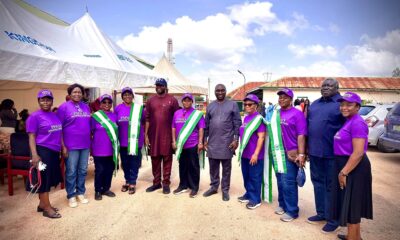
Participants exchanging ideas at one of the sessions at the conference. (PHOTO CREDIT: Mohammed Taoheed/Premium Times)
“Today is actually my first time presenting my work at an international conference, and I think that gives visibility to my work. I have also got to learn from other presenters.”
“It is my earnest desire that the government in Africa would look into the policies that myself and other presenters have come up with, so as to improve the economy, and also aid the livelihood of the citizens of the continent,” she said.
Another paper presenter, Ropheka Bot, stated that she found the discussions in the conference “very timely and engaging as experts gathered to discuss current global issues”
Mrs Bot, a lecturer at Bingham University, Karu, said she hopes that governments in Africa would implement some of their research findings to improve development on the continent.
About AFEA
The African Finance and Economics Association (AFEA) is a professional forum for academics and practitioners (government and industry) of finance, economics, and related disciplines interested in the development of Africa.
It seeks to empower the continent through financial growth and sustainable development, with a mission to promote the exchange of information and ideas among professionals and stakeholders in the field while fostering research that advances knowledge on contemporary African development issues.
With Majune Socrates as its president, Gbadebo Odularu sits as the chairman of the board for the organisation.