Events
Peace in Plateau: Irigwe and Fulani agrees to live in harmony, signs peace accord


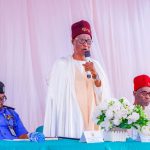
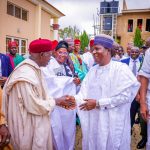
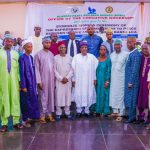
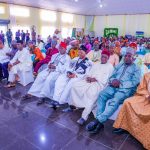
Today the people of Bassa LGA are optimistic about lasting peace and an end to recurring violent attacks on its communities which have resulted in the loss of lives and the destruction of properties, farmlands, and Livestock. After both parties signed a peace agreement in the presents of God, The Governor of Plateau state Barr. Simon Bako Lalong, The Deputy Governor, The chief justice of the Plateau State High court, leaders of the security apparatus of the state, leaders of the Plateau State House of assembly, Royal Highnesses, Youth and Women leaders, International Organizations, NGO,s and the general public.
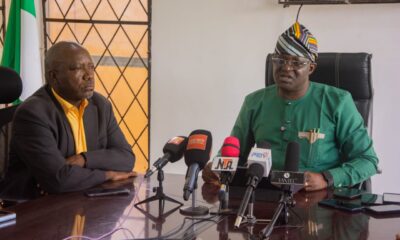
Governor Lalong who witnessed the signing of the expression of commitment to peace between the Irigwe and Fulani communities in Bassa Local Government Area said he was happy that there is a genuine and collective effort to address the spate of violence that has grossly affected people of the area and the State in general.
He said, “Today’s gathering which is at the instance of the leadership of the Irigwe and Fulani is for these two communities to tell the whole world that they had tested the bitter pills that violent conflict serves but are now willing, ready, and able to chart a new course for themselves by first forgiving the past in order to reconcile the future”.
He said upon coming into office in 2015, his administration inherited the crisis but, was determined to confront the challenges head-on, which enables it to immediately develop a policy framework in a way that moves away from the reactive approach to being proactive.
“The nearly two-decade experience of violent conflict between Irigwe and Fulani of Irigwe Chiefdom has given my administration sleepless nights. Yet, we never for once relented in our effort and desire to expand the frontiers of peace and security in those communities in particular and, the entire Bassa Local Government Area in general. My personal involvement in the mediation of this conflict was hinged on the ongoing interventions of both the Plateau State Peacebuilding Agency and the State Inter-Religious Council who have worked closely with other stakeholders, including external actors to bring peace and stability to communities ravaged by internecine conflict” he said.
While commending the Traditional Ruler of Irigwe, Brra Ngwe for his personal commitment to the pursuit of peace as well as other stakeholders including the Fulani representatives, the Governor urged the parties to take full ownership of this Document. “It is your document and you must ensure that you enlighten and sensitize your respective communities on the importance of respecting all the articles contained therein. Be assured that on its own part, Government will support and monitor your commitment towards the implementation of this Agreement”.
He warned that Government will not relent on its duty of maintaining law and order and ensuring that those who attempt to truncate the implementation of the peace agreement are dealt with according to the law.
In his remarks, the paramount ruler of Miango HRH Brra Nngwe, Rev. Ronku Aka (Rtd.) thanked the Governor for his foresight in setting up the Peace Building Agency and empowering it to work towards resolving conflicts and restoring peace and security among the Irigwe and Fulani in Bassa as well as other parts of the State.
He said the people of Bassa want to put the ugly events of the past behind them and live in peace and unity with one another to pursue their legitimate means of livelihood without molestation.
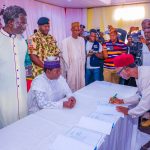
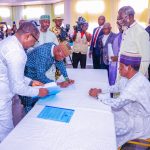
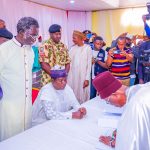
Chairman of the Bassa Internal Peace and Security Committee Mr. John Power and the Co-Chairman Alh. Ya’u Idris signed the peace agreement on behalf of the Irigwe and Fulani communities.
Those who also signed as witnesses include Chairman Bassa Local Government, Chairman Plateau Inter-Religious Council Prof. Pandam Yamsat and his Co-Chairman represented by Emir of Kanam, President Irigwe Development Association, Chairman MACBAN, Kaduna Peace Commission, Commander Operation Safe Haven, Police Commissioner, PIDAN, Inter-Faith Mediation Centre, United States Institute for Peace among others.
Secretary to the Government of the State Prof. Danladi Atu said the Governor has directed him and the Attorney General and Commissioner for Justice to immediately put in place machinery for Gazetting and working out the policy framework for immediate implementation.
DG Plateau State Peace Building Agency Joseph Lengmang said the government will continue to count on the support of the parties to implement the Peace Agreement to further deepen the Peace in the area by providing critical social infrastructures that would in turn, strengthen social cohesion among the people.

He said the Governor has also directed the Plateau State Peace Building Agency to work in conjunction with security agencies as well as local and international partners to support the safe return and resettlement of all victims of violent conflict in Miango and environs as well as the provision of psycho-social support and additional training to youth groups and women.
Various speakers in their goodwill messages commended Governor Lalong for his determination to see the end of crises in Bassa by facilitating several dialogue sessions, capacity-building training, consultations, and Peace advocacy among the leadership of ethnic associations like the Irigwe Development Association (IDA); the Miyetti Allah Cattle Breeders’ Association of Nigeria (MACBAN), the All Farmers’ Association of Nigeria (AFAN); the Gan Allah Fulani Association of Nigeria (GAFDAN) amongst so many others.

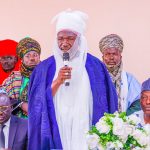
He noted that the signing of the expression of commitment to Peace by both communities was symbolic as it has been a long time coming and the Agency was full of appreciation to the Plateau State Government for the commitment and tenacity towards ensuring that the state has peace.
“Without peace, it is practically impossible for us to achieve our individual and collective goals, we must also thank the plateau state inter-religious council, security agencies, and the committee set in place for facilitating this process as they have worked even in difficult moments and setbacks, standing firm to ensure that the process gets the desired response,” Lengman said.








Lingzhi Global Nigeria Ltd. has announced plans to hold the second edition of the Coffee Festival International Nigeria in Calabar, Cross River State, from October 30 to November 1, 2026, as part of efforts to promote coffee production and expand opportunities across the value chain.
The festival, organised in collaboration with the National Coffee and Tea Association of Nigeria, NACOFTAN, will be held under the theme, “Coffee Sustainability and Empowerment: Focusing on Women and Youth Development,” with emphasis on skills development, community development and job creation.

The Chief Executive Officer of Lingzhi Global, Mrs. Blessing Nanman, disclosed this at a stakeholders’ meeting in Abuja, saying the event would bring together coffee stakeholders, investors and international participants to explore opportunities in farming, processing, packaging, marketing and export.
“Farmers have gone to work. Some processors are already at the verge of breaking through. This is the time where we want to invite all investors, partners and international organisations to support us in the coffee industry,” Nanman said.
She said the maiden edition attracted participants from different countries, while the 2026 festival is expected to draw representatives from about 30 countries. According to her, the event would further define opportunities within the coffee value chain and encourage local consumption of coffee.
Nanman said Lingzhi Global was also expanding its coffee business through the establishment of coffee shops, noting that the outlets had become platforms where communities, families and people from different backgrounds could connect over coffee.

She said Cross River was selected to host the second edition because of its potential for coffee production and the state government’s efforts to expand cultivation through the distribution of millions of coffee seedlings.
Speaking on the forthcoming festival, Cross River State Commissioner for Agriculture and Irrigation Development, Hon. Johnson Ebokpo, commended Lingzhi Global for its role in promoting coffee and tea development in the state and for working with stakeholders to strengthen the sector.
He said the company had contributed efforts to improve farmers’ access to seedlings, knowledge and markets, describing its partnership with the state as important to the development of the coffee value chain.
“We are pleased to be collaborating with Lingzhi Global, organisers of the International Coffee Festival, and NACOFTAN,” Ebokpo said.
The commissioner said the festival would give Cross River greater visibility as a coffee-producing destination while creating opportunities for women and young people to participate in the industry.
“This is also an opportunity for us to use the festival as a platform to create jobs for our people, particularly women and youths, while providing them with opportunities to learn more and develop their skills,” he said.
Ebokpo said the coffee industry extends beyond farming to processing, packaging and export, stressing that young people could create businesses and develop their own brands by participating in different stages of the value chain.
He said Cross River has about 23,000 square kilometres of arable land suitable for coffee development and has the agro-ecological advantage of producing both Arabica and Robusta varieties. He added that the state plans to distribute at least 30 million coffee seedlings over five years.
President of NACOFTAN, Dr. Hassan Usman, said the festival would provide an opportunity for Nigerian stakeholders to exchange knowledge and technology with international players in the coffee industry.
“The Coffee Festival is not only Nigerian in inclusion, but international. We have people coming from Brazil, Indonesia, Kenya and all the countries. The globe will be around with us,” Usman said.
Usman also commended Lingzhi Global for taking stakeholders across the country and beyond to gain knowledge in coffee processing and marketing, saying the company had played a critical role in connecting Nigerian stakeholders with international opportunities.
He said stakeholders would use the gathering to strategise on strengthening the coffee value chain and changing the narrative around coffee production in Nigeria, while calling for greater participation from government agencies, investors and other stakeholders.
The 2026 Coffee Festival International Nigeria is expected to bring together farmers, processors, roasters, investors, experts and other stakeholders from Nigeria and abroad for three days of knowledge-sharing, networking and promotion of the coffee industry.


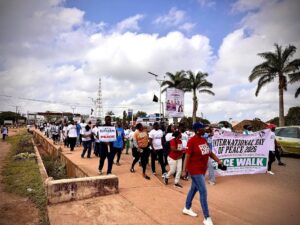
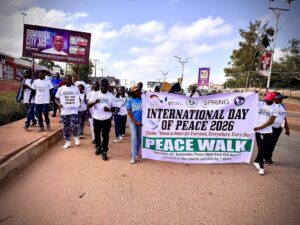
The streets of Jos echoed with a simple message on Saturday: peace is everyone’s responsibility.
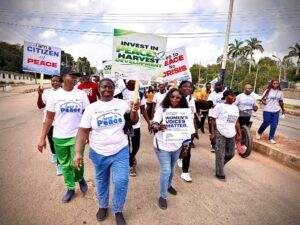
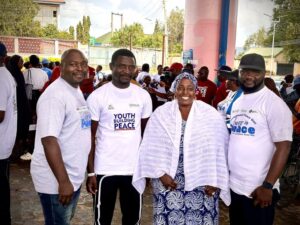
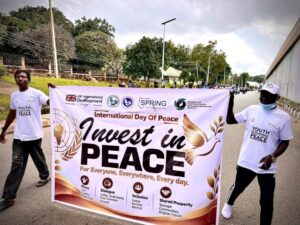
As part of activities marking the 2026 International Day of Peace, the Women for Positive Peacebuilding Initiative (WOPPI) joined other peace organisations for a peace walk from Old Airport Junction to Secretariat Junction Bridge.
Holding placards calling for unity, dialogue and peaceful coexistence, participants took the message of peace to the streets and into the public space.
This year’s International Day of Peace, observed on September 21, is themed “Invest in Peace – For Everyone, Everywhere, Every Day.” The United Nations says the theme highlights the role of ordinary people as “everyday architects of peace.” (United Nations Peacekeeping)
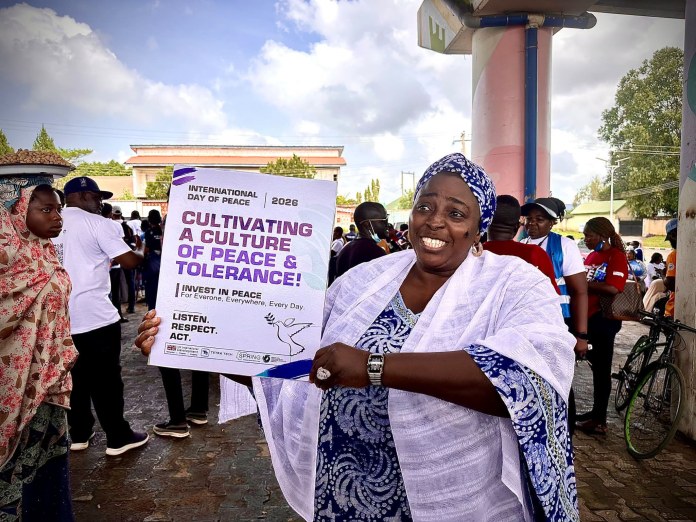
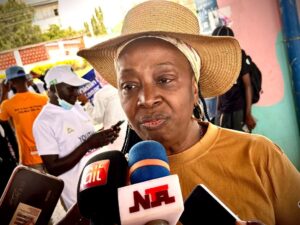
For WOPPI Executive Director, Lantana Abdullah, the message is particularly important for Plateau, a state with a history of violent conflicts.
She said peace cannot be left to government or security agencies alone. Every citizen, she stressed, has a role to play.
“Every citizen residing in Plateau or beyond Plateau or in Nigeria must play their part in making sure we sustain and build enduring peace for everyone.”
Abdullah urged citizens to choose dialogue over confrontation, report responsibly and speak up when they see issues capable of threatening peace.
She also challenged negative narratives about Plateau, pointing out that people continue to live, work and build their livelihoods across the state despite its troubled past.
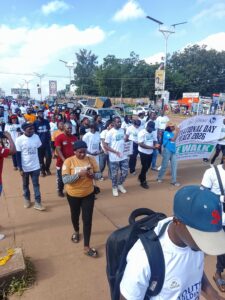
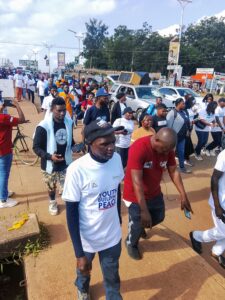
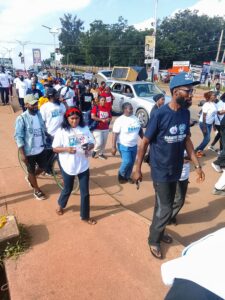

For WOPPI, women must also be at the centre of this process. The organisation works to strengthen women’s voices, train them as mediators and involve them in preventing and resolving conflicts within their communities.
The walk therefore carried more than placards. It carried a reminder: peace is not something people wait for others to create. It is something communities build—one conversation, one intervention and one peaceful choice at a time.
And in the words of this year’s global message, that investment must happen for everyone, everywhere, every day. (United Nations)
-

 News3 days ago
Troops rescued 70 abductees, recovered N10 million ransom: DHQ
-
Business3 days ago
CBN grants JP Morgan approval-in-principle to set up merchant bank
-
News3 days ago
Plateau Activates Ebola Preparedness Measures, Urges Residents to Observe Safety Guidelines
-
Business3 days ago
REA Ends 16 Years of Darkness in Two Kano Communities