News
Airtel Africa data traffic jumps 56.3% as Nigeria drives smartphone growth – Technology Times

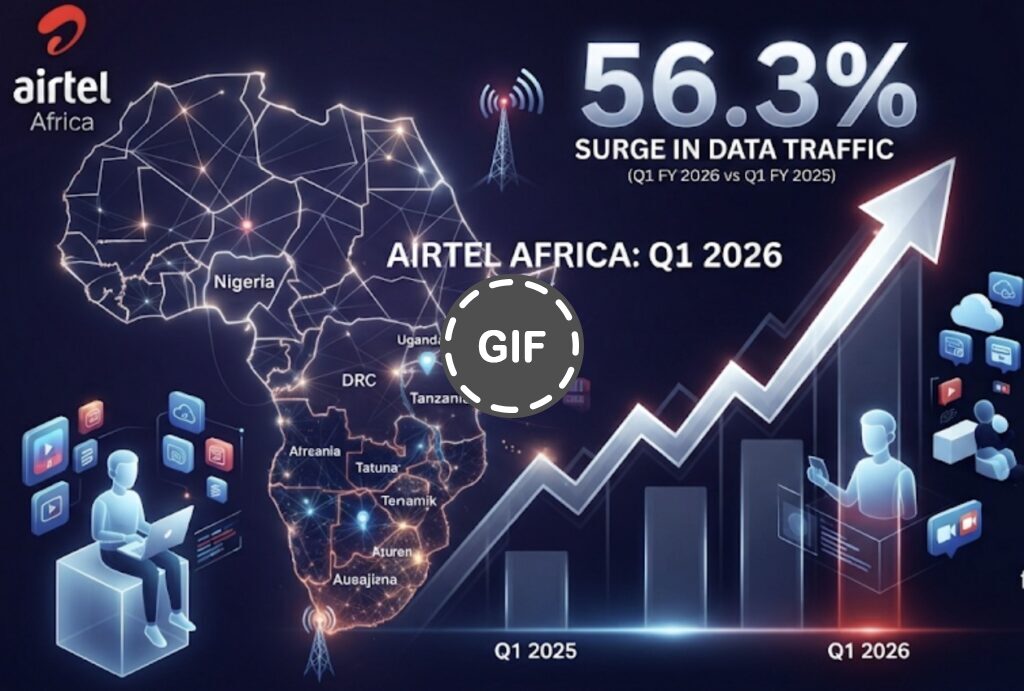
Airtel Africa recorded a 56.3% year-on-year increase in data traffic during the first quarter of its 2026 financial year, with Nigeria emerging as one of the strongest contributors to the growth as smartphone adoption and mobile internet usage accelerated across the country.
The telecoms group’s results for the quarter ended June 30, 2026 released today, show that Nigeria, Airtel Africa’s largest market by revenue, delivered significant gains in data consumption, customer growth and revenue generation, reinforcing the country’s position as a key driver of the company’s digital economy ambitions.
The telecoms company and owners of Airtel Nigeria, the nation’s number two mobile network operator by subscribers, said smartphone penetration across its 14 African markets rose to 51.0%, up from 45.8% in the corresponding period last year, while average monthly data usage per customer increased from 7.8GB to 10.6GB. The surge in data consumption was driven by growing demand for mobile internet services for work, education, entertainment, financial services and e-commerce.


The telecoms company and owners of Airtel Nigeria, the nation’s number two mobile network operator by subscribers, said smartphone penetration across its 14 African markets rose to 51.0%, up from 45.8% in the corresponding period last year, while average monthly data usage per customer increased from 7.8GB to 10.6GB. The surge in data consumption was driven by growing demand for mobile internet services for work, education, entertainment, financial services and e-commerce.
Nigeria powers Airtel’s data expansion
In Nigeria, smartphone penetration climbed to 56.1%, while average monthly smartphone data usage rose sharply to 14.9GB per customer from 11.8GB a year earlier.
Data revenue in the Nigerian market increased by 38% in constant currency, supported by an 11% expansion in the data customer base to 32.5 million subscribers and a 24.9% rise in data average revenue per user (ARPU).
Overall, Airtel Nigeria recorded revenue growth of 50.4% in reported currency to $501 million during the quarter, while constant currency revenue rose by 29.8%.
The Nigerian operation ended the quarter with 60.1 million customers, representing a 12% increase compared with the same period last year for Airtel Nigeria.
The strong Nigerian performance came as Airtel Africa’s total customer base grew by 11.6% to 189 million, while its data customer base expanded by 15.5% to 87.3 million across its operations.
Smartphone adoption drives digital consumption
Sunil Taldar, CEO of Airtel Africa, said the company’s continued investment in digital infrastructure and artificial intelligence was helping to improve customer experience and support long-term growth.
“We have started this year with another pleasing performance. Our continued focus on the customer experience translated into accelerating customer base growth across all business segments,” Taldar said.
“As we continue to digitise our business, we are streamlining customer journeys, increasing digital adoption and harnessing data and AI to improve service delivery and support a strong, sustainable growth profile.”


Data revenue in the Nigerian market increased by 38% in constant currency, supported by an 11% expansion in the data customer base to 32.5 million subscribers and a 24.9% rise in data average revenue per user (ARPU).
Taldar noted that the rise in smartphone penetration was a major factor behind the surge in data traffic.
“Smartphone penetration reached 51.0%, an increase of 5.2 percentage points over the last year, reflecting continued progress in digital adoption across our markets. Supported by sustained investment in our network, this has driven a 56.3% increase in data traffic as customers embrace digital solutions across our markets,” he added.
For Nigeria, the results highlight the rapid shift towards mobile internet consumption as more consumers adopt smartphones and rely on digital services for everyday activities.
Revenue growth strengthens Nigeria’s position
The company’s financial results underscore Nigeria’s importance to Airtel Africa’s overall performance. Nigeria contributed $501 million in revenue during the quarter, accounting for a substantial portion of the group’s total revenue of $1.853 billion.
Airtel Africa’s group revenue increased by 31.0% to $1.853 billion, while profit after tax rose by 27.0% to $198 million. Earnings before interest, tax, depreciation and amortisation (EBITDA) climbed by 36.6% to $928 million, with the EBITDA margin improving to 50.1%.
The telecoms group said the improved profitability was achieved despite higher energy costs linked to global geopolitical developments.
Data revenue across the group grew by 27.2% in constant currency, while data ARPU increased by 10.3%, reflecting higher customer engagement and increased digital adoption.
Massive network, 5G investment
To support the growing demand for high-speed connectivity, Airtel Africa significantly accelerated its network investment during the quarter.
Capital expenditure more than tripled to $389 million, compared with $121 million in the same period last year, as the operator expanded its network infrastructure across its markets.
The company added more than 920 new sites during the quarter, representing its highest first-quarter rollout, while extending its fibre network to 82,100 kilometres.
Airtel Africa also disclosed that its 5G network is now operational in seven African markets, with 3,609 5G sites deployed across its operations.
The accelerated investment programme is aimed at strengthening network quality, expanding coverage and increasing capacity to support future growth in data demand and digital services.
For Nigeria, where demand for broadband and mobile internet continues to rise, the company’s infrastructure expansion is expected to improve network performance and support the country’s digital transformation agenda.
AI and digital services reshape operations
Beyond network expansion, Airtel Africa said it is increasingly deploying artificial intelligence to improve customer service, streamline digital channels and enhance user experience.
The company noted that the continued digitalisation of customer journeys, combined with expanding smartphone adoption, is creating new opportunities across mobile connectivity, digital financial services and enterprise solutions.
Airtel Africa’s mobile money business also recorded strong growth during the quarter. Mobile money revenue increased by 30.3% in constant currency, while the customer base grew by 16.1% to 46.8 million users.
The value of mobile money transactions processed during the quarter rose by 35.0% to $38 billion, highlighting the growing role of digital financial services in the company’s ecosystem.


Airtel Africa’s latest results reflect the broader pace of digital transformation in Nigeria, where increasing smartphone ownership and expanding broadband infrastructure are reshaping how consumers communicate, access financial services, stream content and participate in the digital economy. Nigeria has experienced sustained growth in mobile data consumption in recent years, driven by the expansion of 4G and 5G networks, falling smartphone prices and the increasing availability of digital services.
Nigeria’s digital economy momentum
Airtel Africa’s latest results reflect the broader pace of digital transformation in Nigeria, where increasing smartphone ownership and expanding broadband infrastructure are reshaping how consumers communicate, access financial services, stream content and participate in the digital economy.
Nigeria has experienced sustained growth in mobile data consumption in recent years, driven by the expansion of 4G and 5G networks, falling smartphone prices and the increasing availability of digital services.
The Nigerian Communications Commission (NCC) has consistently identified broadband expansion and digital inclusion as critical pillars of the country’s economic development strategy.
Airtel Nigeria’s strong quarterly performance aligns with these national objectives, as rising smartphone penetration and data usage create opportunities for e-commerce, digital payments, online education, telemedicine and other technology-enabled services.
The company’s results also come amid growing competition in Nigeria’s telecommunications sector, where operators are investing heavily in network infrastructure to meet increasing demand for high-speed internet.
Tariff adjustments boost spending
Airtel Africa said the full impact of tariff adjustments introduced in early 2025 contributed to stronger customer spending on data services in Nigeria.
The combination of higher data usage, increased smartphone adoption and tariff adjustments helped drive the 50.4% revenue growth recorded by Airtel Nigeria during the quarter.
Analysts say the results demonstrate the resilience of Nigeria’s telecommunications market, where demand for digital services continues to grow despite broader economic challenges.
The increase in data ARPU by 24.9% in Nigeria suggests that customers are not only consuming more data but are also willing to spend more on higher-quality connectivity and digital services.
Outlook for Nigeria
Looking ahead, Airtel Africa’s continued investment in network infrastructure, fibre expansion and 5G deployment is expected to support the next phase of Nigeria’s digital economy growth.
The company’s strategy of combining connectivity, artificial intelligence and digital financial services positions it to benefit from the increasing demand for technology-enabled solutions across Nigeria.
With smartphone penetration in Nigeria now at 56.1% and average monthly data usage reaching 14.9GB per customer, the country remains one of Airtel Africa’s most important growth engines.
As demand for high-speed internet, AI-enabled services and digital financial solutions continues to rise, Airtel Nigeria is expected to play a central role in advancing the country’s broadband penetration and digital inclusion goals.
The company’s latest quarterly results reinforce the growing importance of Nigeria’s telecommunications sector in driving economic growth, innovation and digital transformation across Africa.
Stay ahead with real-time reports, breaking news, and exclusive insights delivered directly to your phone. Don’t settle for outdated information. Join TECHNOLOGYTIMES NEWS on WhatsApp for 24/7 updates.
Join Our Whatsapp Channel





A mental health advocacy group, Nigerian Mental Health (NMH), has welcomed the Senate’s passage of the Suicide Prevention Bill, 2024 (SB 730), seeking to decriminalise attempted suicide in Nigeria.
The bill, sponsored by the senator representing Cross River South Senatorial District, Asuquo Ekpenyong, passed second reading on 13 October 2026 and was referred to the Senate Committees on Health (Secondary and Tertiary) and Judiciary, Human Rights and Legal Matters for further consideration.
NMH and the Nigeria Suicide Prevention Advocacy Working Group (NSPAWG) made their position known in a joint statement shared with PREMIUM TIMES on Friday, calling for inclusive public hearings as the bill progresses.
The organisations urged the Senate committees to allow mental health professionals, civil society organisations, healthcare professionals and people with lived experience to contribute to the legislative process.
Why the bill matters
Under Section 327 of the Criminal Code and Section 231 of the Penal Code, attempted suicide remains a criminal offence, with survivors exposed to the risk of prosecution and imprisonment.
NMH and NSPAWG said criminalisation can discourage people experiencing suicidal distress and their families from seeking timely support.


“A person who survives a suicide attempt should be able to access care without fear of criminal punishment,” the organisations said.
The groups cited World Health Organisation (WHO) estimates that Nigeria records more than 15,000 deaths by suicide and roughly 300,000 suicide attempts annually.
The bill’s sponsor, Mr Ekpenyong, said during deliberations, that attempted suicide should be treated as a mental health emergency requiring medical intervention rather than criminal punishment.
What the bill proposes
The proposed legislation seeks to establish a coordinated national framework for suicide prevention, going beyond the removal of criminal penalties for attempted suicide.
It proposes medical assessment, referral, treatment and follow-up support for people who survive suicide attempts, as well as crisis-response services.
The bill also provides for training of relevant professionals and first responders, public education and stronger national data collection.
NMH and NSPAWG said effective implementation would require clear responsibilities, sustainable funding and accountability.
The organisations said the bill’s progress builds on advocacy efforts following the passage of the National Mental Health Act, 2021.
NMH said it launched the #SuicideNotCrimeNG campaign, bringing together more than 40 mental health organisations, professional associations and civil society partners calling for an end to the criminalisation of attempted suicide.
Akpabio’s position
The Senate’s consideration of the bill also featured opposition from Senate President Godswill Akpabio to removing imprisonment as a punishment for attempted suicide.
During the debate, Mr Akpabio argued that removing the penalty could encourage suicide attempts.
“If you attempt suicide, make sure you die. Anyone who attempts and fails will go to jail,” he said.
He also called for adequate input from state Houses of Assembly during the public hearing to avoid conflicts between the proposed legislation and existing laws.
Call for public hearings.
NMH and NSPAWG urged the two Senate committees handling the bill to ensure that the next stage of consideration is informed by evidence, the experiences of affected people and the practical realities of delivering mental health services across Nigeria.
“The Senate has moved the process forward; now it is our turn. This next stage, which opens the door to public hearings, is a meaningful opportunity for people with lived experience, mental health professionals, and civil society to engage and help shape a framework that protects lives and upholds human dignity,” said Chime Asonye, founder of NMH.
ALSO READ: World Mental Health Day: NHRC seeks inclusion of human rights focus in strategic plan
The organisations urged Nigerians, health advocates and community leaders to participate by submitting memoranda and supporting the national petition for decriminalisation.
They also renewed their call on the Federal Ministry of Health and Social Welfare to “operationalise and adequately fund the Department of Mental Health Services established under the National Mental Health Act, 2021.”
“The bill’s passage through second reading is progress, but the legislative process is not over. Nigeria needs a legal and service-delivery framework that prioritises prevention, treatment, recovery and the dignity of people experiencing suicidal distress,” NMH noted.
Discover more from Premium Times Nigeria
Subscribe to get the latest posts sent to your email.
Segun Showunmi, a former ally of the African Democratic Congress, ADC, presidential candidate, Atiku Abubakar, has said President Bola Tinubu is one thousand years wiser than all the opposition and he will defeat all those vying for the presidency in 2027.
Showunmi made the remark while backing Tinubu's stance that he will not visit all states to campaign.
Speaking in Abuja, the president had said he would focus on governance because there are bills to pay.
Reacting, Showunmi faulted critics and opposition members berating Tinubu over his remark of being absent from campaign rallies.
Addressing a press conference on Saturday, Showunmi said: “The President said he won't attend all of the rallies and of course the children of hate have latched onto that.
"In the build up to 2023 when they were filling stadia and they were saying absolutely nothing apart from calling the name of their party and getting their friends to answer, the man told them at that time that town hall is different from ballot blue, they were laughing, did he not defeat them?
"Now he has told them that we are going to use science and technology, I have work to do and can't leave the nation's work undone and be jumping up and down the street to say hello, we have built our structure on how polling units will work and governors will be in charge.
"Instead of them going to figure out how to build structures, they are coming to ask me how he will not be there. You check a candidate out mostly so that he can be recognized.
"When a candidate has achieved optical recognition across board, he can design his campaign in a way that it's a little bit more efficient and a little bit more easy for him.
"Do you even like that kind of criss-crossing that they will be littering the whole place, whereas, they are talking to themselves, that guy called President Tinubu is a thousand years wiser than them and I guarantee you that he's going to defeat them again.
"Tinubu must not go around the country for campaigns. He is adopting a smarter approach. All these campaign rallies by political parties are just making noise on the streets, nothing meaningful.”
2027: Tinubu 1000 years wiser than opposition – Atiku’s ex-ally, Showunmi
-

 News4 days ago
MTN, Airtel take 90% of Nigeria’s 15m new subscribers as Glo shifts ground – Technology Times
-
News2 days ago
Miners Association Seeks Support To Unlock $3bn Gemstone Export Potential
-
Health3 days ago
Katsina health professionals declare 7-day warning strike
-
Business3 days ago
AFC Appoints CBN Governor Yemi Cardoso as Board Chairman