Connect with us

News

AMD takes on Nvidia with its Helios AI rack scale system

info

Published

on

GettyImages 2254260600.jpg

Chipmaker AMD is taking aim at competitor Nvidia with its latest hardware release: a rack-scale system designed to power computing needs of the world’s largest AI labs.

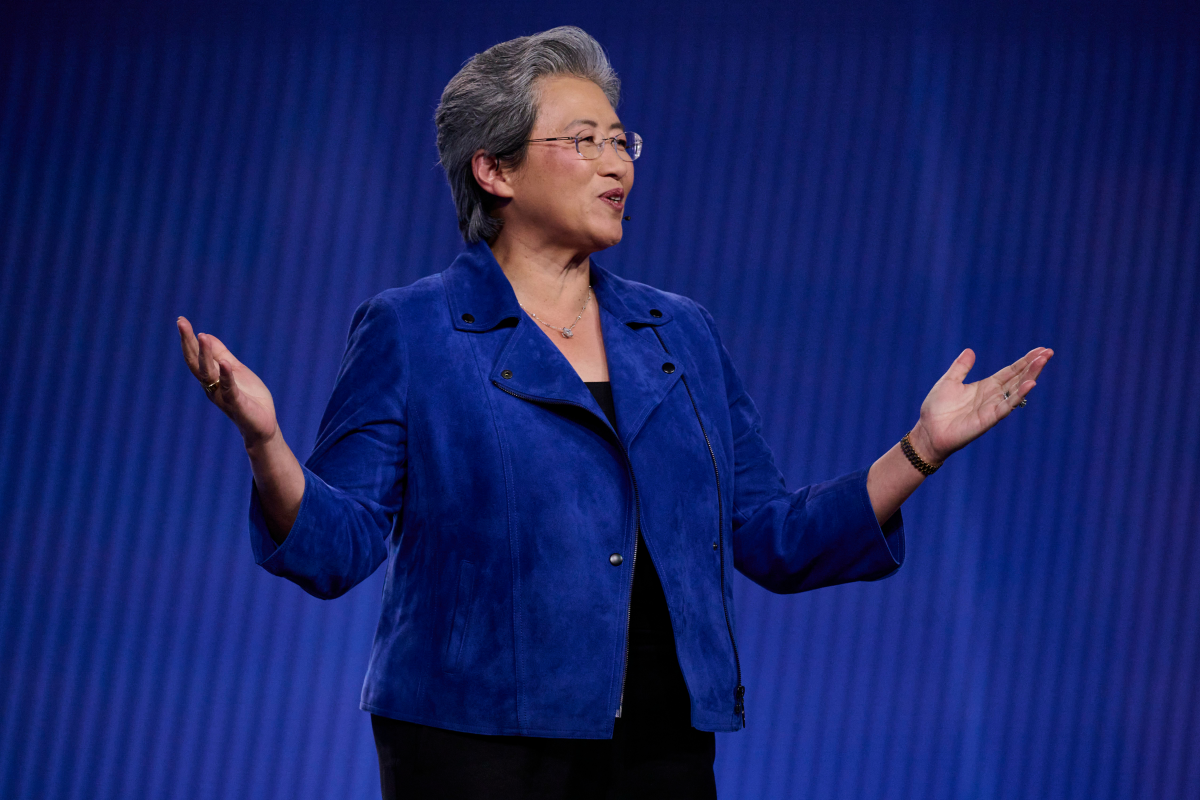
At the company’s sold-out Advancing AI conference in San Francisco on Thursday, AMD Chair and CEO Dr. Lisa Su promoted the new AI rack system known as Helios — along with its growing list of customers, including Microsoft — as the company prepares to ship it later this year. Su also pitched the company’s newest chips that are designed to feed the compute-hungry dragon that is the AI industry.

Rack systems combine many processors into a single high-powered unit. They are built for data centers, where they train and run AI models and other compute-intensive workloads.

Su called Helios the tech industry’s “highest performance AI rack,” adding that it was “built to train and run the most demanding frontier models in the world at massive scale.” The system will be deployed by leading AI companies at gigawatt-scale, the company said.

Nvidia has historically dominated this market with its Vera Rubin and Grace Blackwell rack-scale systems. AMD is clearly looking to get in on the action. And Helios’ performance metrics appear to give it a real chance, beating out Vera Rubin by a number of metrics, the Register reported.

Helios, which was first revealed in 2025 and shown onstage in January at CES 2026, already has several well-known customers, including OpenAI, Meta, Oracle, Anthropic, and Microsoft, all of which have plans to deploy the system. Microsoft CEO Satya Nadella said Monday that the company would expand its Azure infrastructure with Helios. Meanwhile, Anthropic and AMD announced a strategic partnership Wednesday for deploy up to two gigawatts of GPUs via the new rack system.

AMD also introduced Thursday its Venice-X CPU, which is designed for data centers and to handle high-computing workloads. The Venice-X is expected to launch in 2027.

During her remarks, Su commented on the trajectory of the chip industry, claiming that, by the year 2030, chips that power AI will become a massive part of the overall computing market. This’s because the industry is “seeing a step change in compute demand” driven largely by the rise of agentic AI, she said.

“When you ask the agent to do something, it actually has dozens of steps, and it has to reason, and it has to call tools, and it has to access data, and it has to keep doing it over and over until it solves the problem, and so you need lots of GPUs to do all that,” the executive said.

“We’re now expecting that by 2030, the AI accelerator market is going to reach about $1.4 trillion,” Su said. “What that means is, by the end of the decade, the AI accelerator market is going to approach the size of the entire semiconductor market today.”

“We do expect that GPUs are going to make up the vast majority of that market because the algorithms are still very much in their infancy, and we’re still continuing to see the workloads change, and that favors programmability in the overall silicon ecosystem,” she added.

When you purchase through links in our articles, we may earn a small commission. This doesn’t affect our editorial independence.

Continue Reading
Click to comment

Leave a Reply

Your email address will not be published. Required fields are marked *

News

‘Last Season Is History’ — Victor Boniface Fires Warning As Bayer Leverkusen Target More Silverware

info

Published

on

By

20260723 221010.jpg

Super Eagles forward Victor Boniface has declared that Bayer Leverkusen are fully focused on writing another successful chapter in the club’s history, insisting that last season’s achievements will count for little when the new campaign begins.

The Nigerian striker, who played a pivotal role in Leverkusen’s remarkable rise over the past few seasons, said the club’s recent accomplishments remain a source of pride but stressed that attention has now shifted to new objectives.

Boniface was instrumental during Leverkusen’s historic domestic success, helping establish the club among Europe’s elite and ending decades of waiting for major honours. However, the 24-year-old believes the challenge now is to maintain those standards rather than dwell on past achievements.

“What we achieved over the last few years is like a dream come true—for me, the club and our supporters. Those memories will always be special,” Boniface said.

The former Union Saint-Gilloise striker acknowledged that success in football is measured by consistency, adding that every new season presents fresh expectations and greater challenges.

“This is a new season with new objectives. We have to stay focused, work hard and hopefully celebrate more success at the end of the campaign,” he added.

Leverkusen head into the new Bundesliga season determined to remain among Germany’s top contenders despite changes within the squad and increased competition from traditional rivals Bayern Munich, Borussia Dortmund and RB Leipzig.

For Boniface, the campaign also presents another opportunity to cement his status as one of Africa’s leading forwards after establishing himself as a key figure for both club and country.

The Nigerian international is expected to spearhead Leverkusen’s attack once again as the club competes on multiple fronts, including the Bundesliga, domestic cup competitions and European football.

His comments reflect the mentality that has defined Leverkusen’s resurgence in recent years—a relentless desire to keep improving despite already achieving historic milestones.

With pre-season preparations entering their final stages, Boniface believes the squad has the quality, hunger and experience to challenge for more trophies.

For Leverkusen’s supporters, the message from their Nigerian star is clear: the celebrations of previous seasons are over, and the pursuit of new silverware has already begun.

Continue Reading

Business

Nigeria’s Housing Agenda Must Prioritise Risk Protection – Fayemi

info

Published

on

By

The Managing Director/CEO of Heirs General Insurance,Wole Fayemi, has challenged h policymakers, developers, financiers, and homeowners in the real estate  industry o rethink the country’s housing agenda by placing risk protection at the centre of national conversations.

Speaking at the recently concluded 20th Africa International Housing Show as a panelist, Fayemi argued that increasing the supply of homes, while essential, will never be sufficient if the homes themselves remain vulnerable to preventable risks.

“A housing policy that focuses solely on construction is incomplete. The true measure of success is not only the number of homes we build, but how effectively we protect the people, investments and communities those homes represent.

“As Nigeria intensifies efforts to bridge its housing deficit, one critical question continues to receive far less attention than it deserves: what happens after the keys are handed over?

Fayemi’s remarks come against the backdrop of recurring building collapses across Nigeria, incidents that have resulted in the tragic loss of lives in thousands, significant economic waste, and declining public confidence in the built environment.

While regulatory reforms continue to evolve, Fayemi stressed that insurance must move from being viewed as a compliance requirement to becoming an integral pillar of responsible housing development.Referencing the recently introduced NIIRA Act, 2025, he noted that both developers and occupiers have a critical responsibility to insure properties, not merely to satisfy legal obligations, but to strengthen resilience across the housing ecosystem.

“Every building represents years of investment, aspiration and sacrifice,” he said.

“When those assets are left uninsured, the consequences extend far beyond individual property owners. Families are displaced, businesses are disrupted, financial institutions are exposed and national development suffers.”

Fayemi further observed that achieving affordable housing requires stronger collaboration across government, regulators, developers, insurers, financial institutions, and ultimate beneficiaries – the homeowners.

According to him, integrating insurance into housing finance and development from the outset will improve investors’ confidence, encourage more sustainable developments, and help create communities that can better withstand unforeseen events.

He also called for greater public awareness of the role insurance plays in wealth preservation and economic stability, noting that many Nigerians continue to view insurance as an afterthought rather than a strategic safeguard.

“Insurance should not begin when disaster strikes; it should begin when plans are being drawn,” he said.

“If we are serious about creating sustainable cities and protecting the wealth of future generations, then insurance must become part of every housing conversation.

“As Nigeria continues to pursue ambitious housing initiatives, Fayemi believes the conversation must evolve beyond the number of housing units delivered to the long-term resilience of the assets being created.

The question, he suggested, is no longer whether Nigeria can build more homes. It is whether the nation is equally committed to protecting them.

The post Nigeria’s Housing Agenda Must Prioritise Risk Protection – Fayemi appeared first on Business Today NG.

Continue Reading

Trending