Connect with us

Business

Nigerian-British grandma Arrested with 13kg Cocaine Concealed in Plantain Peels

info

Published

on

1776464673 download.jpeg

BY SUNDAY SAMUEL—At 67-year-old Nigerian-British grandmother, Mary Yetunde Barek, has been arrested by the operatives of the National Drug Law Enforcement Agency (NDLEA), after officers allegedly discovered 13kg of cocaine concealed in fake plantain peels hidden among food items in her luggage at the Murtala Muhammed International Airport (MMIA), Lagos.

The suspect who works as a caregiver in the United Kingdom was arrested at the departure hall of terminal 2 of the Lagos airport while attempting to board a Virgin Atlantic airline flight to London on Sunday 28th June 2026. A thorough search of her bags resulted in the discovery of 31 big wraps of cocaine which were packaged to appear like plantain hands, weighing a total of 13 kilograms. In her statement, the elderly woman admitted full ownership of the recovered cocaine exhibits.

Meanwhile, a sting operation in Ekwusigo Local Government Area of Anambra State on Monday 29th June 2026 has resulted in the arrest of a 45-year-old PhD student at the University of Putra, Malaysia, Nwabueze Felix Onyeka over the seizure of 5.80 kilograms of cocaine concealed in walls of nine cartons of Orijin bitters, a consignment that was part of a consolidated cargo heading to Kuala Lumpur, Malaysia.
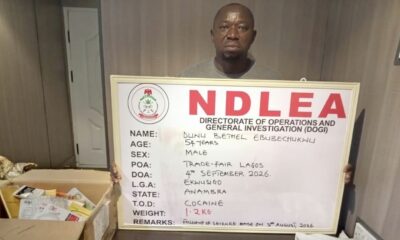
The arrest of Nwabueze in Anambra state followed the interception of 36 parcels of cocaine, with a gross weight of 5.80 kilograms, concealed within the walls of the herbal drink cartons. Four suspects initially arrested in parts of Lagos during investigations include: the cargo agent, Alalade Taiwo Azeez; the driver who conveyed the consignment to the cargo agent, Ndem Ogbonna Kelechi; a trader at ASPANDA market, Trade Fair Complex, Lagos who handed over the consignment to the driver for delivery to the cargo agent, Okeke Tochukwu Chimezie and an accomplice who supplied the cartons of Origin bitters used in concealing the cocaine, Igwilo Chidi Henry. The efforts eventually paid off, leading to the unmasking of Nwabueze hiding in his village Aziora, Ozubulu, Anambra state as the leader of the syndicate.
In Taraba, NDLEA operatives acting on credible intelligence on Saturday 4th July arrested a suspect, Daniel Harrison Ugwuoke, 30, with 43,980 capsules of Tramadol concealed inside two vehicle fuel tanks along Zaki-biam road Wukari Local Government Area of the state, while coming from Onitsha, Anambra state.
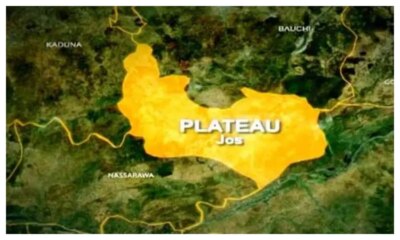
Two suspects: Boniface Agu, 65, and Monday Nwaeze, 50, were arrested in possession of 1.7 kilograms of methamphetamine by NDLEA officers on Thursday 2nd July during a raid operation at Gwantu, Gwantu LGA Kaduna state, while a 65-year-old suspect Francis Ifara Eja was nabbed with 231.7kg skunk at Ikwo, Ebonyi state on Saturday 4th July. Similarly, a 75-year-old grandpa Alhaji Babani was arrested in possession of 15kg skunk at Kurgwi, Qua’anpan LGA, Plateau state on Friday 3rd July.
In Gombe, NDLEA operatives acting on credible intelligence on Wednesday 1st July arrested the duo of Dahiru Mohammed, 65, and Isiya Lawan, 36, at Kuri village, Yamaltu- Deba LGA, where they were found with 587 blocks of cannabis sativa, weighing 556 kilograms.
With the same level of dedication, Commands and formations of the Agency across the country continued their War Against Drug Abuse (WADA) sensitization activities in schools, worship centres, work places and communities among others in the past week. These include: WADA enlightenment lecture to students and staff of Girls Secondary School, Abagana, Anambra; Government Technical College, Obe, Enugu; Adeola Odutola College, Ijebu Ode, Ogun state; and FCE Staff Demonstration School, Kabuga, Kano state, among others.
While commending the officers and men of MMIA, Taraba, Kaduna, Ebonyi, Plateau, and Gombe Commands for the arrests and seizures, Chairman/Chief Executive Officer of NDLEA, Brig. Gen. Mohamed Buba Marwa (Rtd) noted their drug supply reduction efforts balanced with WADA sensitization activities while he charged them and their compatriots across the country to continue to raise the operational bar.

The post Nigerian-British grandma Arrested with 13kg Cocaine Concealed in Plantain Peels appeared first on Business Today NG.
Continue Reading
Click to comment

Leave a Reply

Your email address will not be published. Required fields are marked *

Business

Nigerian govt not operating “shadow budget” – Finance Minister

info

Published

on

By

Admin ajax 3 2.jpg

MTN ADVERT

The Federal Government has dismissed claims that it spent more than ₦8 trillion outside the approved budget, insisting that it does not operate a “shadow budget” and that all public expenditures are carried out within the framework of the Constitution and relevant laws.

In a statement issued on Sunday, the Minister of Finance and Coordinating Minister of the Economy, Taiwo Oyedele, described recent public commentary suggesting that about two per cent of Nigeria’s Gross Domestic Product (GDP) was spent outside legislative approval as inaccurate and misleading.

The minister said the claims, reportedly linked to references made by the International Monetary Fund (IMF) and its 2026 Article IV Consultation Report, created a false impression about the Federal Government’s financial management practices.

“For the avoidance of doubt, the Federal Government does not operate a ‘shadow budget’ or expend public funds outside the constitutional and statutory framework established for public finance,” Mr Oyedele stated.

He explained that under Sections 80 to 83 and 162 of the 1999 Constitution, as amended, public funds may be withdrawn and spent only in accordance with constitutional provisions and laws enacted by the National Assembly.

PT WHATSAPP CHANNEL

According to him, federal expenditures are undertaken through duly enacted Appropriation Acts, Supplementary Appropriation Acts and other statutory authorisations approved by lawmakers.

The minister also noted that multi-year capital projects, which often extend beyond a single fiscal year, are implemented under existing legal provisions, including approved capital rollovers where necessary.

He argued that such arrangements are standard features of public financial management and should not be interpreted as spending outside the budget.

Mr Oyedele challenged those making the allegations to provide evidence of specific projects allegedly executed without appropriation or legal authorisation.

“Such allegations should have identified the specific projects purportedly executed without appropriation or legal authority and present credible evidence in support of the claim,” he said.

The minister further explained that Nigeria’s fiscal framework includes several statutory transfers, first-line charges and intervention mechanisms established by Acts of the National Assembly.

These include statutory allocations to development commissions and agencies created by law, cost-of-collection provisions for revenue-generating agencies, capital expenditures approved through separate budgets, special interventions addressing national priorities, as well as debt service obligations and other statutory transfers.

He stressed that these expenditures are lawful, publicly disclosed and subject to oversight, audit and accountability mechanisms.

According to Mr Oyedele, differences between how such expenditures are reported in fiscal documents and how they appear in annual appropriation laws often arise from international reporting standards and should not be misconstrued as evidence of unlawful spending.

The minister also rejected suggestions that the reported amount represented an increase in Nigeria’s fiscal deficit.

He explained that fiscal deficits are determined by the relationship between total government revenues and expenditures, adding that the source of financing for approved projects does not automatically increase the deficit.

Mr Oyedele said the IMF’s observations were largely focused on improving the comprehensiveness, timing and presentation of fiscal reporting rather than questioning the legality of government spending.

He recalled that President Bola Tinubu had, during the presentation of the 2026 Appropriation Bill to the National Assembly in December 2025, advocated harmonising multiple and overlapping budgets into a single, cohesive framework.

The minister reaffirmed the Federal Government’s commitment to transparency, accountability and prudent fiscal management, noting that ongoing reforms have strengthened budget credibility, revenue administration, treasury management and the digitalisation of government financial processes.

READ ALSO: Oyedele confirms Nigeria has drawn first $1.5 billion under $5 billion Abu Dhabi financing deal

He added that these reforms have received recognition from the IMF, other multilateral institutions, international credit rating agencies, investors and major global media organisations.

While welcoming public scrutiny of government finances, Mr Oyedele urged commentators to ensure that debates are based on facts and a proper understanding of Nigeria’s constitutional and fiscal framework.

“The Federal Government will continue to uphold the rule of law, maintain transparency in the management of public resources, and work with the National Assembly, oversight institutions, development partners and the Nigerian people further to strengthen fiscal governance in line with international best practices,” he said.


Continue Reading

Business

Alake warns mining firms over host community agreements, threatens licence revocation

info

Published

on

By

IMG 20260704 WA0057.jpg

MTN ADVERT

The Minister of Solid Minerals Development, Dele Alake, has warned mining companies operating in Nigeria that failure to comply with their Community Development Agreements (CDAs) could lead to sanctions, including the revocation of their licences.

Mr Alake gave the warning on Saturday during the ministry’s 2026 Ministerial Retreat in Abuja.

He said although the government has made significant progress in reforming the solid minerals sector, greater emphasis would now be placed on accountability and ensuring that host communities benefit from mining activities.

“Our reforms have restored confidence, attracted serious investors and made the sector a key part of Nigeria’s economic diversification. Now, our focus is on accountability,” he stated.

The minister stressed that companies must honour the agreements reached with their host communities.

PT WHATSAPP CHANNEL

“Mining companies that fail to honour their Community Development Agreements will face sanctions, including the revocation of their licences,” he said.

He added that, “Host communities deserve to benefit from the resources in their land, and there will be consequences for those who ignore that responsibility.”

Community Development Agreements are legally required arrangements between mining companies and host communities, outlining commitments on social amenities, employment, infrastructure and other development projects.

READ ALSO: Alake calls for united African front to capture greater value from global mineral economy

Illegal mining

Mr Alake also reaffirmed the Federal Government’s commitment to tackling illegal mining across the country.

According to him, the ministry will strengthen the operations of the Mining Marshals while adopting practical and innovative measures to improve security in the sector.

“I also reaffirmed our commitment to ending illegal mining by strengthening the Mining Marshals and embracing practical, innovative ideas that will make the sector more secure and more beneficial to all Nigerians,” he said.

The minister said the government’s ongoing reforms are aimed at building a more transparent, secure and investment-friendly mining sector capable of contributing more significantly to Nigeria’s economic diversification.


Continue Reading

Trending