News
Nigeria Appoints Prof. Elias Lamle to Integrate Peacebuilding into Climate Action Plan

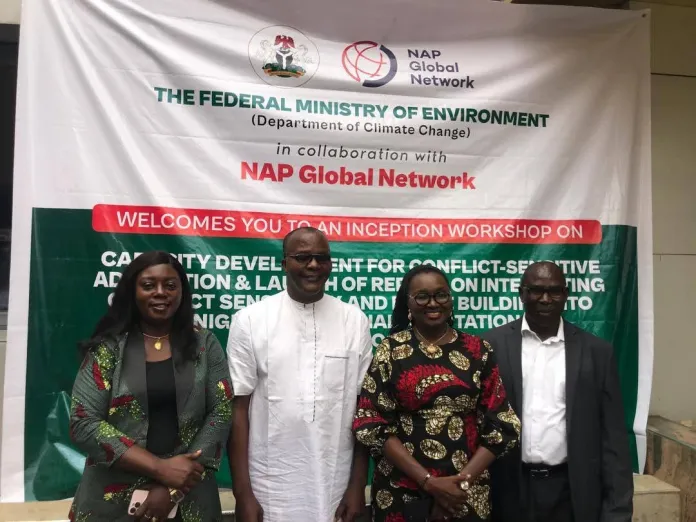
The Federal Ministry of Environment, in collaboration with the International Institute for Sustainable Development (IISD) through the NAP Global Network, has appointed Professor Elias Nankap Lamle as Lead Consultant to integrate peacebuilding into Nigeria’s National Action Plan (NAP) on Climate Change.
Prof. Lamle, a distinguished scholar of conflict management and peacebuilding at the University of Jos, will lead efforts to embed conflict sensitivity and peacebuilding into the country’s climate adaptation framework. His assignment includes building the capacity of government agencies, civil society organisations, and subnational actors to address the growing link between climate impacts and insecurity.
The initiative is part of Nigeria’s ongoing NAP process, supported by the NAP Global Network’s In-Country Support Program, which provides technical expertise to help nations design climate policies that strengthen resilience while fostering social stability.
In his remarks, Prof. Lamle stressed the importance of connecting environmental and security priorities:
“Climate change is not only an environmental challenge—it is also a peace and security challenge. By integrating peacebuilding into Nigeria’s National Action Plan, we are creating adaptation strategies that protect both our environment and our people. This is an opportunity to turn climate risks into pathways for resilience and cooperation.”
A spokesperson for the Ministry of Environment described the appointment as a milestone in Nigeria’s climate policy journey:
“This appointment represents a vital step in ensuring that our national climate policies are not only climate-smart but also conflict-sensitive. With Professor Lamle’s leadership, Nigeria is poised to set a standard for linking climate resilience with peacebuilding.”

As Lead Consultant, Prof. Lamle will oversee the development of training materials, organise capacity-building workshops across Nigeria’s six geopolitical zones, and provide technical guidance to ensure adaptation strategies address conflict realities. The outcomes are expected to influence both national and subnational climate planning.
Established in 2014, the NAP Global Network—supported by partners including Austria, Canada, Germany, Ireland, the United Kingdom, and the United States—works with developing countries to strengthen climate adaptation planning. Its Secretariat is hosted by IISD.
Through this appointment, Nigeria signals its commitment to aligning climate resilience with peacebuilding—an approach increasingly recognised as vital for countries grappling with the dual challenges of environmental stress and insecurity.





Kenya has confirmed a second case of Ebola, involving a 39-year-old man who developed symptoms while in quarantine, 10 days after the country’s first confirmed patient died.
The development comes barely a week after PREMIUM TIMES reported Kenya’s first imported case of the Bundibugyo strain of Ebola virus, linked to the ongoing outbreak in the Democratic Republic of the Congo (DRC).
In a report by the BBC, the second patient was identified as a close relative of the first case and developed symptoms on Tuesday, 13 October, while already in quarantine under health authorities’ monitoring.
The Kenyan Ministry of Health said the two cases were linked and there was no evidence of transmission in the wider community.
Contact tracing continues
The first patient, a 40-year-old Kenyan man who had travelled from the DRC through Uganda, died on 5 October after testing positive for Ebola in Nairobi.
As previously reported by PREMIUM TIMES, his infection raised concerns about the risk of cross-border transmission and prompted Nigeria to review its preparedness for a possible imported case.


Following the second confirmation, Kenyan health authorities continued efforts to trace people who had contact with the first patient.
Of the 128 contacts identified, 113 had been located as of Tuesday, including 108 who were in quarantine in Kenya. Efforts to trace the remaining 15 contacts were continuing.
READ ALSO: Health Review: Ebola alert, Lassa fever deaths, maternal health push, other developments that shaped September
The health ministry said the early detection of the second case had improved the patient’s chances of recovery and reduced the risk of further transmission.
It advised residents to seek prompt medical attention if they developed fever, unusual tiredness, muscle or joint pain, vomiting, diarrhoea or unexplained bleeding.
Ebola
Ebola is a severe viral disease that can cause serious illness and death. It spreads through direct contact with the blood or other bodily fluids of an infected person who is showing symptoms, or the body of someone who has died from the disease.
Symptoms may include fever, fatigue, muscle pain, vomiting and diarrhoea. The incubation period ranges from two to 21 days, meaning symptoms can develop several weeks after exposure.
The current outbreak in the DRC is caused by the Bundibugyo species of Ebola virus. The outbreak has also been linked to cases reported in other countries, including Uganda.
Unlike some other Ebola virus species, Bundibugyo has no specifically approved vaccine or treatment. However, supportive medical care can improve a patient’s chances of survival.
Discover more from Premium Times Nigeria
Subscribe to get the latest posts sent to your email.

The Benue State governorship candidate of the Social Democratic Party (SDP), Prof. Sebastine Hon, SAN, has urged party members and supporters to remain calm following the omission of his name from the final list of candidates released by the Independent National Electoral Commission (INEC).
The call was contained in a statement issued by the Director-General of the Prof. Sebastine Hon Gubernatorial Campaign Organisation, Dr. Ngutor Anyanwu.
Hon expressed confidence that the omission was a minor error that would be corrected.
“I believe this is just a minor error. It will be corrected,” he said.
The omission reportedly threw party members and supporters into confusion after INEC released its final list of governorship candidates for the 2027 election on Saturday.
The list contained 12 governorship candidates representing 12 political parties in Benue State, but Hon’s name was missing.
It was a minor error – Benue SDP governorship candidate on omission from INEC list
-

 News4 days ago
Microsoft’s Satya Nadella says AI models need an ‘emergency brake’
-
Business4 days ago
Veritas Kapital CEO Nwakuche Joins Coal City University Governing Council
-
News2 days ago
Meta releases its first frontier model, Muse Wonder
-
News4 days ago
2027: INEC publishes final names of governorship candidates across states [FULL LIST]