Connect with us

News

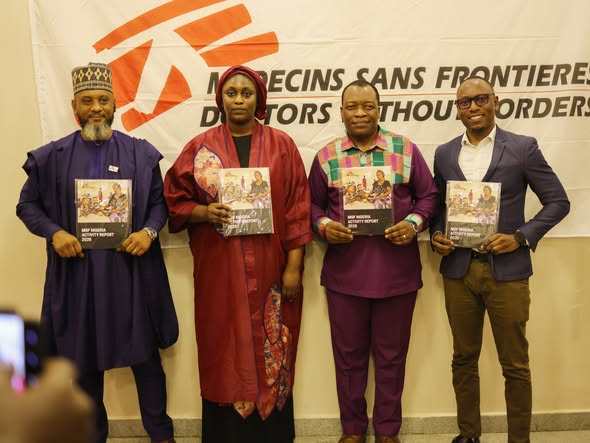
MSF Bridges Malnutrition Gap, Treats 444,723 Children In 2025

info

Published

on

MSF 2.jpg

Médecins Sans Frontières, also known as Doctors Without Borders, says it treated 444,723 children for malnutrition in Nigeria in 2025.

The Country Representative, Ahmed Aldikhari, said this on Wednesday in Abuja during the unveiling of the organisation’s Nigeria Activity Report for 2025.

Aldikhari said 353,989 children with severe acute malnutrition were treated through MSF-supported outpatient programmes, while 90,723 children requiring specialised care were admitted into stabilisation centres nationwide.

According to him, the figures represent a 20 per cent increase in severe acute malnutrition cases treated and a 15 per cent rise in admissions compared to 2024.

He said MSF teams had observed a steady rise in malnutrition cases across northern Nigeria since 2022, with 2025 marking the peak of the crisis so far.

“Malnutrition is not only about lack of food.

“It is closely linked to preventable diseases such as measles, diphtheria, meningitis and malaria, which weaken children further and push them into severe malnutrition,” he said.

Aldikhari identified conflict, insecurity, inflation, displacement, flooding and drought as factors limiting access to healthcare services and adequate food supplies across affected communities.

He said MSF provided inpatient and outpatient care, Ready-to-Use Therapeutic Food, vaccination campaigns and nutrition interventions using locally available nutrient-rich foods such as Tom Brown.

Speaking on government response, Aldikhari said MSF was collaborating with key ministries and engaging the Presidency to ensure the malnutrition crisis received sustained national attention.

“Last year, we had the biggest conference for combating malnutrition in the Northwest, where we also had commitments from governors to ensure action is taken.

“We are beginning to see some action, but these actions are still not enough,” he said.

He also warned of a widening global funding gap caused by donor withdrawal, emphasising that governments and communities must strengthen food systems and healthcare delivery mechanisms.

On disease outbreaks, the Medical Activity Manager, Shafa’atu Abdulkadir, said MSF treated 38,753 children for measles and 6,123 for diphtheria nationwide in 2025.

She added that 985 patients were treated for meningitis, while 341,239 people received treatment for malaria across MSF-supported facilities in the country.

According to Abdulkadir, MSF also supported vaccination of more than 300,000 children against measles, meningitis and diphtheria through nationwide immunisation campaigns.

She said Nigeria continued to face seasonal outbreaks of cholera, Lassa fever, meningitis, measles, diphtheria and typhoid fever, especially during the rainy season annually.

Abdulkadir emphasised that many disease outbreaks remained preventable through vaccination, timely diagnosis, safe water access and early treatment interventions in vulnerable communities.

The Medical Coordinator, Louis Vala, said Nigeria remained among countries with the highest maternal and newborn mortality rates globally in spite of existing interventions.

According to him, MSF assisted 33,590 deliveries, conducted 119,469 antenatal consultations and carried out 224 Vesico-Vaginal Fistula surgeries during the reporting period.

Vala said access to emergency obstetric and newborn care remained limited in many rural and conflict-affected communities because of insecurity, cost and overstretched healthcare facilities.

The News Agency of Nigeria (NAN) reports that Médecins Sans Frontières has operated in Nigeria since 1996, responding to disease outbreaks, disasters, emergency health needs and gaps in healthcare access nationwide.

The organisation supports paediatric and maternal healthcare, treatment for malnutrition, tuberculosis, measles and malaria, while also providing mental health services and care for survivors of sexual violence.

MSF also conducts reconstructive surgeries for noma and fistula patients and operated across 10 states in 2025, including Bauchi, Borno, Cross River, Ebonyi, Jigawa, Kano, Katsina, Kebbi, Sokoto and Zamfara.

The organisation additionally established a new presence in Kaduna and responded to medical emergencies in Benue, Plateau and Taraba states in 2026.(NAN)(www.nannews.ng)

Edited by Abiemwense Moru

Continue Reading
Click to comment

Leave a Reply

Your email address will not be published. Required fields are marked *

Health

Ebola: NCDC raises importation risk, says Nigeria remains case-free

info

Published

on

By

NCDC 5 1062x598 1.jpg

MTN ADVERT

The Nigeria Centre for Disease Control and Prevention (NCDC) has urged Nigerians to remain calm, assuring that the country currently has no confirmed case of Ebola Virus Disease (EVD).

The Director-General of NCDC, Jide Idris, gave the assurance during a media briefing on Friday in Lagos.

The briefing provided updates on the country’s preparedness and response efforts following outbreaks of the Bundibugyo strain of Ebola Virus Disease in the Democratic Republic of the Congo (DRC) and Uganda.

Mr Idris said that since confirmation of the outbreaks in the region, the NCDC had intensified preparedness activities nationwide to ensure Nigeria remained ready to rapidly detect, investigate, contain and respond to any potential importation of the disease.

He explained that the agency had conducted a comprehensive dynamic risk assessment, which classified the risk of Ebola importation into Nigeria as high.

PT WHATSAPP CHANNEL

According to him, the assessment reflects increasing regional transmission, international travel and population movement, porous borders, and the potential for delayed recognition because Ebola symptoms may resemble those of malaria and Lassa fever.

“As I speak, there is currently no confirmed case of Ebola Virus Disease in Nigeria,” he said.

“While there are currently no widely available licensed vaccines or approved treatments specifically for the Bundibugyo strain of Ebola virus.

“Experience from previous outbreaks has demonstrated that early detection, rapid isolation, infection prevention and control, contact tracing, risk communication, and effective emergency coordination remain the most effective tools for preventing transmission and saving lives.

“Hence, we encourage Nigerians to remain calm and continue to do their normal activities.

“Members of the public should obtain information only from credible sources, avoid spreading rumours and misinformation, and promptly report any unusual illness through established public health channels,” Mr Idris said.

Highlighting key achievements of NCDC in preparedness, Mr Idris said readiness assessments were completed in 549 health facilities across 32 states and the Federal Capital Territory.

He added that the assessment of 17 designated treatment centres was completed to evaluate screening capacity, isolation readiness, infection prevention and control systems, healthcare workers’ protection, and treatment readiness.

Regarding training of staff and healthcare workers in the management of Ebola, Mr Idris said there was no mapped-out training, but managing Ebola, like every other pandemic, required adherence to the use of Personal Protective Equipment (PPE) and Infection Prevention and Control (IPC) precautions.

READ ALSO: Ebola: WHO says DRC cases rise to 344, death toll reaches 60

The NCDC DG stated that there was a high level of surveillance at all entry points (borders) of the country, as the Centre was collaborating with the authorities who man the borders to ensure Ebola was not transmitted into the country.

According to him, preparedness is a shared responsibility, noting that while NCDC leads national coordination efforts, effective preventive and early response requires active collaboration among state governments, healthcare facilities, communities, development partners, and the public.

“Nigeria successfully contained Ebola in 2014 through strong leadership, rapid detection, effective coordination, public trust, and collective action.

“Today, we are building on those lessons and strengthening preparedness even further.

“If Ebola should come into the country, Nigeria will contain it,” Mr Idris said. (NAN)

Continue Reading

News

Super Falcons 2-1 Senegal: Oshoala Delivers Goal and Powerful Message on Kidnapped School Children, Teachers

info

Published

on

By

IMG 20260605 WA0314.jpg

Super Falcons striker delivered more than just a goal during Nigeria’s international friendly victory over Senegal on Friday, as the forward used the moment to spotlight pressing educational issues in the country.

READ ALSO:  ProStar Sports International Elevates Miss World Nigeria 2026 with Premium Fitness and Swimwear Partnership

After calmly converting a first-half penalty to hand Nigeria the lead against Senegal at the Remo Stars Stadium in Ikenne, Ogun State, Oshoala revealed a message written on her wristband which read: “Save The Teachers” and “Bring Back Our Children.”

The gesture quickly drew attention from fans and observers, with many praising the Barcelona Femeni star for using her platform to advocate for education and the welfare of children in Nigeria.

Oshoala’s strike came in the 32nd minute after she was fouled inside the penalty area, before midfielder Toni Payne  doubled Nigeria’s advantage nine minutes later with a composed finish.


The Super Falcons eventually secured a 2-1 victory over the Lionesses of Senegal in the friendly encounter, which forms part of the team’s preparations for the upcoming Women’s Africa Cup of Nations (WAFCON).

Senegal pulled one goal back late in the game through Sokhna Nogaye, but Nigeria held firm to seal the win in front of the home supporters in Ikenne.

Beyond the result, Oshoala’s post-goal message became one of the defining moments of the match, highlighting concerns over the state of kidnapping of School children across in Oyo State.

A goal and a message — Oshoala once again showed her passion for making an impact both on and off the pitch.

Continue Reading

Trending