News
It’s Crowning Season: Little Miss Plateau 4th Edition Takes Center Stage.


The moment we’ve all been waiting for is finally here as we proudly present the beautiful contestants of Little Miss Plateau 2026 — a celebration of beauty, intelligence, culture, confidence, and the bright future of our young queens. 🌟
Little Miss Plateau has grown beyond a pageant into an inspiring platform dedicated to nurturing young talents, promoting education, self-belief, cultural values, and leadership among children from different backgrounds.
Join us for an unforgettable afternoon as these amazing young contestants take the stage and begin their journey to the crown. Let’s celebrate their brilliance, dreams, and potential together! 💫👸
📅 Date: Sunday, 24th May, 2026
📍 Venue: Sarau Event Centre, Behind NTA Jos Network Centre
🕑 Time: 2:00 PM

Come witness the crowning of the next Little Queen of Plateau! 👑✨
Powered by African Cultural Fashion – Africulfash
Promoted online by Jos E Vents



















News
LA 2028 Olympic Qualifiers: Toni Payne, Uchenna Kanu Hit Braces as Super Falcons Thrash Comoros 5-0, Advance 7-0 on Aggregate

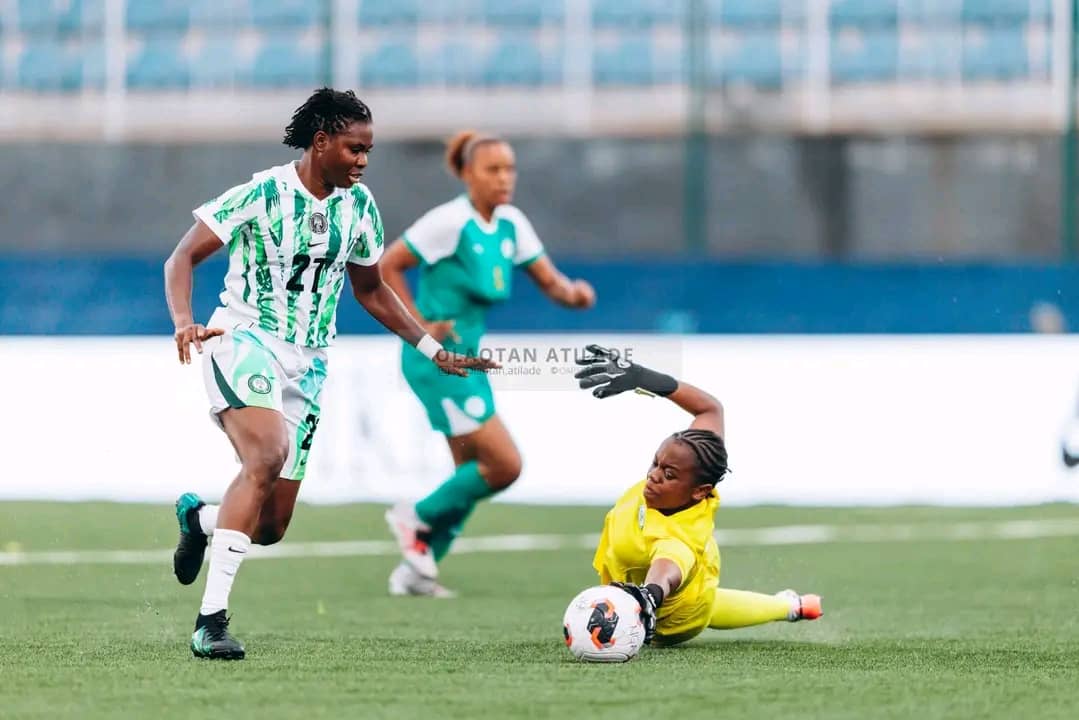
Nigeria’s Super Falcons produced a commanding performance to defeat Comoros 5-0 in the second leg of their 2028 Olympic Games qualifying encounter on Tuesday, completing an emphatic 7-0 aggregate victory to advance to the next round.
Sports247 reports that Toni Payne and Uchenna Kanu were the standout performers, scoring twice each, while Christy Ucheibe added another goal as Nigeria demonstrated their attacking quality against the visitors.
The victory followed the Super Falcons’ 2-0 first-leg triumph at the Remo Stars Stadium in Ikenne, Ogun State, giving Nigeria a comfortable advantage heading into the decisive encounter.
Despite entering the match with a two-goal cushion, the Super Falcons approached the second leg determined to extend their advantage rather than simply defend their first-leg result.
Their persistence eventually paid off in the 41st minute when Toni Payne broke the deadlock, putting Nigeria ahead and increasing their aggregate lead to 3-0.
The opening goal ensured that the Nigerian side entered the interval in a commanding position, leaving Comoros with an increasingly difficult task.
The Super Falcons returned for the second half with renewed attacking determination, producing four additional goals to complete an impressive victory.
Uchenna Kanu doubled Nigeria’s lead in the 57th minute before Payne completed her brace six minutes later, making it 3-0 on the day. Kanu then grabbed her second goal in the 67th minute, extending Nigeria’s advantage to four goals.
Christy Ucheibe completed the scoring in the 71st minute, putting the finishing touch on a dominant performance that underlined Nigeria’s superiority across both legs.
The five-goal victory also ensured that the Super Falcons finished the two-legged contest without conceding, recording consecutive clean sheets against Comoros. The result represented a successful outing for interim head coach Austin Eguavoen, who had emphasised the importance of winning rather than relying on Nigeria’s first-leg advantage.
Speaking before the encounter, Eguavoen stressed that maintaining the team’s structure remained his priority, although he welcomed the possibility of scoring more goals. His players responded with an impressive attacking display, scoring five times while maintaining their defensive discipline.
Kanu also delivered on her pre-match ambition after expressing confidence in the squad’s ability to secure another convincing victory.
With Comoros eliminated 7-0 on aggregate, Nigeria will now turn their attention to Morocco in the next round of the qualification campaign.
The upcoming encounter represents another important challenge as the Super Falcons continue their pursuit of a place at the 2028 Olympic Games in Los Angeles.
For Nigeria, the comprehensive victory provides a significant confidence boost ahead of the tougher assignments expected in subsequent rounds.
Five goals, two braces, two clean sheets and a 7-0 aggregate triumph — the Super Falcons have delivered a strong statement of intent as their Olympic qualification journey continues.

The Nigerian National Petroleum Company Limited (NNPC Ltd.) says it recorded a 54.5 per cent increase in Profit After Tax (PAT), rising from N279 billion to N431 billion in August 2026.
NNPC Ltd. made this known in its monthly operations and financial report for the month of August 2026.
According to the report, revenue for the period stood at N3.74 trillion as against N3.09 trillion recorded in July.
It said the company also recorded a 19.89 per cent increase in cumulative statutory payments, from N7.91 trillion for January to July, amounting to N9.49 trillion from January to August.
The report puts the average crude oil and gas production figures for the period at 1.69 million barrels per day (bpd) and 7,680 million standard cubic feet per day, respectively.
ALSO READ: NNPC posts ₦535 billion profit, records 1.72 million barrels daily oil output in June
On the state of infrastructure, it said there was 100 per cent availability of upstream pipelines, while the OB3 and Ajaokuta-Kaduna-Kano (AKK) Gas Pipelines stood at 100 per cent and 95 per cent completion, respectively.


(NAN)
Discover more from Premium Times Nigeria
Subscribe to get the latest posts sent to your email.
-
News4 days ago
Inside INEC’s AI and cybersecurity plans to secure Nigeria’s 2027 Elections – Technology Times
-

 News3 days ago
EuroMatch NPFL: Ikorodu City Return to Winning Ways as Salami, Ikechukwu Sink Kwara United in Lagos
-
News3 days ago
Petra Power looks to modernize energy for data centers and defense vehicles
-
News3 days ago
Microsoft’s Satya Nadella says AI models need an ‘emergency brake’