Connect with us

News

Elon Musk repeatedly one-upped his execs on SpaceX’s first earnings call

info

Published

on

Elon musk election afd purple.jpg

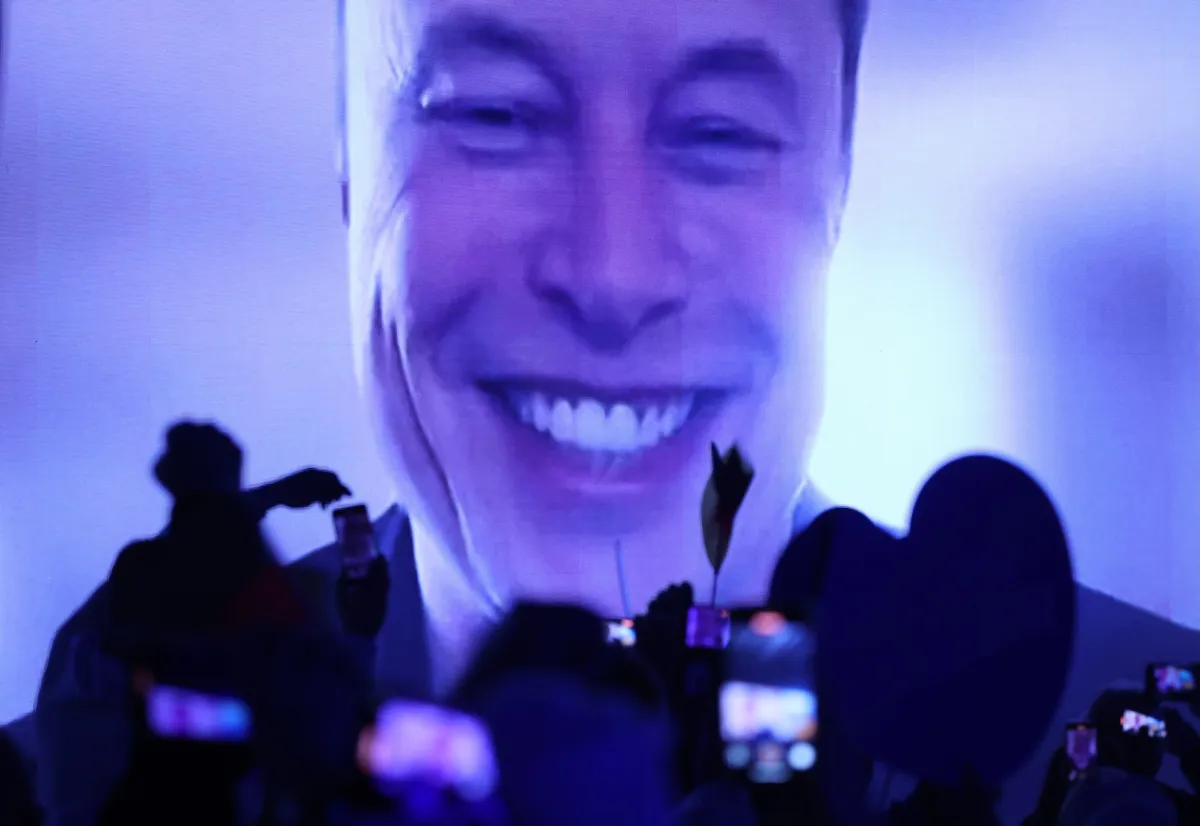
Elon Musk spent SpaceX’s first earnings call making some out-of-this-world claims about the company’s business and future prospects, while his fellow executives kept trying to bring his ideas closer to Earth — providing a hint of what’s to come now that his rocket-launching, compute-leasing, satellite-based telecom is public.

The conference call, held Tuesday, was the latest in a years-long succession of Musk making outrageous promises that his executives then have to make more digestible for the investing public — like at Tesla, where a recent analysis by TechCrunch showed that the world’s richest man is increasingly focused on futuristic topics while his colleagues spend their time talking about the actual business of selling cars.

Let’s start with one of the biggest ideas Musk floated on the call: that he expects SpaceX’s Starlink service to “deliver a majority of the world’s internet” in “less than 10 years.” Musk made the comment in the context of SpaceX preparing to launch the first “V3” versions of its Starlink satellites, which have much higher bandwidth than previous versions.

Here’s what he said:

It’s kind of hard for people to wrap their minds around this, but like, it’s not out of the question that at some point, Starlink will deliver a majority of the world’s internet, at least in countries where we’re allowed to operate, which is the vast majority of countries. So this is, you know, important to bear in mind, and it’s not in like the infinity future. It’s, you know, less than 10 years.

Contrast that with what chief operating officer Gwynne Shotwell said just a few minutes later, emphasis mine:

The significant amount of capacity we’re able to add to the Starlink constellation from the V3 satellites will enable us to continue providing even better service — and it’s pretty great already — but to do so while serving more and more customers over the world. In fact, in the years ahead, we expect Starlink will represent a significant portion of global internet traffic, which Elon also talked about.

It’s a far more lawyered-up claim to make, even though it’s still obviously ambitious.

But that was not the only instance where Musk optimistically diverged. At one point, SpaceX chief financial officer Bret Johnsen offered investors one of the few new financial targets discussed on the call. Johnsen was highlighting SpaceX’s relatively new business of renting out compute power to other AI players, which has helped the company generate billions in fresh, fast cash.

I’ll once again emphasize the big promise Johnsen made during his prepared remarks, and note how carefully he phrased it. It’s a very hedged and quite specific claim that he’s making. It’s clearly meant to excite investors while also leaving room for the company to avoid legal exposure if it misses the projection:

Looking ahead, we continue to see robust demand in all three of our business segments, but in particular in our cloud services arrangements. We see increasingly favorable economics with each agreement we sign, and as Elon mentioned, we expect the supply-demand imbalance in the compute market to continue. The current economics have translated into a less than one-year payback on our new capital deployments for compute. For example, in the first few weeks of the third quarter, we’ve already contracted an additional $6.7 billion of cloud services revenue over a six-month period that begins ramping starting in October of this year. We believe this puts us on a trajectory, including contribution from Cursor, to reach $100 billion of ARR, or annualized revenue run rate by the end of this year, based on our expected revenue in the month of December of this year.

Musk, 20 minutes later, bulldozed that carefully constructed statement before immediately inflating it:

To be clear, the $100 billion ARR in December is not a question mark. That’s… that’s what we would achieve if we basically did nothing. So like, you know, I think it may be higher than that. It probably will be higher than that.

Musk also riffed on another major prediction about overall revenue on the call, pumping up a goal that SpaceX laid out just two months ago in its IPO documents:

It’s probably also worth mentioning that our internal projections for reaching a trillion dollars in revenue, not ARR, but revenue, have moved up from 2031 to 2030. So prior to the IPO, the financial projections we had were reaching a trillion dollars in revenue in 2031. We now expect that to be in 2030. And there’s a non-zero chance of that being in 2029.

The pattern kept repeating throughout the call. A shareholder question about progress on the “human landing system” that SpaceX is developing for NASA’s Artemis moon missions using Starship prompted Musk to all but claim that the prototype rocket will be ready to fly people by the end of next year. He later said SpaceX would be flying Starship rockets once a day, or “possibly more,” by this time next year.

Shotwell immediately followed Musk’s comments about human flight to clarify that SpaceX is still focused on NASA-mandated milestones, and offered a more vague (but still ambitious) goal (again, emphasis mine) that “we want to put boots on the ground, boots on the moon, in 2028.”

None of that will happen unless SpaceX can prove that Starship can fly without failing and, crucially, become fully reusable. A huge part of making it reusable is the heat shield that keeps the Starship upper stage from exploding when it re-enters Earth’s atmosphere. The company saw the best results from its improved heat shield on the most recent Starship test flight, which splashed down in the Indian Ocean last month and is still intact. But before the rocket stage had even been recovered, Musk was willing to claim on Tuesday that he’d “consider the heat shield problem solved at this point.”

Musk has made many wild promises about SpaceX that never came true, such as when he said in 2016 that he’d put humans on Mars in six years. The difference now is that SpaceX is a public company, and ostensibly subject to regulation and fines if the company and its executives make promises they know can’t be met.

Of course, the Securities and Exchange Commission has pulled way back on corporate enforcement, especially against public companies. The Department of Justice is doing the same. And if SpaceX can’t follow through on Musk’s wide-eyed claims, investors won’t even be able to do much in civil court — because the company has all but inoculated itself against those kinds of lawsuits by incorporating in Texas.

When you purchase through links in our articles, we may earn a small commission. This doesn’t affect our editorial independence.

Continue Reading
Click to comment

Leave a Reply

Your email address will not be published. Required fields are marked *

News

MTN faces pressure as 95% network runs on diesel in Nigeria, CEO says – Technology Times

info

Published

on

By

IMG 2886.png

Rising diesel costs are putting pressure on MTN Nigeria’s profitability, with the telecommunications company revealing that about 95% of its network in the country is powered by diesel generators.

IMG 2886 1IMG 2886 1
Ralph Mupita, MTN Group President and CEO. Image credit: MTN.

The disclosure was made by Ralph Mupita, MTN Group President and CEO on Monday during the presentation of the company’s interim results for the six months ended June 30, 2026.

Mupita says higher global oil prices during the period translated into increased diesel costs for the Nigerian operation, where dependence on generators remains extensive.

“Our network in Nigeria is like 95% on diesel generators, 5% on the grid,” Mupita says adding that energy costs, largely driven by diesel, now account for more than 30% of MTN Nigeria’s operating expenditure.

“Just over 30% of opex within Nigeria is energy prices, and that’s substantially diesel,” he says.

Diesel costs to hit coming quarters

The impact of higher diesel prices, according to Mupita, is not limited to the quarter in which the increase occurs because of the way MTN Nigeria’s energy contracts are structured. The cost recognised in a quarter is based on the average diesel price from the previous quarter. This means the effect of fuel-price movements can carry into subsequent reporting periods.

“And the way our contracts work, the cost in the quarter is the prior quarter’s average diesel price,” he explained. As a result, the higher diesel prices experienced during the second quarter are expected to affect MTN Nigeria’s third-quarter operating costs.

“What we experienced in Q2 of this year will come into Q3, and then Q3 will come into Q4,” Mupita says.

The cost pressure comes as MTN continues to invest heavily in its Nigerian network to meet growing demand for connectivity.

Data demand drives network investment

Mupita said demand for MTN’s services remains structurally strong in Nigeria, particularly as customers consume increasing amounts of mobile data.

He disclosed that the company recorded 2.7 million net customer additions in the first quarter, while average data consumption per customer reached 14.8GB.

The increase in data usage is pushing the company to continue investing in network capacity.

Mupita said MTN’s capital intensity in Nigeria exceeded 20% during the period as the company pursued growth in its mobile network and expanded its home connectivity strategy.

The operator is targeting the home broadband market through a combination of fixed wireless access and fibre, areas it believes offer significant growth opportunities in Nigeria.

The challenge for the company is that expanding network infrastructure also increases the amount of equipment that needs to be powered, making energy efficiency increasingly important to the economics of network expansion.

Nigeria remains a key growth market

Despite the pressure from energy costs, MTN maintained that Nigeria continues to offer strong growth opportunities.

Mupita described demand in the Nigerian market as robust, pointing to continued customer additions and rising data consumption.

He also noted that the naira remained relatively stable during the period, while liquidity at the prevailing exchange rate was not creating significant difficulties for the company. Inflation also moderated during the period.

However, higher diesel prices remain a major cost concern. Mupita says the impact of energy prices means MTN expects its Nigerian operation to remain within its medium-term guidance but towards the lower end of its EBITDA margin range.

“We are confident that the medium-term guidance framework we gave around Nigeria will maintain on service revenue, on the EBITDA margin will still be in range, but because of the high energy prices, we see ourselves at the lower end of the range,” he says.

The lower end of that range is around 53% EBITDA margin, according to the MTN CEO.

nigeria smartphone usernigeria smartphone user
Despite the pressure from energy costs, MTN maintained that Nigeria continues to offer strong growth opportunities. Mupita described demand in the Nigerian market as robust, pointing to continued customer additions and rising data consumption. Image credit: Image FX.

Airtime advance adds another pressure

Energy costs are not the only factor affecting MTN Nigeria’s financial performance.

The company also faced a significant revenue impact after Nigeria’s competition authorities directed it to suspend its airtime advance service in April.

Mupita said MTN responded by reducing its airtime advance base to about a quarter of its first-quarter run rate.

The suspension affected revenue generated during April, May and June, contributing to the weaker service revenue performance reported for the quarter.

However, MTN subsequently received communication from the competition authorities allowing the company to move towards restoring airtime advance through four vendors.

Mupita expects this to support the recovery of the business during the second half of the year, although he cautioned that the restoration would not immediately return the operation to its previous level because of the need for the new vendors to build experience and optimise their operations.

AI emerges as cost-cutting tool

Against the backdrop of rising energy expenses, MTN is also looking at technology, including artificial intelligence, to improve operational efficiency.

Ferdi Moolman, MTN CEO, South Africa says the group’s cost-efficiency programme is increasingly focused on structural changes to how the business operates rather than simply cutting expenses.

He cited the use of AI to improve power consumption at network sites in South Africa as an example.

“We did some proof of concept (POC) in the Western Cape, used AI to help us get more efficiency out of power consumption, which was very successful,” he says.

MTN plans to expand the initiative across the country. Moolman says the company still has significant room to extract efficiencies, with the broader cost initiative expected to take two to three years because of its structural nature.

For MTN in Nigeria, however, the scale of diesel dependence means energy costs will remain a major factor in determining how much of its strong data and subscriber growth translates into profitability.

Stay ahead with real-time reports, breaking news, and exclusive insights delivered directly to your phone. Don’t settle for outdated information. Join TECHNOLOGYTIMES NEWS on WhatsApp for 24/7 updates.
Join Our Whatsapp Channel

Continue Reading

News

Ogun 2027: ‘APC can’t suspend me after taking N50m’ – Hunye

info

Published

on

By

Abayomi Hunye.jpg

Ogun State All Progressives Congress, APC, governorship aspirant for the 2027 election, Abayomi Hunye, has blasted the party for suspending him.

Speaking during an interview on Channels Television’s Politics Today on Tuesday, Hunye questioned how the APC could suspend him and still sell the nomination form to him for N50 million.

He said he received the necessary forms, completed the documentation and passed the screening process, stressing that he was number 52 on the screening list.

According to him, during the primary election on May 21, he was recognised as a valid candidate.

Recommended

DAILY POST recalls that the APC disowned Hunye, who claims to be its Ogun governorship candidate for the 2027 election, and reaffirmed Solomon Adeola, popularly known as Yayi, as the duly recognised candidate.

Responding during the interview, Hunye said, “I bought the N50 million nomination form and was cleared for the screening.

“The first thing they said was that I had been suspended. They said I was suspended on April 7. How can you suspend me on April 7 and, on April 28, collect money from me and give me a form?

“I got the nomination form and the expression of interest form. I filled everything and returned it. I have the receipt. On the screening list, my number is 52.”

Continue Reading

Trending