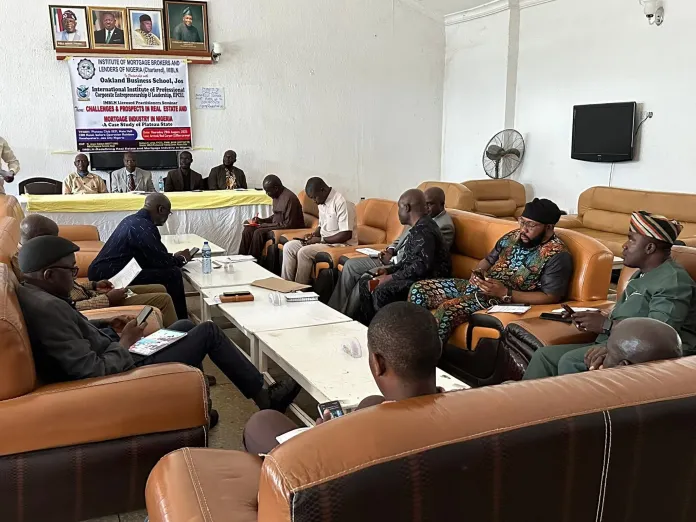
The Institute of Mortgage Brokers and Lenders of Nigeria (Chartered) (IMBLN) has held its maiden Practitioners Seminar in Jos, Plateau State, setting the stage for new standards and reforms in Nigeria’s real estate and mortgage industry.
The seminar, hosted at Plateau Club 1921, was organized in partnership with Oakland Business School, Jos—IMBLN’s professional training centre—and the International Institute of Professional Corporate Entrepreneurship & Leadership (IIPCEL). With the theme “Challenges and Prospects in the Real Estate and Mortgage Industry in Nigeria – A Case Study of Plateau State,” the forum brought together industry experts, licensed practitioners, and policymakers.
Delivering a welcome address on behalf of the IMBLN Registrar-General, Dr. Jasper Adeleye, Mr. Godwin E. Urhie, Executive Chairman/CEO of Oakland Business School, described the seminar as a milestone in professionalizing the industry.
“The housing deficit in Nigeria, estimated at 28 million units and still growing, cannot be solved without innovative approaches. IMBLN is ready to work with government agencies to ensure transparency, eliminate quackery, and promote professionalism in the industry,” Urhie said.
He further noted that the institute’s licensing and training framework will help curb fraud, money laundering, and terrorism financing, while creating a credible environment for housing finance.
Key Presentations
Sunday Bulus Ndaka, in a paper titled “Land and Property Registration as a Catalyst for Mortgage Financing in Jos-Bukuru Metropolis,” identified difficulties in accessing land documentation and the burden of high equity contributions as barriers to affordable housing.
“Many Nigerians hold Certificates of Occupancy but still cannot access mortgage facilities due to stringent requirements such as high equity contributions. This continues to worsen the housing deficit and push rents higher,” Ndaka explained.
Ishaya Adams Dung, in his presentation on “Mortgage Challenges and Prospects: A Case Study of Plateau State,” explained that mortgage opportunities are not exclusive to civil servants but available to all qualified Nigerians. He, however, highlighted low awareness, bureaucratic delays, and slow legal processes as key factors discouraging potential homeowners.
Stakeholder Participation
The seminar was attended by representatives of the Plateau State Government, including a delegate for Arc. Sylvanus Dongtoe, Commissioner for Housing and Urban Development, and Saje Joseph Adeh, who represented the Commissioner for Education, Dr. (Mrs.) Kachollom Pyam Gang.
The event concluded with the presentation of training certificates to licensed practitioners. IMBLN also announced that the second batch of practitioners will begin lectures in September 2025, to be followed by a formal induction ceremony and the award of practice licences and seals.
Moving Forward
IMBLN reaffirmed its commitment to raising a new generation of ethical mortgage professionals and supporting Nigeria’s quest for affordable housing. The institute emphasized that its core values—professionalism, integrity, customer focus, transparency, and accountability—will remain central to its operations as it expands across the country.
The Economic and Financial Crimes Commission, EFCC, Lagos Zonal Directorate 2, Okotie-Eboh, Ikoyi, Lagos, have handed over the sum of N140million to an investment and money-lending company, B4 Sail Limited.
The recovery of the funds, handed over in bank drafts by the Acting Zonal Director, Lagos Zonal Directorate 2, Assistant Commander of the EFCC, ACE I Bawa Usman Kaltungo, followed investigations into an alleged case of obtaining money by false pretence and diversion of funds involving one Jacob Oyebola Esan and companies linked to him.
In a petition submitted on April 20, 2026, B4 Sail Limited alleged that Esan, on behalf of his company, Geo Fields Plc, had approached the company in August 2025 for a N500 Million Naira loan facility to boost his business.
The loan facility, according to the petitioner, attracted an interest rate of 15 per cent per month and had a tenor of one month.
Investigation revealed that Esan, who is the first suspect, had previously obtained other loan facilities from the company, bringing his total loan exposure to N1,065,000,000.00 (One Billion, Sixty-Five Million Naira).
It was also revealed that Esan pledged shares held by him as collateral for the facilities through Calyx Securities Limited, the clearing house for the stocks, with the understanding that the shares would be subject to a lien in favour of B4 Sail Limited and that the company would have the first right of payment upon the sale of the shares.
The lien, investigation revealed, was communicated to B4 Sail Limited through a letter signed by the second suspect, Gbolahan Azeez Bello, Managing Director, Calyx Securities Limited.
Further investigation, however, revealed that the shares pledged as collateral had been sold without the knowledge of the petitioner, resulting in the suspect’s alleged default in repaying the facilities.
Consequently, the outstanding loan and accrued interest had risen to N2,250,500,000.00 (Two Billion, Two Hundred and Fifty Million, Five Hundred Thousand Naira).
Speaking during the handover ceremony, Kaltungo stated that the recovery “represents a further step in the Commission’s efforts to ensure that funds and assets recovered in the course of its investigations are appropriately returned to legitimate owners and victims in accordance with due process.
Four years ago, a startup lab launched that wasn’t quite an incubator, accelerator program, or venture firm. UP.Labs, as it was called then, built startups designed to solve problems for corporate customers such as Alaska Airlines and Porsche, as well as for the outside world.
The firm still has the same mission — albeit with a critical addition to its approach, a new name, and a $100 million investment from Silversmith Capital Partners. Vantora, as the firm is now called, continues to work with its corporate customers, including some new ones in industrial manufacturing that it declined to name, and in the oil and gas sector.
But now, it’s more focused on building startups solely for its corporate customers, and not for the broader market.
Founder and CEO John Kuolt told TechCrunch that Vantora is moving toward a “proprietary M&A pipeline.” This means Vantora will still build startups for its corporate partners, which invest in the ventures and serve as their first customers. But those corporate partners now have the option to fold the startups into their core businesses — and essentially keep them to themselves.
That shift has influenced Vantora’s increased focus on physical AI startups, according to Kuolt.
In the past, Vantora would end up spiking ideas that were strategic to its corporate partners, but too sensitive to bring to the outside world.
“We were missing on the biggest value problems, which had the biggest upside because of that,” Kuolt said in a recent interview. “Imagine you’re a Fortune 100 industrial company and you need to retrofit all of your hardware and machines for autonomy. You need to own that, it needs to be sovereign, and you can’t rely on a third party to go do that for you. You need to own that intelligence layer. They’re never going to let us go sell that to their competitors.”
This change has allowed Vantora to “unlock big physical AI use cases,” according to Kuolt, including with its existing customers.
For example, the firm came up with an idea to use AI to advance the business of its partner J.B. Hunt. “They said there is no way you can take this out to the world, and so we passed on it,” he said, adding that this proprietary model now allows Vantora to pursue it.
The firm launched in 2022 with Porsche as its first corporate partner. Since then, Vantora has launched several startups for Porsche and struck deals with Alaska Airlines, J.B. Hunt, Wabash, and TDG, the parent of Ashley Furniture.
In its early days, UP.Labs was tied — although never financially — to venture firm Up.Partners. While Vantora still shares office space with the California-based VC, it is its own entity, Kuolt explained, noting that the $100 million from Silversmith is the company’s first outside investment.
When you purchase through links in our articles, we may earn a small commission. This doesn’t affect our editorial independence.