News
Stakeholders in Plateau Central Zone Tackle Drug Abuse, Call for Stronger Governance Response

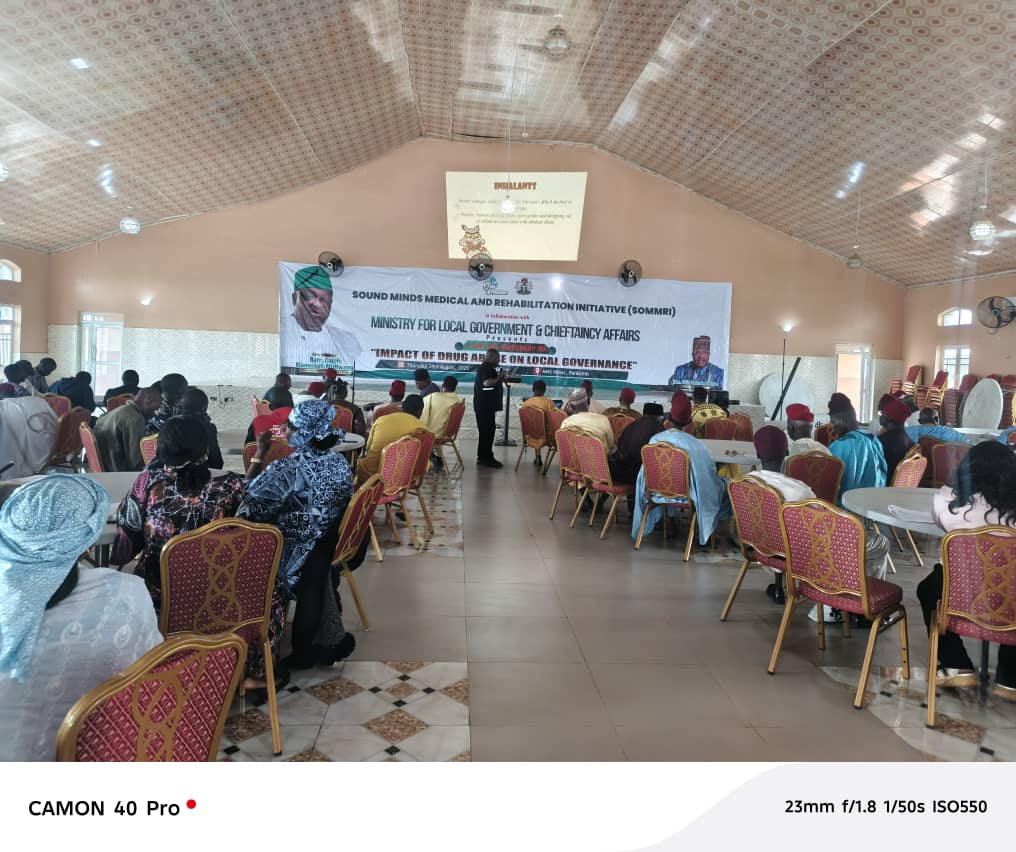
A one-day workshop on the Impact of Drug Abuse on Local Governance was held on Thursday, August 28, 2025, at MNS Hotel, Pankshin, bringing together critical stakeholders to deliberate on the growing menace of substance abuse and its far-reaching effects on governance, security, and community development in Plateau State.
The event, organized by the Sound Minds Medical and Rehabilitation Initiative (SOMMRI) in collaboration with the Ministry for Local Government and Chieftaincy Affairs, followed a similar session in the southern zone and is part of a series covering all senatorial zones of the state.
Participants included members of the Plateau Youth Council (PYC), security agencies, local government chairmen, directors of primary health care and social services, traditional rulers, religious leaders, and community representatives. Proceedings began with the administration of questionnaires to generate data that will inform state policies on prevention and rehabilitation.

Experts Warn of Health and Social Consequences
Prof. Nwoga Charles of the University of Jos highlighted the medical dangers, noting that while substances like cannabis, tramadol, and codeine may give a temporary high, they leave lasting damage to the brain, lungs, heart, and immune system.
“Substance abuse destabilizes mental health, drains motivation, and disrupts relationships, trapping young people in cycles of addiction and societal decline,” he said.

Clinical Psychologist Mafai Dauboyi stressed the need to address root causes.
“People use drugs for a reason, but the consequences are devastating. Poor family management, academic stress, and lack of monitoring create openings. However, positive relationships, coping skills, and a sense of purpose can shield our youth,” he explained.

Facilitator Ndak Zuhumnan Andarawus (Nurse Kizito) called for collective action.
“The stakeholders here are enough to end drug syndicates if we unite. Parents must know their children’s friends, schools should maintain drug testing, and communities must block supply chains. With psychoeducation and government support, the future can be secured,” he urged.


Local Government Leaders Call for Sustainability
Deputy council chairpersons emphasized the need for consistency and grassroots involvement.
-
Hon. Mrs. Grace Lapnen Tomwat, Deputy Chairman of Kanke LGA, said:
“This workshop is very timely, and I would love to see it held regularly, even in our churches, mosques, and communities. Many of our youths are deeply entangled in drug abuse, which is destroying their education and future. Beyond recreational use, some also become addicted to prescribed drugs after illness, and that is equally worrying. We really appreciate this effort and want it sustained.”
-
Hon. Lawal Yakwen Nuhu, Deputy Chairman of Mangu LGA, commended the inclusiveness of the forum:
“The programme is very positive because it brought together youths, religious leaders, and traditional councils—the very people who can help fight this menace. Drug abuse is rising in our communities, disrupting education and worsening insecurity, as many see drugs as an escape from hardship. With more initiatives like this, we can drastically reduce the problem and restore hope to our youths.”


Traditional Rulers Decry Weak Structures
Traditional rulers voiced frustration over weak enforcement and lack of empowerment.
- The Pankyan District Head lamented that drug distributors are often released due to interference:“Some even operate with official registrations. Until traditional rulers are empowered, our ability to fight this menace remains limited.”
- Bala Makkah, District Head of Chip, added:“No parent desires a child destroyed, yet social media worsens exposure. We are ready to partner with government once a strong law is passed. It is a shame Plateau still lacks rehabilitation centres.”
- Kupshak Goma, District Head of Amper, stressed synergy:“Without collaboration between traditional councils and security agencies, our efforts will remain fragmented.”
- Idris Shehu, District Head of Kanam, called for youth engagement:“Idleness fuels drug use. Reviving debates, quizzes, and cultural events will channel youthful energy into positive growth.”

Youths Demand Grassroots Action
Young leaders insisted that the drug trade is becoming normalized.
- Ahmed Abdullahi Kantana, Deputy KYC Chair (Kanam), said:“In the past, drugs were hidden, but now they are sold openly, even in cattle markets. Plateau ranks among the highest states in drug use—this must stop.”

- Mrs. Firapmun Zacharia of the NCWS, Bokkos, noted the burden on families:“Women bear the heaviest brunt. Some harmful substances even carry NAFDAC approval, confusing families. This campaign must reach every local government.”
- Tromhan Yusuf Iliya from Gindiri advocated for accessibility:“Rehabilitation should be affordable and available in every local government, alongside stronger school-based prevention.”


Religious Leaders Call for Moral Revival
Faith leaders urged the integration of spiritual guidance in policy responses.
- Alh. Hudu Ibrahim, JNI Chairman, Mangu, stated:“Our holy books condemn addiction, yet leaders are sidelined. If laws combine with spiritual guidance, we will achieve better results. We must return to God.”
- Catechist Yeyek Amos, CAN Assistant Secretary, Pankshin, warned:“Neglecting children today means arming tomorrow’s criminals. Many schools lack qualified religious instructors, leaving them vulnerable. If the government delays, the consequences in ten years will be dire.”
Security and Other Stakeholders Stress Law Enforcement
Security operatives linked drug abuse to rising crime.
“Many youths under the influence commit acts with no restraint. This workshop is timely as it empowers parents and communities while complementing government measures like compulsory drug testing in schools,” a representative said.

Other participants called for clear roles for security and traditional councils, stronger NDLEA presence across LGAs, continuity in government policies, and strict enforcement of by-laws. They also warned against collusion between security operatives and drug dealers, stressing that substance abuse goes beyond illicit drugs to include misuse of prescription medicines.

Path Forward
The workshop ended with a consensus that tackling drug abuse requires a multi-sectoral approach combining health, security, education, community, and faith-based efforts. Participants urged government to strengthen policies, establish rehabilitation centres, and empower traditional institutions, while communities play their role in prevention and monitoring.


News
EuroMatch NPFL: ‘We Never Gave Up!’ — Fidelis Ilechukwu Hails Rangers’ Fighting Spirit, Reacts to Two Penalties Against Barau FC



Rangers International Technical Adviser Fidelis Ilechukwu has praised his players’ resilience and fighting spirit after the Flying Antelopes battled back to secure a dramatic 2-2 away draw against Barau FC in Kano during Matchday 8 of the EuroMatch Nigeria Premier Football League (NPFL).
The experienced tactician described the encounter as an important lesson in determination, insisting that his players demonstrated the character required to compete under difficult circumstances.
Read Also: EuroMatch NPFL: ‘Our Defending Is Very Disturbing’ — Salisu Yusuf Admits Shooting Stars Were Outplayed by Kun Khalifat
Rangers appeared destined for defeat after surrendering their first-half advantage, but a stoppage-time equaliser ensured the Enugu-based club returned home with a valuable point.
Speaking during his post-match assessment, Ilechukwu expressed satisfaction with his team’s refusal to surrender despite the challenges encountered during the game, Sports247 gathered.
“It’s a great game. Today teaches us that we don’t have to give up. When we were a goal down, we rallied together and got a point away from home,” Ilechukwu said.
Rangers took the lead in the 38th minute through Ifeanyi Okechukwu, putting the visitors in a promising position heading into the interval.
However, Barau FC responded strongly after the restart, with Joseph Atule converting a penalty in the 56th minute to restore parity.
The hosts completed their turnaround in the 68th minute when Aliyu Sugau converted another spot-kick, putting Rangers under pressure as the contest approached its closing stages.
With time running out, Rangers continued searching for an equaliser, and their persistence eventually paid off.
Chidiebere Nwobodo emerged as the visitors’ hero, scoring in the third minute of stoppage time to rescue a point and deny Barau FC a home victory.
Ilechukwu Reacts to Controversial Penalty Decisions
The two penalties awarded to Barau FC became a major talking point following the encounter.
However, Ilechukwu declined to directly criticise the officiating, acknowledging that the referee had the authority to make decisions during the match.
“I’m not the referee. It’s not my duty, but the referee has the final say on the penalties awarded to the home team,” he explained.
His response reflected a measured approach to the decisions, with the Rangers boss choosing instead to focus on his players’ determination to recover from a difficult situation
Beyond the result, Ilechukwu revealed that Rangers’ continental commitments and the absence of several important players had affected his team’s preparations.
According to the technical adviser, injuries and fatigue prevented some key members of the squad from travelling for the encounter.
“We have to face continental games. Some of our top players couldn’t be here because of injuries and fatigue, but the players available tried their best to secure an away draw,” he said.
The demanding schedule has placed additional pressure on the Rangers squad, making rotation and player recovery important considerations as the season progresses. Nevertheless, Ilechukwu was encouraged by the commitment displayed by those who featured against Barau FC.
Although Rangers were unable to secure maximum points, the dramatic nature of their comeback provided encouragement for the technical crew.
Recovering from a 2-1 deficit to claim a draw in stoppage time demonstrated the determination Ilechukwu wants his players to maintain throughout the campaign.
For Barau FC, the result represented a missed opportunity to secure all three points after overturning Rangers’ early advantage.
For the Flying Antelopes, however, the encounter reinforced the importance of persistence, particularly when facing difficult away assignments.
Ilechukwu’s message was unmistakable: regardless of injuries, fixture congestion or controversial decisions, Rangers must continue fighting until the final whistle.

The Independent National Electoral Commission (INEC) has disowned a fake online publication claiming to be a special announcement on governorship candidates in six states.
Politics Nigeria reports that the commission identified the affected states as Zamfara, Gombe, Delta, Plateau, Yobe and Kano.
It urged members of the public to disregard the publication and rely on its verified communication channels for electoral information.
INEC said the publication did not originate from the commission and described it as fraudulent.
“The Commission wishes to categorically inform the general public that the publication is FAKE and did not originate from INEC,” the statement partly read.
“INEC therefore urges members of the public to disregard the fraudulent publication and refrain from sharing it.”
The commission’s warning comes amid concerns over the omission of several candidates from its final list of governorship candidates for the 2027 elections.
In Kano State, the Kwankwassiyya Movement has vowed to engage INEC over the omission of Mustapha Rabiu Kwankwaso, the Nigeria Democratic Congress (NDC) deputy governorship candidate, and his principal, Aminu Abdussalam Gwarzo, from the final list.
Habibu Mohammed, spokesperson for the movement, said the omissions came as a shock, insisting that the candidates had met the requirements for registration.
Speaking on Arise Television, Mohammed said the movement would explore the legal provisions available to candidates whose names were omitted from the commission’s list.
“It came as a shock because there had been no issue with INEC. Kwankwas, a former deputy governor, is registered with the NDC and met the stipulated deadline,” he said.
He added that electoral provisions allow affected candidates 14 days to seek redress over omissions from the list.
“We will explore that opportunity and engage with INEC,” Mohammed said.
The spokesperson maintained that the movement was unaware of any court judgment or order that could have justified the omission.
He expressed confidence that the matter would be resolved through engagement with the commission and the available legal procedures.
The NDC has also described the omission as an error and said it is seeking a correction.
Meanwhile, the Peoples Democratic Party (PDP) has also begun engaging INEC over the omission of its governorship candidates in Ogun and Gombe states.
The party’s National Publicity Secretary, Jungudo Mohammed, disclosed this in a statement on Sunday, saying the party was working towards an amicable resolution in line with the law and established electoral guidelines.
He assured affected candidates, members and supporters that the party was treating the matter seriously and would communicate further developments when necessary.
The PDP also urged those affected to remain calm and exercise patience while discussions with the commission continued.
This was just as the party warned against actions or statements that could undermine the ongoing engagements with INEC, stressing its commitment to addressing the concerns through lawful means.
INEC released its final list of candidates for the February 6, 2027 governorship elections on Saturday.
The list, signed by the commission’s Secretary, Rose Oriaran-Anthony, and published on its website, contained 13 candidates in Ogun State and 16 in Gombe State, with no PDP candidate listed in either state.
Among those omitted were Ladi Adebutu, the PDP candidate in Ogun State, and Isa Ali Pantami, the party’s candidate in Gombe State.
-

 Business3 days ago
Communications Ministry made ₦345.5 million duplicate payment for Abuja ICT Park project
-
Business3 days ago
Fuel subsidy would cost Nigeria over N20trn yearly — Minister
-
News3 days ago
LumenUs helps automate tedious paperwork in times of grief
-
News2 days ago
Inside INEC’s AI and cybersecurity plans to secure Nigeria’s 2027 Elections – Technology Times