Connect with us

News

Special Task Force OPSH Renamed ‘Operation Enduring Peace’ Ahead of Official Unveiling

editor

Published

on

Operation Safe Haven ,Operation Enduring Peace ,Plateau

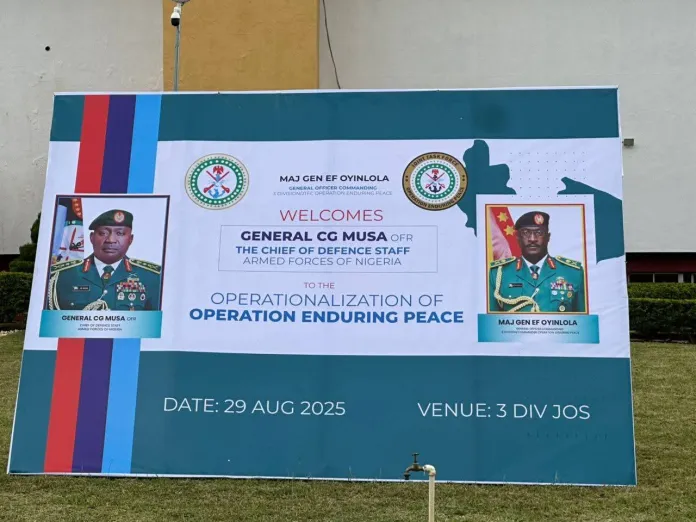
The Special Task Force in Plateau State, formerly known as Operation Safe Haven (OPSH), has been officially renamed Operation Enduring Peace.

The Chief of Defence Staff, General Christopher Gwabin Musa, is scheduled to formally unveil the new name today, Friday, August 29, at the Headquarters of the Nigerian Army’s 3 Division in Jos.

The rebranding represents a significant shift in the operational identity of the task force, which has played a central role in peacekeeping and security interventions in Plateau and other parts of the North-Central region.

Further details on the objectives and implications of the new name are expected to be announced during the unveiling ceremony.

Continue Reading
Click to comment

Leave a Reply

Your email address will not be published. Required fields are marked *

News

Ilobu Killing: Osun APC, Adeleke’s campaign council exchange blame

info

Published

on

By

Ademola adeleke .jpg

The death of a 14-year-old boy in Ilobu, Osun State, has sparked a fresh war of words between the All Progressives Congress, APC, and the Imole Campaign Council, with both sides accusing each other of politicising the tragedy ahead of the forthcoming governorship election.

DAILY POST recalls that a teenager, identified as Ezekiel Olapade, was reportedly killed during a shooting incident on Sunday near the Irepodun Local Government Secretariat, Ilobu with nother person also injured during the attack.

The incident has generated widespread concern in the state and intensified political tensions, as rival political parties continue to trade accusations over the circumstances surrounding the killing and the reactions that followed.

The APC, in a statement issued on Tuesday by its Director of Media and Information, Kola Olabisi, criticised Governor Ademola Adeleke’s visit to the bereaved family, alleging that the occasion was transformed into a political event.

According to Olabisi, “the governor should have focused solely on mourning with the family rather than making remarks that the party interpreted as political in nature.

“Such an occasion for strictly mourning the young lad was inappropriate for Governor Adeleke to have turned it to a campaign ground as it could be likened to the state chief executive doing the wrong thing at the wrong time and wrong place,” he said.

The opposition party also questioned the governor’s comments regarding the incident, arguing that it was improper to attribute responsibility for the killing before the conclusion of police investigations.

Olabisi stated, “It didn’t add up and unexpected of a worthy chief executive to have bypassed the police in their investigation when he named the opposition party as being responsible for the killing.”

The APC alleged that there were contradictions in the governor’s position after he reportedly called for a police investigation while simultaneously expressing views on those responsible for the attack.

Meanwhile, the Imole Campaign Council dismissed the APC’s allegations and accused the opposition party of attempting to exploit the teenager’s death for political advantage.

In a statement signed by its spokesperson, Pelumi Olajengbesi, the council expressed concern over what it described as an increase in political violence in Osun State and called on all political actors to exercise restraint.

Olajengbesi said the loss of innocent lives should unite stakeholders in the pursuit of peace rather than deepen political divisions.

“The recent escalation of political violence in Osun is a threat to us all. The loss of innocent lives has no place in a civil society. Democracy cannot thrive where citizens live in fear,” he said.

The council also urged security agencies, including the Inspector-General of Police, to ensure that all residents receive equal protection regardless of political affiliation and warned against selective enforcement of the law.

Olajengbesi maintained that electoral contests should be determined through public support and democratic participation, adding, “Democracy demands persuasion, not coercion. 

Political parties should compete with ideas, policies, and performance, not with conduct that threatens public peace and safety.”

The controversy followed allegations by the deceased’s father, Gbenga Olapade, who claimed that his son was struck by a bullet while trying to assist his mother during the chaos. 

He also alleged that armed men opened fire near a palm wine bar owned by his wife and the deceased teenager’s mother and that security personnel at the scene failed to intervene as the attackers arrived.

Continue Reading

Business

Africa records hydropower growth but Nigeria still suffers power shortages — Report

info

Published

on

By

Whats the Difference Between Distribution Transmission Power Lines.png

MTN ADVERT

Africa added more than 4,200 megawatts (MW) of new hydropower capacity in 2025, making it a fast growing region for hydropower development globally, according to a new report released by the International Hydropower Association (IHA).

The report, 2026 World Hydropower Outlook, said the continent commissioned 4,297 MW of new hydropower capacity during the year, the second consecutive year that additions exceeded 4,000 MW.

The growth was driven largely by the completion of mega projects in Ethiopia and Tanzania, even as more than 90 per cent of Africa’s hydropower potential remains untapped.

The findings come as Nigeria continues to grapple with chronic power shortages, frequent grid collapses and one of the world’s largest electricity access deficits despite possessing significant hydropower resources.

Malcolm Turnbull, president of the International Hydropower Association, said countries are increasingly turning to hydropower and energy storage solutions as they seek reliable electricity supplies amid growing dependence on renewable energy and rising geopolitical uncertainties.

PT WHATSAPP CHANNEL

“As electricity systems become more dependent on variable renewables, and geopolitical tensions make reliance on imports more challenging, countries are increasingly recognising the importance of flexibility, long-duration storage and resilient domestic generation. Hydropower and pumped storage are uniquely positioned to provide these services at scale,” he said.

Ethiopia, Tanzania lead Africa’s growth

According to the report, Ethiopia fully inaugurated the 5,000 MW Grand Ethiopian Renaissance Dam (GERD) in 2025, making it the largest power station in Africa.

Tanzania also completed the Julius Nyerere Hydropower Project, a development the report said has substantially reduced the country’s dependence on diesel-powered electricity generation.

The report noted that Africa’s hydropower expansion places the continent at the forefront of global growth in conventional hydropower development.

However, it warned that progress remains far below potential.

“Despite progress, only around 10% of Africa’s hydropower potential has been realised, representing one of the most significant development opportunities in the world, with direct implications for electrification, industrial growth and energy security across a continent growing at twice the global average,” the report stated.

Most projects, it said, remain stalled by financing difficulties, regulatory bottlenecks and delays in securing approvals.

The report also identified weak transmission infrastructure and fragmented electricity networks as major barriers preventing power generated from reaching consumers efficiently.

Nigeria’s modest progress

Nigeria received only a brief mention in the report, which highlighted the rehabilitation of the Kainji Hydroelectric Power Station.

According to the report, the upgrade added 80 MW to the facility, increasing its installed capacity to 600 MW.

The modest increase contrasts sharply with the scale of new investments seen elsewhere on the continent.

Hydropower remains a critical component of Nigeria’s electricity supply. The Kainji, Jebba and Shiroro hydroelectric plants together account for a significant share of power delivered to the national grid.

Yet electricity supply remains inadequate for Africa’s most populous nation.

Data from the Nigerian Electricity Regulatory Commission (NERC) show that while Nigeria’s installed generation capacity exceeds 14,000 MW, actual available generation is significantly lower because of gas constraints, transmission limitations, ageing infrastructure and operational challenges.

The country has also experienced multiple national grid collapses in recent years, highlighting long-standing weaknesses in the electricity value chain.

Energy access challenge

The report arrives at a time when Nigeria is seeking to expand electricity access and reduce dependence on self-generated power.

According to the World Bank, about 86 million Nigerians lack access to electricity, giving the country the largest electricity access deficit in the world.

Businesses and households spend billions of naira annually on diesel and petrol generators to compensate for unreliable grid supply, a situation that raises production costs and constrains economic growth.

Although the 700 MW Zungeru Hydropower Plant has begun contributing electricity to the grid, several proposed hydropower projects across the country have faced delays linked to funding, environmental concerns and implementation challenges.

The IHA report suggests that while Africa is witnessing a resurgence in hydropower development, countries such as Nigeria will require significant investments in generation, transmission and energy storage infrastructure to fully benefit from the continent’s vast renewable energy potential.


Continue Reading

Trending