
News
Deadly Depths Of Treasure: The Perils Of Artisanal Mining In Jos


By Lengnan Tobias, News Agency of Nigeria (NAN)
The hazardous world of artisanal mining has claimed the lives of numerous young people, leaving countless families in Plateau devastated.
Many people are still mourning the breadwinners and children trapped and killed in collapsed, unregulated mining pits.
In Plateau mining communities, it is hard to find a family that has not lost someone to the sand. Some have lost three or more when tunnels gave way beneath them.
Yet, the mining sites grow busier each day. For many, they are a lifeline, attracting people from across the state with the promise of quick money. For others, the mining pits have become a sort of curse.
Jane Pam, 45, a widow, calls the site where her daughter died “cursed.”
Her 17-year-old, Karen, died in April 2025 while mining in Barkin Ladi.
“She left home to work to provide for us because of the hardship.
“I was told the site collapsed on them while they were digging for treasures. Since then, life has not been easy.
“Karen was our heroine and breadwinner; we can only tell stories now of how she supported us with proceeds from mining; we are in serious grief, we don’t know how to survive without her,” she said.
Samson Bulus lost his brother at Kassa, a village near Barkin Ladi in 2004.
“My brother was one of the successful young men who built a life from mining.
“Just last year, he and a few friends went to mine tin. They never returned. He left a wife and three children.
“This is the second time someone close to me has been buried under the rocks. We heard that site had a lot of treasure; that is why it drew people from many communities,” Bulus said.
Also, Joseph Gar’s friend, John, died the same way in Bassa last year.
“John was one of the most successful young people in our community.
“He started early when mining began there. It’s unfortunate that the source of his livelihood claimed his life.
“He always told us to join him, but I was reluctant because of school. Still, John supported me and other friends. He was more than a friend to many of us,” Gar said.
NAN investigations found John was among more than 20 people who were buried last year in an old mining pit collapse.
An expert, Bot Fondom, who is familiar with the area, said the miners were warned not to enter that pit but they refused.
“They went because others had pulled more than 200,000 from it that morning.
“Some said the pit was big enough to hold two cars. Many who went in were dancing and playing music, driven by the wealth they found. But the rocks caved in and swallowed them anyway.’’
He added that hardship was pulling miners from neighboring states into Plateau villages.
“There are even civil servants who mine before going home. Mining has drastically reduced traditional crime in these communities. The youths are busy with their lives,’’ Fondom said.
Gyang Bere, Dr Gyang Bere, the Director of Press and Public Affairs (DOPPA) to Gov. Caleb Mutfwang of Plateau, said the government briefly suspended mining activities to stop the frequent collapse of burrow pits.
“Government has directed artisanal miners to register under cooperatives so they can be assisted with modern equipment.
“We believe this will significantly reduce pit collapses,” Bere said.
He said only screened miners with valid licenses are currently allowed to operate.
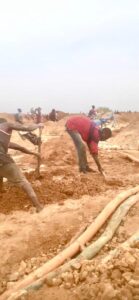 NAN reports that illegal and artisanal mining operations have caused over 200 deaths in the last decade.
In 2024–2025, a surge in incidents, especially in Niger, Plateau, and Zamfara States, killed more than 100 people in single events, often driven by heavy rain and poor safety protocols.
Observers say external interests also fuel illegal and artisanal mining.
A recent report by the Renevlyn Development Initiative (RDI) titled Silent Conquest:
The Chinese infiltration of Nigeria’s Solid Minerals Sector showed heavy Chinese interests in the nations precious mineral belts.
The report connected granular field-level events to broader patterns of national security risk, environmental decline, and governance failures.
Philip Jakpor, Executive Director of RDI, said that the local communities, especially the unemployed youths were only victims of a system that only extracted their wealth and gave them nothing in return.
He said such youths got involved in artisanal mining to also benefit from what God had given them.
“In the process, many get maimed or buried in the mining pits while the external forces behind the illegal mining activities escape liability and continue to smile to the banks,’’ he said.
Recall that stakeholders in the solid minerals sector in 2024 called for the payment of 10 per cent benefits to host communities as part of measures to build an environment that would ensure peaceful coexistence between miners and indigenes.
This is just as they proposed a 10-year renewable mining lease instead of the 25 years as captured in Section 66 of the Solid Minerals Mining Act 2007.
These demands were tabled for deliberations at the public hearing of repeal and enactment of a bill titled, “Nigeria Mineral Development Company Limited (Establishment) Bill 2023,” organised by the House of Representatives Committee on Solid Minerals.
Speaking at the hearing, Jakpor, who represented Renevlyn Development Initiative, lamented the health risk of mining activities owing to environmental degradation and the lack of proper care for miners in host communities.
“We suggest an upward review of the extraction net value revenue that goes to the Community Development Association; 10 per cent is recommended and this should be reviewed periodically.
“The duration of a mining lease is 25 years and shall be renewable every 24 years as captured in Section 66 of the Solid Minerals Act.
“The 25-year mining lease arrangement is too long and leaves room for operators to get away with impunity at a huge cost to the nation; instead, a 10-year mining lease is proposed to compel operators to be more responsive and accountable for their actions.
“The community development agreement should be flexible to allow the host community to determine exactly what they want to use the funds for without tying it to a particular line item.
“Their needs may change depending on the situation; hence the agreement details should not be open-ended,” he said.
The representatives of the Environmental Defenders Network and the Nigerian Geological Survey Agency faulted the bill on the ground, saying that it gave too much power to the minister.
“The bill gives too much power to the minister; other ministries relevant to the subject including the Ministry of Environment should be involved,” they said.
Ms Lumun Feese, who represented the Nigerian Economic Summit Group, said that in spite of enacting new laws to sanitise the sector, much had not been achieved concerning revenue to the government and improved standard of living for Nigerians.
“The mining sector’s impact on the economy remains suboptimal, hovering below one per cent of Gross Domestic Product by 2015.
“In 2016, the government approved an industry roadmap aimed at enhancing the sector’s role as an economic driver, targeting a three per cent GDP contribution by 2025.’’
He commended the committee for initiating the bills to address the staggering decline of mining, even as he called on the Federal Government to make deliberate efforts to promote good governance in the sector.
“This call is similar to the government’s successful approach in the oil and gas sector demonstrated through the Petroleum Industry Act, 2021 to implement the Nigerian oil and gas policy.
“The PIA overhauled the institutional, legal, and regulatory framework for the oil and gas industry, establishing two regulatory agencies and fully commercialising the Nigerian National Petroleum Company Limited,” he said.
On his part, the Chairman of the committee and member representing Karu/Keffi/Kokona Federal Constituency, Nasarawa State, Jonathan Gbefwi, said the proposed law would go a long way to sanitise the industry.
“We need a heavy rod in the mining sector; we need a vehicle where the government can be a player in the mining sector.
“A situation where five per cent of whatever is extracted will be given to host communities. If this is achieved, Nigeria will experience astronomical growth,” he said.
For critical stakeholders, addressing the menace and loss of lives in Plateau’s illegal mining entails a concerted approach—formalisation, strict regulation, and community-based safety initiatives.(NANFeatures)
Edited by Chijioke Okoronkwo
***If used, please credit the writer and the News Agency of Nigeria.







The World Health Organisation (WHO) says drug-resistant bacterial infections kill about one million people globally every year, calling for coordinated action across human, animal, food and environmental sectors to curb the growing threat.
Jean-Pierre Nyemazi, Acting Director of the AMR Department at WHO Headquarters, said this at a virtual media conference marking an exhibition at the European Parliament on AMR and its human impact.
The virtual conference preceded the exhibition, “AMR: The Human Stories Behind a Silent Pandemic,” being held at the European Parliament from 28 September to 2 October and featuring stories of people affected by AMR across Europe.
“AMR is taking many lives. One million people die every year due to drug-resistant bacteria alone – that is, two people every minute die of bacterial AMR,” Mr Nyemazi said.
He said the scale of deaths meant that AMR should no longer be treated as a “silent pandemic”, stressing that “we know what works” to prevent and control the threat.
“Preventing infections is the number one priority. This can be done through better vaccination, infection prevention and control, Water, Sanitation and Hygiene (WASH), and improved animal husbandry,” he said.


“All of these work and can prevent AMR.”
Mr Nyemazi said strengthening surveillance, responsible use of antimicrobials, access to quality medicines and diagnostics, and reduction of environmental contamination could also make a difference.
“The tools exist, and the evidence is there, but the cost of inaction is rising. The longer we delay action, the higher the cost becomes,” he said.
He said the One Health approach, which recognises the links between human, animal, plant and environmental health, was essential because drug-resistant pathogens could move across sectors and borders.
According to him, parliamentarians have a critical role in ensuring that national AMR commitments are supported by legislation, financing and accountability.
“The media also plays an indispensable role. Journalists help bring AMR out of scientific circles and into public debate,” he said.
“They raise awareness, combat misinformation, and ensure that AMR remains visible to decision-makers and the public alike.”
He said WHO Member States approved an updated Global Action Plan on AMR at the World Health Assembly in May, providing a framework for combating AMR over the next 10 years through a One Health approach.
Mr Nyemazi said the updated plan placed stronger emphasis on prevention, governance, behavioural change and measurable targets, and that the four Quadripartite organisations developed it jointly.
He said the organisations comprised the Food and Agriculture Organisation (FAO), United Nations Environment Programme (UNEP), WHO and World Organisation for Animal Health (WOAH).
“What is new about the updated Global Action Plan on AMR for the next 10 years is that it is truly multi-sectoral – a genuine One Health plan.
“The previous plan was heavily focused on human health; this time the four Quadripartite organisations worked together and engaged all sectors,” he said.
Mr Nyemazi said a 10 per cent reduction in AMR was achievable through infection prevention and control, vaccination and improved access to quality antimicrobials, with better coordination, education and surveillance capable of delivering further gains.
He also called for investment in new antibiotics, antifungals, phage therapy and other technologies, while stressing the need to preserve existing medicines.
He said there was also a major access problem, with many regions unable to obtain even existing antibiotics.
A member of the European Parliament, Martin Häusling, said excessive antibiotic use in food-producing animals was contributing to the problem, particularly through mass treatment.
“When it comes to food-producing animals, we still use far too many last-resort antibiotics, and we must get away from that,” Mr Häusling said.
He said AMR was a global issue that could affect anyone, adding that it could destroy families and livelihoods.
To tackle it, the parliamentarian said it was important to create public awareness so that parliaments could address the issue properly, adding that the issue was still not taken as seriously as a future challenge should be.
Rob Purdie, an AMR survivor and member of the WHO Task Force of AMR Survivors, said his experience demonstrated the consequences of delayed diagnosis and treatment.
Mr Purdie said an infection that began with a headache eventually progressed to fungal meningitis after he received antibiotics for a condition that had not been properly diagnosed.
READ ALSO: Four Super Eagles stars who could decide Nigeria’s AFCON Qualifier against Guinea-Bissau
He said he eventually spent about $250,000 on hospital costs and had been unable to work for about five years.
“My ability to earn a living was eliminated for about five years in a single-income household where I provided for my wife and two children,” he said.
Mr Purdie said his experience underscored the need to keep AMR visible in public discussions.
“That is why it is so important for those of us who have survived and can speak, to remove the word ‘silent’ from the ‘silent pandemic’,” he said.
(NAN)
Discover more from Premium Times Nigeria
Subscribe to get the latest posts sent to your email.

-

 News1 day ago
PLASU Opens Doors to Global Investors at 2nd Inaugural Lecture
-
News2 days ago
Plateau Specialist Hospital Celebrates Nigeria at 66, Salutes Mutfwang’s Health Initiatives
-
News2 days ago
Nigeria At 66: Rotjimwa Yilyok Salutes President Tinubu, APC Leadership and Plateau Government
-
News2 days ago
Nigeria’s data protection agency’s revenue surges over ₦12b as compliance expands – Technology Times


