Connect with us

News

ALFRED DAPAL DAMIYAL (ADD): AN EXPERIENCED CONTENDER FOR PLATEAU 2027

info

Published

on

FB IMG 1778184934520.jpg

A SEASONED LEADER WITH PROVEN CAPACITY

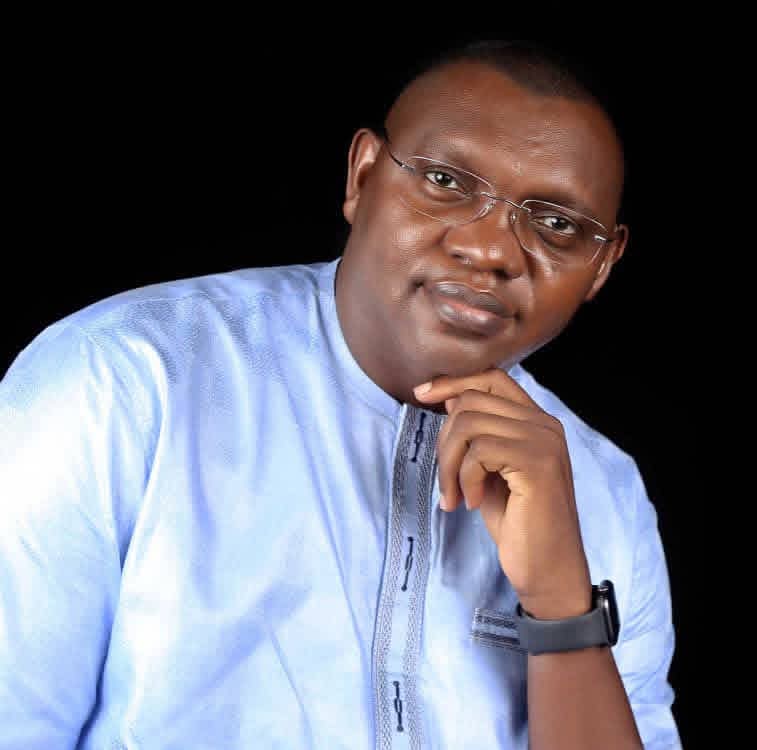
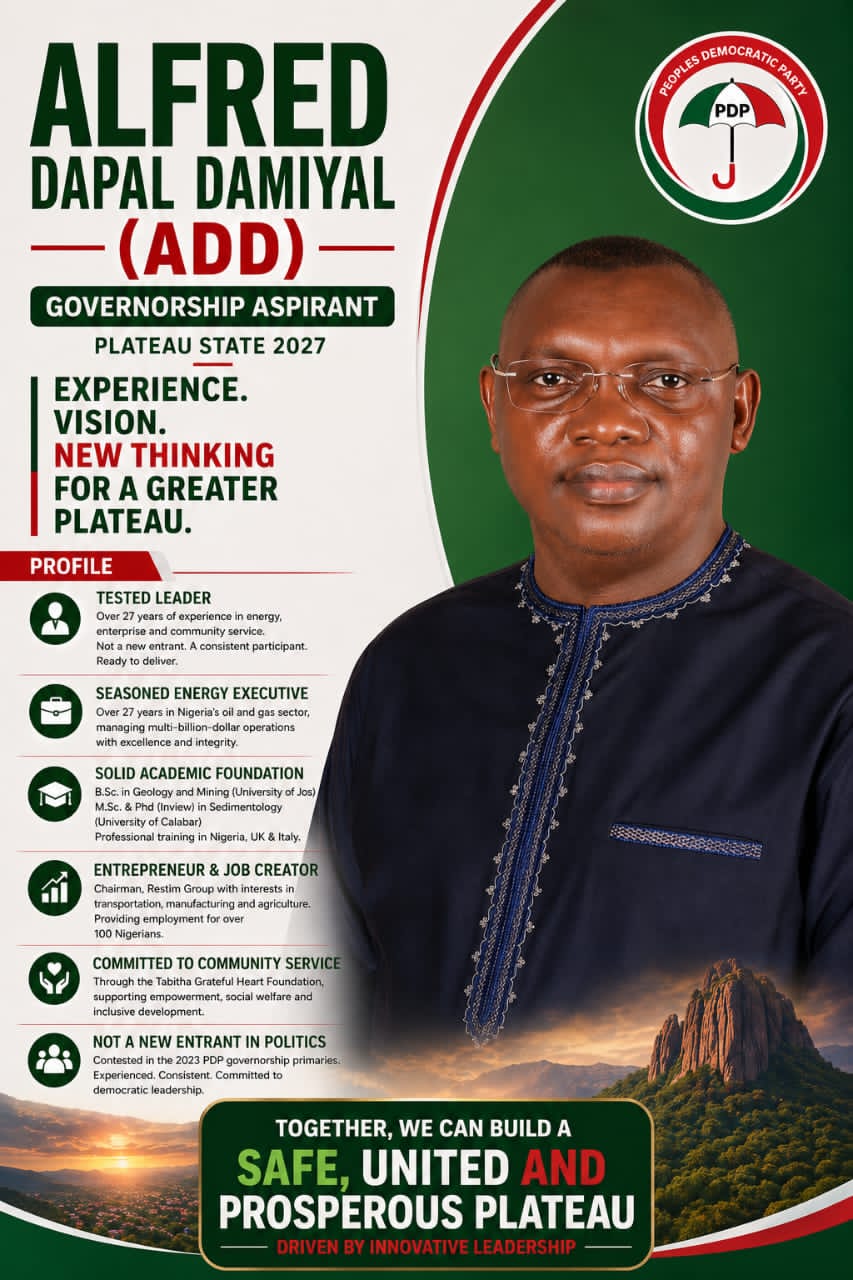
Alfred Dapal Damiyal (ADD) is a seasoned energy executive, entrepreneur, and reform-driven political leader with more than 27 years’ experience delivering results in Nigeria’s oil and gas sector. His career demonstrates a consistent pattern of leadership, technical competence, and strategic decision-making in complex environments.
With this depth of experience, he brings a practical understanding of governance, resource management, and institutional coordination qualities increasingly seen as essential for addressing Plateau State’s evolving challenges.

ROOTED IN HERITAGE AND GUIDED BY VALUES

Born on September 10, 1971, in Mangun, Plateau State, ADD comes from the respected family of His Royal Highness, Da Ali Dapal Damiyal, the late Mishkaham Mwaghavul. His upbringing was shaped by strong values of discipline, integrity, and service principles that continue to define his approach to leadership and public life.
A committed Christian and member of the Church of Christ in Nations (COCIN), he is married to Mrs Patricia Dapal, and they have four children. His personal life reflects stability and a strong sense of responsibility, which he extends into his professional and public engagements.

STRONG ACADEMIC AND PROFESSIONAL FOUNDATION

ADD’s academic journey demonstrates a strong foundation in science and technical expertise. He began his early education at Baptist Primary School in Mangu and later attended Gindiri Boys Secondary School, where he obtained his Senior Secondary Certificate Examination (SSCE). He holds a B.Sc. in Geology and Mining from the University of Jos, as well as an M.Sc. and a PhD (in view) in Sedimentology from the University of Calabar.
In addition to his formal education, he has undertaken specialised training in petroleum exploration, production, and management in Nigeria, the United Kingdom, and Italy. This combination of academic depth and international exposure has shaped his analytical approach to problem-solving and policy thinking.

A CAREER DEFINED BY RESPONSIBILITY AND RESULTS

Throughout his career, ADD has held senior roles in Nigeria’s oil and gas industry, managing high-value operations within joint-venture frameworks and complex regulatory environments. His experience includes overseeing multi-billion-dollar projects, ensuring compliance, and driving efficiency in demanding environments.
Colleagues and industry observers often note his ability to balance technical precision with strategic oversight, which translates well into governance and public administration.

ENTREPRENEURSHIP AND ECONOMIC CONTRIBUTION

Beyond his corporate career, ADD has demonstrated a strong commitment to enterprise development. As Chairman of the Restim Group, he leads a diversified portfolio spanning transportation, manufacturing, and mechanised agriculture.
These ventures have created employment for over 100 Nigerians from diverse backgrounds, contributing to livelihoods and local economic activity. His involvement in agriculture and small-scale industry reflects a practical understanding of the challenges and opportunities in Plateau’s economy.

COMMITMENT TO COMMUNITY SERVICE AND SOCIAL IMPACT

ADD’s engagement extends beyond business and professional life into community service. Through the Tabitha Grateful Heart Foundation, he has supported initiatives to assist vulnerable populations, promote empowerment, and encourage inclusive development.

This aspect of his work highlights a broader commitment to social responsibility and the belief that leadership should translate into tangible improvements in people’s lives.

NOT A NEW ENTRANT: A CONSISTENT PARTICIPANT IN THE DEMOCRATIC PROCESS

ADD is not a new entrant in Plateau politics. He actively participated in the 2022 governorship primaries under the Peoples Democratic Party (PDP), demonstrating both his interest in public service and his willingness to engage through established democratic processes.
His continued involvement reflects persistence, experience, and a growing familiarity with the political landscape. It also signals a long-term commitment rather than a one-time ambition.

A CLEAR AND PRACTICAL VISION FOR PLATEAU

As a governorship aspirant for 2027, ADD presents a reform-oriented agenda anchored in his guiding philosophy of NEW THINKING, a call for more deliberate, proactive, and people-centred governance.
His vision focuses on addressing key areas critical to Plateau State’s development, including:
Strengthening security through coordinated institutional action and community engagement
Driving economic growth through diversification, agriculture, and enterprise support
Expanding employment opportunities, particularly for young people
Promoting transparency, accountability, and trust in governance
Building unity and cooperation across Plateau’s diverse communities
His approach emphasises not just policy formulation, but effective implementation and measurable outcomes.

CONCLUSION: EXPERIENCE, CONSISTENCY, AND READINESS TO LEAD

Alfred Dapal Damiyal (ADD) stands at the intersection of professional experience, entrepreneurial capacity, and political engagement. His background provides him with both the technical understanding and leadership exposure required to navigate the complexities of governance.

As Plateau State looks toward 2027, his profile presents a combination of experience, consistency, and preparedness qualities that position him as a serious contender in the conversation about the state’s future.

#Sponsoted
Continue Reading
Click to comment

Leave a Reply

Your email address will not be published. Required fields are marked *

Business

How I was denied entry into South Africa – BUA Chair

info

Published

on

By

698593853 1587804786682612 6725165405484876293 n.jpg

The founder of BUA Group, Abdul Samad Rabiu, said South African authorities denied him entry because his visa expired a day before his arrival in 2025, while Europeans were reportedly allowed into the country without visas.

The business mogul disclosed his travel experience while speaking at the Africa CEO Forum titled “Africa at Scale: Capital, Policy, and the Architecture of Growth” on Thursday in Kigali.

The billionaire said he returned to Lagos after waiting at Cape Town airport for hours, noting the experience as part of the challenges faced by Africans in Africa.

“I had a personal experience. Last February, I was travelling to Cape Town for the Mining Indaba. And as we landed, I left at night from Lagos to Cape Town. We arrived at 6 in the morning.

“As we arrived, we went to immigration. I tendered my passport, and the immigration officer looked at it and asked, ‘Where is your visa?’ and I said, ‘My visa is there.’ Unknown to me, my visa had expired the day before.

PT WHATSAPP CHANNEL

“Unfortunately, our crew did not check the visa to ensure the visa was valid. We were there for four hours, but at the end of the day, I had to turn back. I was turned back to Lagos,” he said.

According to the BUA Group chairman, passengers from three international flights, most of whom were Europeans, were allowed into Cape Town without visas.

The businessman said he understood why he was denied entry, but noted that allowing foreigners from other continents into South Africa without visas while restricting Africans from entering did not sit well with him.

“But the issue is, while we were waiting to see whether we would be able to get access to the countries without visas, there were three international flights from Europe. All three flights were mostly Europeans.

“I was standing there by the immigration desk, and every passenger on those three flights went into Cape Town without any visa. I do not have a problem with the fact that I was there without the visa and I was returned. I took full responsibility for that,” he said.

“I had an issue with being an African in Africa, being turned away because I did not have a visa, while foreigners from other continents were coming in and were allowed to enter without a visa. This must change,” he said.

Lack of cooperation

Mr Rabiu said there is a lack of cooperation among African countries, which affects the movement of Africans and also frustrates business expansion from one country to another on the continent.

Giving another instance, he said some countries lack the spirit of agreement on the continent, noting that their practices were not supportive when the BUA Group tried to expand into those countries.

“At BUA Group, as we expanded our regional investment, we actively sought to supply several African markets under the African Continental Free Trade Area framework.

“While some countries embraced the spirit of agreement, others were less supportive in practice, with administrative barriers and legacy import structures limiting our ability to participate fully in regional trade.

“So really, AfCFTA is not working as it should. Because I had a personal experience in one of the countries that we tried to penetrate, we were actually frustrated,” he said.

The BUA Group chairman said the experience underscores a broader challenge facing Africa, noting that although the African Continental Free Trade Area framework was created to integrate African markets, implementation across the continent remains inconsistent.

According to him, true integration is what transforms potential into economic scale, with the AfCFTA serving as a key driver through its market of more than 1.4 billion people across 55 countries.

ALSO READ: South Africa relaxes visa rules for Nigerian tourists, business persons

He described the AfCFTA as one of the world’s most ambitious integration initiatives, stating that “its promise is clear: intra-Africa trade, regional value chains, and industrial scale that no single economy can achieve alone. Its potential does not deliver outcome, execution does.”

Africa’s transformation

Mr Rabiu said Africa’s next phase of transformation largely depends on five areas: capital, policy, infrastructure, value addition, and integration.

According to him, Africa needs capital to finance ambition, policy to enable execution, infrastructure as the foundation of growth, value addition to unlock the full value of its resources, and integration to unlock scale and fully drive its next phase of transformation.

“Let me start with capital. Across the continent, institutional capital is expanding—pension funds, sovereign wealth funds, and increasingly sophisticated private investment vehicles, yet infrastructure financing remains far below potential.

“The reality is clear: Africa is not short of capital; it is short of coordinated, mobile capital deployed at scale. We must unlock cross-border capital flows, harmonise investment frameworks, strengthen project preparation, and expand risk-sharing mechanisms for both domestic and international investments.

“Deepening capital markets is equally critical; cross-border listings, interoperable settlement systems, and expanded local currency trade are not merely technical reforms; they are strategic infrastructure,” he said.

He said segmented legal frameworks, overlapping approvals, and inconsistent enforcement continue to raise the cost of investment across many regions in Africa, describing them as structural constraints on growth.

“What is required is clear and transparent rules, predictable enforcement, and coordinated industrial strategies across borders. Alignment does not compromise independence; rather, it strengthens economic performance,” he added.

He reiterated that infrastructure is important to Africa’s growth, noting that no economy can industrialise without systems that power growth, including reliable energy, efficient ports, modern rail networks, quality roads, and digital connectivity.


Continue Reading

Business

Nigeria’s Inflation Rate Rises to 15.69% in April 2026 – NBS

info

Published

on

By

Images 6.jpeg

BY NKECHI NAECHE-ESEZOBOR—The National Bureau of Statistics (NBS), has said that Nigeria’s headline inflation rate increased to 15.69% in April 2026, when compared to 15.38% recorded in March.

This was contained its Consumer Price Index (CPI) Report April 2026.

According to NBS report Consumer costs continued to increase across key sectors of the economy, even though the pace of monthly price growth slowed and remained lower than levels recorded in the same period last year.

The NBS noted that the year-on-year movement reflects ongoing pressure from elevated food costs, higher energy expenses, and continued disruptions in supply chains.

It noted that on a month-on-month basis, the Headline inflation rate in April 2026 was 2.13%, which was 2.05% lower than the rate recorded in March 2026 (4.18%).

“This means that in April 2026, the rate of increase in the average price level was lower than the rate of increase in the average price level in March 2026.”

Urban inflation was recorded at 15.40 percent, while rural inflation stood higher at 16.36 percent, with food prices rising by 16.06 percent year-on-year, though lower than 24.68 percent in April 2025 due to changes in the cost of major staples.

Core inflation, which excludes volatile food items and energy costs, stood at 15.86 percent in April 2026, significantly lower than 26.05 percent recorded in the corresponding period of the previous year.

The post Nigeria’s Inflation Rate Rises to 15.69% in April 2026 – NBS appeared first on Business Today NG.

Continue Reading

Trending