Health
“We Can Finally Start Again” — 300 Riyom Households Received ₦100,000 and Relief Support After Devastating Attacks


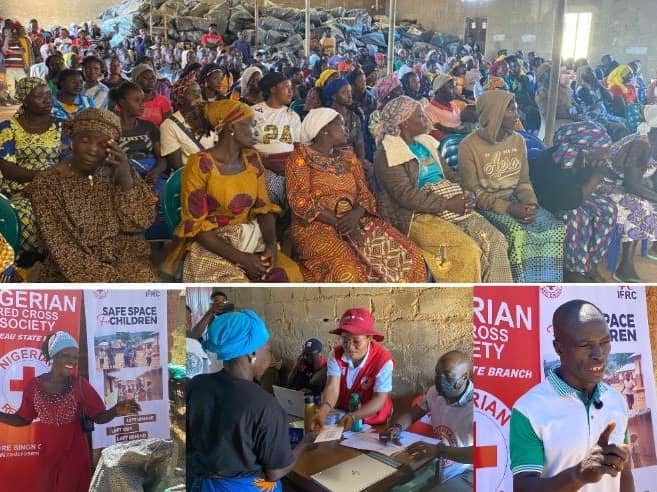
More than 300 households in Riyom Local Government Area of Plateau State have received ₦100,000 cash and essential relief materials from the Nigerian Red Cross Society (NRCS) in collaboration with the International Federation of Red Cross and Red Crescent Societies (IFRC) to help them rebuild their lives after recent violent attacks displaced many residents.
The relief flag-off, held on Monday, November 10, was both emotional and hopeful as displaced families gathered to receive items including mats, mosquito nets, blankets, aqua tabs for water purification, cooking utensils, buckets, soap, and ATM cards preloaded with ₦100,000 each.


Representatives from the Red Cross, security agencies, traditional leaders, and local government officials were present at the event, which many described as a “fresh beginning” for affected families in the area.

In his welcome address, Rev. Davou Daka, a member of the Community Resilience Corps Committee, expressed gratitude to the Red Cross and its donors, noting that their support came at a time when many households were struggling to survive. “You have given us hope again,” he said.

Speaking on behalf of the Red Cross, Plateau State Training Officer, Mr. Mafeng Mark, emphasized that the intervention was purely humanitarian. “The purpose of this support is to help people pick up again, reintegrate into the society, and decongest camps. We are neutral and serve without discrimination. This is our little way of alleviating human suffering,” he stated.
He further appealed for continued support from well-meaning Nigerians and the government, acknowledging that access to some communities remains difficult due to insecurity and poor network connectivity.


Representing the security agencies, the Divisional Police Officer (DPO) assured residents of ongoing efforts to restore peace in Riyom. “We appreciate this intervention and promise to do our best to safeguard our communities. But we need your cooperation — when you see something, say something,” he urged.

Traditional ruler of Riyom, His Royal Highness Dara Samuel Jok, the Gomre of Riyom, thanked the Red Cross for their compassion, describing the support as a “pathway back home.” “No matter how poor your house is, it is still your home. The Red Cross has given us a way to rebuild. Let’s protect what we’ve received and ensure peace returns,” he said.

The acting Disaster Management Officer of the NRCS Plateau branch, Mr. Yusuf Ibrahim, revealed that beneficiaries were selected through community-based volunteers who identified the most affected households. “The greatest joy is seeing smiles return to people’s faces,” he added.

Chairman of Riyom LGA, in his goodwill message, expressed mixed emotions — sorrow for the losses suffered and gratitude for the lifeline provided. “We are not happy about what brought us here, but today gives us hope to start again,” he said. “Riyom has one of the highest numbers of displaced persons in Plateau, and this support means a lot to us.”
The distribution ceremony also featured dance performances, children’s poems, and a symbolic naming gesture — as community leaders gave the visiting donors indigenous names “Simi” (Love) and “Fel” (Thank You) in appreciation.


For many residents, the gesture represents more than aid; it’s a chance to begin rebuilding. One beneficiary, Kangang Samson, shared that she plans to use the funds to settle her son’s hospital bills. “During the attack, my son was badly burned. This money will help me pay the remaining ₦50,000 and still cover his school fees,” she said.


Another widow, Chundung Danladi, whose children were killed in the violence, said through tears of gratitude, “This ₦100,000 is the first money I’ve received since the attack. May God bless the Red Cross for remembering us.”


Others, like Envou Markus and Tep Bitrus, said the intervention would help them return to farming and rebuild their livelihoods. “The Red Cross is selfless — they came to our aid even though they have no ties to us,” Bitrus remarked.


As Riyom slowly recovers from its painful past, one message echoed through the crowd — a renewed determination to heal, rebuild, and move forward together.




The World Health Organisation (WHO) has expressed hope that the Ebola outbreak in the Democratic Republic of the Congo (DRC) can be contained, despite confirmed cases of Bundibugyo virus disease surpassing 10,000.
The optimism comes as data released by the DRC’s Ministry of Public Health on Tuesday put confirmed cases at 10,060, with 4,887 deaths, according to a report by Al Jazeera.
The outbreak, declared on 15 May, is the largest and deadliest Ebola epidemic recorded in the DRC.
It is also the second-largest and second-deadliest Ebola outbreak globally, behind the 2014–2016 West African epidemic, which recorded about 28,600 cases and more than 11,000 deaths.
Reasons for hope
In a post on his official X account on Tuesday, Mohammed Janabi, the WHO Regional Director for Africa, said the rising figures reflected the toll the outbreak had taken on families and communities but noted that progress in recovery, research and response efforts offered reasons for hope.
Mr Janabi said more than 2,600 people had recovered, while new vaccine and treatment candidates were advancing through clinical trials.


He added that laboratory testing, treatment capacity, infection prevention and control, community engagement and surveillance were being strengthened to help contain the outbreak.
“Our teams are on the ground, working side by side with the government and partners to stop transmission and save lives,” he said, calling for sustained commitment, community trust and solidarity, as well as safe access to affected communities.
Spread beyond the DRC
The rising figures come amid growing concerns about the spread of the virus beyond the DRC, with Kenya and Nigeria reporting infections linked to the wider outbreak.
PREMIUM TIMES reported last week that Kenya had recorded nine confirmed cases, including two deaths, after the virus was introduced by a traveller who arrived from the DRC through Uganda.
Nigeria also confirmed its first Ebola case in more than a decade on 20 October, after a woman who had travelled from Uganda tested positive in the Federal Capital Territory (FCT).
In a subsequent report, PREMIUM TIMES reported that the Africa Centres for Disease Control and Prevention (Africa CDC) was investigating a possible link between the Nigerian case and the infection recorded in Kenya.
Both patients travelled through Entebbe International Airport in Uganda on 3 October, prompting investigations into whether they had shared equipment or had other contact. However, health officials have stressed that a direct connection between the infections has not been established.
Nigeria’s health minister, Muhammad Pate, later said genomic sequencing showed that the viruses detected in Nigeria and Kenya differed by only one mutation. He cautioned, however, that the finding did not establish where the Nigerian patient contracted the virus.
Contact tracing challenges
According to the Al Jazeera report, about 80 per cent of new cases in the DRC are occurring outside the known chains of transmission being monitored by health authorities.
This means many infections are being detected among people whose exposure to previously confirmed cases has not been established, complicating efforts to identify contacts and interrupt further transmission.
The Africa CDC has said at least 95 per cent of cases must be linked to known contacts of infected people for an outbreak to be considered under control.
Vaccine research underway
The absence of an approved vaccine against the Bundibugyo strain remains another major challenge in the response.
PREMIUM TIMES reported on Friday that the World Health Organisation (WHO) had announced the commencement of the Tumaini clinical trial in Bunia, eastern DRC, to assess potential vaccines against the strain.
READ ALSO: Ebola: Nigeria has no active case after patient’s evacuation — WHO
The trial began with the vaccination of its first participants on 23 October and is expected to evaluate several vaccine candidates, including Ervebo, which is licensed against a different Ebola virus species, as well as experimental candidates being developed by Moderna and the University of Oxford in collaboration with the Serum Institute of India.
The trial is intended to establish whether the candidates can safely generate an immune response and protect against the Bundibugyo virus. Their effectiveness against the strain has not yet been established.
The development follows an earlier WHO recommendation, reported by PREMIUM TIMES in August, that Ervebo be prioritised for a clinical trial after preliminary animal studies suggested it might offer some cross-protection against Bundibugyo virus disease.
Discover more from Premium Times Nigeria
Subscribe to get the latest posts sent to your email.

The Nigeria Centre for Disease Control and Prevention (NCDC) has revealed that its decision to pay ₦100,000 weekly to people quarantined over possible exposure to Ebola was an unplanned, temporary measure introduced on compassionate grounds after some threatened to leave the facilities.
The NCDC Director-General, Jide Idris, disclosed this on Monday during an appearance on Channels Television’s Politics Today, explaining that the agency introduced the payments to address concerns raised by quarantined contacts who said their absence from home was affecting their families and businesses.
Mr Idris said the authorities had taken affected people out of their normal environments for public health reasons, making it necessary to consider their welfare while ensuring they complied with quarantine measures.
“Those people who were in the quarantine area, there are people who never planned to be there. We took them out of their comfort zones to put them there for public health reasons,” he said.
Mr Idris said the agency had taken responsibility for their feeding and accommodation but faced complaints from some quarantined contacts who said they had families to support and businesses to run.
He said some threatened to leave the facilities because of the disruption to their daily lives, a development he described as a potential public health concern.
“If you allow them to leave the place, it’s a public health issue because you don’t know whether they will turn positive or who is ill,” he said.
Mr Idris explained that the financial support was introduced to ease tensions and encourage affected people to remain in quarantine for the period health authorities require.
He said the arrangement was temporary and had not been part of the agency’s original budget.
“It’s a temporary thing because it’s not something we’ve done,” he said, adding that the government had to intervene because the expected support from state governments was not forthcoming.
State governments’ responsibilities
Mr Idris said state governments were responsible for providing quarantine facilities and the resources needed to manage people placed under public health restrictions.
He said the NCDC stepped in to address the immediate welfare concerns of the quarantined contacts because the necessary support had not been provided.
The agency’s intervention, he explained, was intended to prevent people from leaving designated facilities before completing the required monitoring period.
Nigeria’s Ebola response
PREMIUM TIMES earlier reported that the NCDC approved a weekly allowance of N100,000 for each person quarantined following possible exposure to Nigeria’s confirmed Ebola patient in the Federal Capital Territory (FCT).
Speaking on Channels Television on Monday, Mr Idris said the number of identified contacts had increased to 54 after authorities traced an Uber driver who transported the patient to the first hospital where she sought treatment.
The contacts include healthcare workers, the patient’s husband, domestic staff and personnel involved in collecting samples.
They are being monitored for 21 days after their last possible exposure, in line with Ebola’s incubation period.
Nigeria confirmed the imported Ebola case on 20 October, its first since the 2014 outbreak. The patient, a 42-year-old Ugandan-born woman living in Abuja, was subsequently evacuated to Switzerland alongside her husband.
The woman is receiving treatment in Geneva, while her husband, who had shown no symptoms, remains in isolation in Zurich.
Following their evacuation, the World Health Organisation said Nigeria had no remaining confirmed Ebola cases, noting that contact monitoring and other public health measures continue.
Discover more from Premium Times Nigeria
Subscribe to get the latest posts sent to your email.
-

 News3 days ago
Troops rescued 70 abductees, recovered N10 million ransom: DHQ
-
News3 days ago
Plateau Activates Ebola Preparedness Measures, Urges Residents to Observe Safety Guidelines
-
Business3 days ago
CBN grants JP Morgan approval-in-principle to set up merchant bank
-
Business3 days ago
REA Ends 16 Years of Darkness in Two Kano Communities