News
Supreme Court Delays Verdict in Plateau Governorship Election Dispute

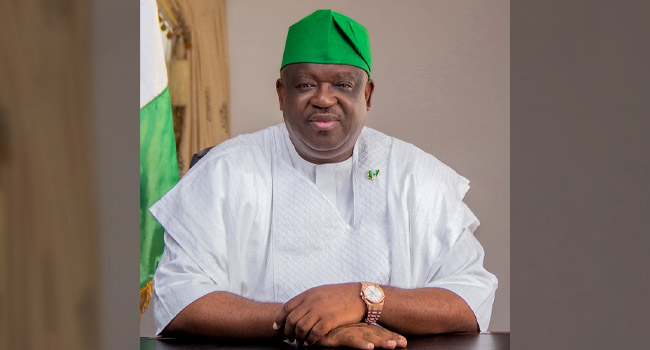








There was a mild drama live on air as Arise TV presenter, Rufai Oseni and the All Progressives Congress, APC, National Publicity Secretary, Felix Morka clashed over the remarks of President Bola Tinubu in Kaduna and Nigeria’s economic conditions.
The heated argument started when Oseni questioned Morka about the current state of Nigeria’s economy under the administration of President Tinubu.
Responding, Morka defended President Tinubu’s remarks at a campaign rally in Kaduna, insisting that there was nothing wrong with what the President said.
According to Morka, all President Tinubu needed to do in Kaduna was show up and tell people to support him again.
Morka further stated that the Kaduna rally was not a policy summit or dialogue where President Tinubu was expected to deliver a policy speech to appease what he described as "opposition tribesmen dressed as journalists."
But Oseni insisted that Morka was dodging the real question about the hardship Nigerians are facing.
During the heated exchange, Rufai told Morka that he had yet to answer his question about the current state of Nigeria’s economy, adding that he should respond whenever he was ready to answer.
"You are yet to answer my question about the current state of Nigeria's economy. Respond whenever you are ready to answer," Rufai told Morka.
Arise TV anchor, Rufai Oseni, APC Felix Morka clash over Tinubu

The Nigeria Centre for Disease Control and Prevention (NCDC) has revealed that its decision to pay ₦100,000 weekly to people quarantined over possible exposure to Ebola was an unplanned, temporary measure introduced on compassionate grounds after some threatened to leave the facilities.
The NCDC Director-General, Jide Idris, disclosed this on Monday during an appearance on Channels Television’s Politics Today, explaining that the agency introduced the payments to address concerns raised by quarantined contacts who said their absence from home was affecting their families and businesses.
Mr Idris said the authorities had taken affected people out of their normal environments for public health reasons, making it necessary to consider their welfare while ensuring they complied with quarantine measures.
“Those people who were in the quarantine area, there are people who never planned to be there. We took them out of their comfort zones to put them there for public health reasons,” he said.
Mr Idris said the agency had taken responsibility for their feeding and accommodation but faced complaints from some quarantined contacts who said they had families to support and businesses to run.
He said some threatened to leave the facilities because of the disruption to their daily lives, a development he described as a potential public health concern.


“If you allow them to leave the place, it’s a public health issue because you don’t know whether they will turn positive or who is ill,” he said.
Mr Idris explained that the financial support was introduced to ease tensions and encourage affected people to remain in quarantine for the period health authorities require.
He said the arrangement was temporary and had not been part of the agency’s original budget.
“It’s a temporary thing because it’s not something we’ve done,” he said, adding that the government had to intervene because the expected support from state governments was not forthcoming.
State governments’ responsibilities
Mr Idris said state governments were responsible for providing quarantine facilities and the resources needed to manage people placed under public health restrictions.
He said the NCDC stepped in to address the immediate welfare concerns of the quarantined contacts because the necessary support had not been provided.
The agency’s intervention, he explained, was intended to prevent people from leaving designated facilities before completing the required monitoring period.
Nigeria’s Ebola response
PREMIUM TIMES earlier reported that the NCDC approved a weekly allowance of N100,000 for each person quarantined following possible exposure to Nigeria’s confirmed Ebola patient in the Federal Capital Territory (FCT).
Speaking on Channels Television on Monday, Mr Idris said the number of identified contacts had increased to 54 after authorities traced an Uber driver who transported the patient to the first hospital where she sought treatment.
The contacts include healthcare workers, the patient’s husband, domestic staff and personnel involved in collecting samples.
They are being monitored for 21 days after their last possible exposure, in line with Ebola’s incubation period.
Nigeria confirmed the imported Ebola case on 20 October, its first since the 2014 outbreak. The patient, a 42-year-old Ugandan-born woman living in Abuja, was subsequently evacuated to Switzerland alongside her husband.
The woman is receiving treatment in Geneva, while her husband, who had shown no symptoms, remains in isolation in Zurich.
Following their evacuation, the World Health Organisation said Nigeria had no remaining confirmed Ebola cases, noting that contact monitoring and other public health measures continue.
Discover more from Premium Times Nigeria
Subscribe to get the latest posts sent to your email.
-

 News3 days ago
Plateau Activates Ebola Preparedness Measures, Urges Residents to Observe Safety Guidelines
-
News3 days ago
Troops rescued 70 abductees, recovered N10 million ransom: DHQ
-
Business3 days ago
CBN grants JP Morgan approval-in-principle to set up merchant bank
-
News4 days ago
Agent cloud startup Daytona hits $1B valuation backed by FirstMark and a who’s who of angels