News
Nigeria telecoms market in 2026: MTN leads as Airtel surges, 5G rises and broadband expands – Technology Times

Nigeria’s mobile market is entering a new competitive phase in 2026, with market data showing MTN Nigeria strengthening its leadership, Airtel Nigeria recording the fastest subscriber growth, Globacom gradually recovering from last year’s subscriber verification shock, and T2 stabilising after years of decline.
Technology Times analysis of subscriber statistics from January to May 2026 shows the country’s four largest mobile network operators collectively added more than 7.5 million new subscriptions within five months, signalling renewed momentum in the telecoms market despite economic headwinds.
The figures by the Nigerian Communications Commission (NCC), the telecoms regulator, also reveal changing competitive dynamics, with growth increasingly driven by customer acquisition, network investments and data demand rather than regulatory adjustments that reshaped the market in 2024.
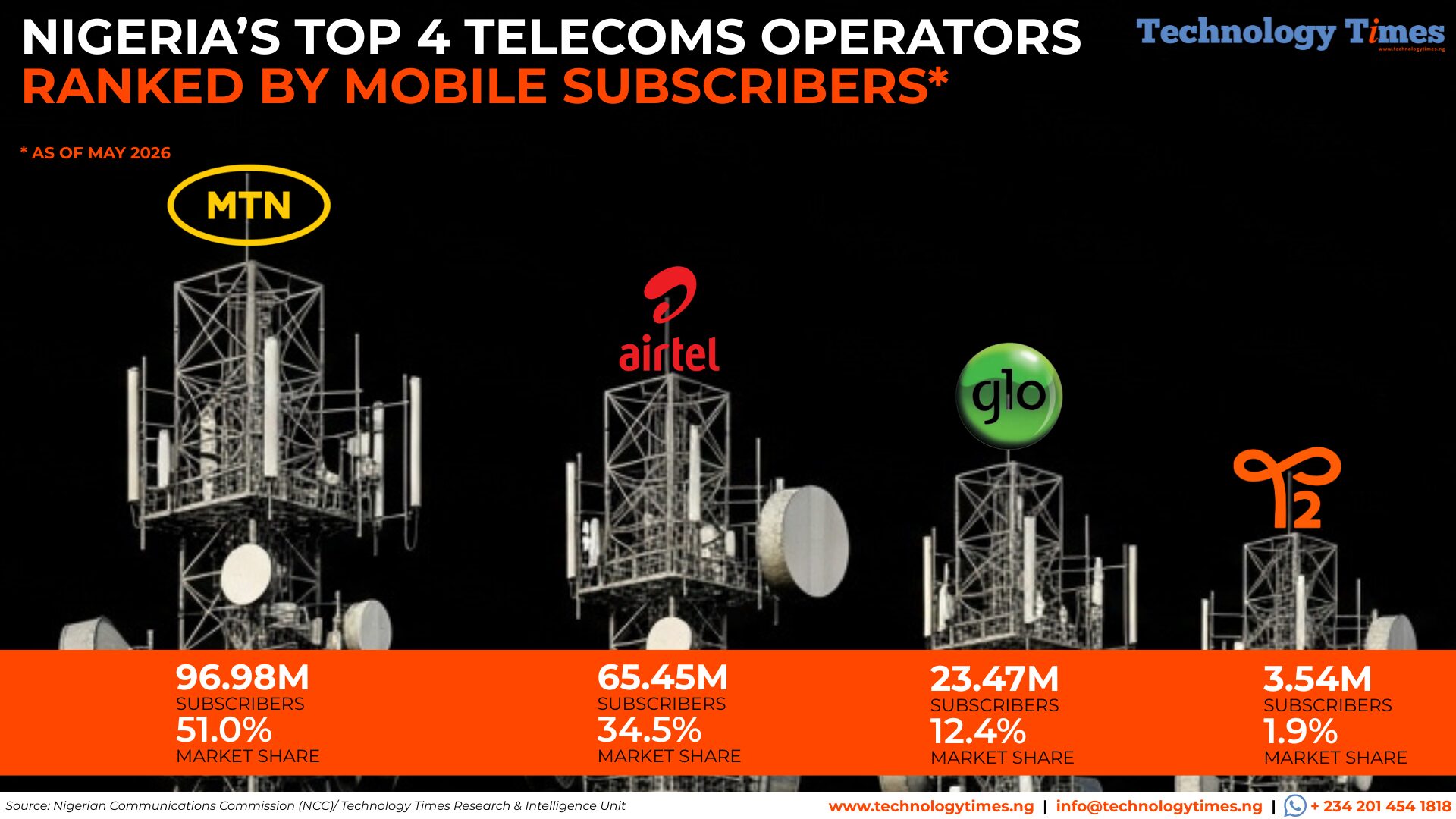

Technology Times analysis of subscriber statistics from January to May 2026 shows the country’s four largest mobile network operators collectively added more than 7.5 million new subscriptions within five months, signalling renewed momentum in the telecoms market despite economic headwinds.
Five key trends shaping Nigeria telecoms market in 2026
1. MTN Nigeria closes in on the 100 million subscriber milestone
MTN Nigeria, the nation’s largest mobile operator, continues to widen its lead over competitors. Its subscriber base grew from 94.25 million in January 2026 to 96.98 million in May 2026, representing a net gain of approximately 2.73 million customers in five months.
The steady expansion reinforces MTN’s dominance in both the voice and data markets as the operator inches closer to becoming Nigeria’s first mobile network with 100 million active subscriptions.
By May, MTN Nigeria accounted for about 51% of the combined subscribers of the four largest operators in the country.
2. Airtel Nigeria emerges as 2026’s fastest-growing operator
Airtel Nigeria recorded the strongest subscriber growth among Nigeria’s major telecoms operators during the review period. The mobile operator expanded from 62.04 million subscribers in January to 65.45 million in May, adding more than 3.4 million new customers.
The performance suggests Airtel continues to gain market momentum through aggressive network expansion, competitive pricing and increasing demand for mobile broadband services. Its sustained monthly growth also narrows the gap with MTN, strengthening Airtel’s position as Nigeria’s second-largest telecoms provider.
3. Globacom stages gradual recovery
Globacom continued rebuilding its subscriber base following the industry’s major subscriber clean-up exercise that affected the Second National Operator’s mobile unit, Glo mobile.
The operator increased its subscriptions from 22.46 million in January to 23.47 million in May, representing growth of just over one million customers.
Although the gains remain modest compared with MTN and Airtel, they indicate improving customer acquisition after the sharp market correction experienced in 2024 when regulatory audits significantly reduced reported subscriber numbers.
The figures suggest Globacom is gradually rebuilding its market position while focusing on retaining existing customers.
4. T2 shows signs of stabilisation
T2, formerly operating as 9mobile, continued to show gradual stabilisation after years of subscriber losses.
Its customer base rose from 3.26 million subscribers in January to 3.54 million by May, adding nearly 282,000 subscribers.
While its market share may appear relatively small, the positive trajectory suggests the operator has slowed its long-term decline and is beginning to rebuild its subscriber base.
The improvement follows years of restructuring aimed at restoring competitiveness in Nigeria’s mobile market.
5. Competition increasingly centres on data services
Beyond subscriber growth, the latest market trends point to an increasingly data-driven competitive landscape.
With voice revenues maturing, operators are investing heavily in:
- 4G and 5G expansion
- fibre transmission infrastructure
- digital financial services
- enterprise connectivity
- artificial intelligence-enabled customer experience
- cloud and digital platforms
Subscriber gains increasingly reflect network quality and broadband performance rather than traditional voice services, reinforcing Nigeria’s transition towards a digital economy.


Airtel Nigeria recorded the strongest subscriber growth among Nigeria’s major telecoms operators during the review period. The mobile operator expanded from 62.04 million subscribers in January to 65.45 million in May, adding more than 3.4 million new customers.
Market leaders strengthen their positions
By May 2026, the combined subscriber base of the four operators reached approximately 189.98 million.
The market distribution shows:
| Operator | Subscribers (May 2026) | Share* |
| MTN | 96.98 million | ~51.0% |
| Airtel | 65.45 million | ~34.5% |
| Globacom | 23.47 million | ~12.4% |
| T2 | 3.54 million | ~1.9% |
*Based on combined subscriptions of the four operators.
The figures illustrate a market increasingly dominated by two national players, MTN Nigeria and Airtel Nigeria, which together account for more than 85% of subscribers among the four largest operators.
What the numbers mean
Several broader trends emerge from the 2026 data:
- Market growth has resumed, with all four major operators recording subscriber gains between January and May.
- MTN remains firmly ahead, edging closer towards the symbolic 100 million subscriber mark.
- Airtel is the market’s biggest growth story, adding more subscribers than any rival during the period.
- Globacom is rebuilding steadily after the subscriber verification exercise that reshaped the market.
- T2 has halted its prolonged decline, although it remains a distant fourth player in a positive outcome of rebranding and overall transformation embarked upon by its new management.
The data also suggests Nigeria’s telecoms market is entering a more mature phase where competitive advantage will increasingly depend on network quality, broadband coverage, 5G deployment, customer experience and digital service innovation rather than subscriber acquisition alone.
As demand for mobile broadband, digital payments, streaming, cloud services and AI-powered applications accelerates, operators are expected to intensify investment in infrastructure while competing more aggressively for high-value data customers.
For Nigeria’s telecoms industry, 2026 is shaping up not simply as a year of subscriber growth, but as the beginning of a new phase in which data leadership, not just subscriber numbers, will determine long-term market success.
Nigeria’s internet market: MTN and Airtel fuel broadband boom
Nigeria’s internet market gathered fresh momentum in 2026, with the country’s four largest mobile operators adding more than six million internet subscriptions within the first five months of the year as demand for mobile broadband, video streaming, digital payments and AI-powered services continued to rise.
Technology Times analysis of Nigerian internet subscription data from January to May 2026 shows MTN Nigeria consolidating its leadership in broadband, Airtel Nigeria emerging as the fastest-growing internet provider, Globacom returning to growth after the 2024 subscriber audit, and T2 showing signs of stabilisation despite remaining a distant fourth player.
The figures also indicate that internet adoption is growing faster than traditional mobile voice subscriptions as operators intensify investments in 4G, 5G, fibre infrastructure and digital services.
By May 2026, Nigeria’s four major mobile operators served 157.02 million internet subscriptions, up from 150.91 million in January, representing a net increase of approximately 6.1 million internet connections in just five months.
Five key trends shaping Nigeria’s internet market in 2026
1. MTN remains Nigeria’s broadband powerhouse
MTN maintained its commanding lead in Nigeria’s internet market. Its internet subscriber base increased from 81.10 million in January to 83.53 million in May, adding about 2.43 million new internet users within five months.
The growth reinforces MTN’s position as Nigeria’s largest internet service provider by subscriber base, driven by continued investment in 4G expansion, 5G rollout and fibre transmission infrastructure.
With more than half of all internet subscriptions among the four major operators, MTN Nigeria remains the benchmark for broadband competition.


By May 2026, Nigeria’s four major mobile operators served 157.02 million internet subscriptions, up from 150.91 million in January, representing a net increase of approximately 6.1 million internet connections in just five months.
2. Airtel records the fastest internet subscriber growth
Airtel Nigeria emerged as the strongest growth story in Nigeria’s broadband market during the period under review. Its internet subscriber base rose from 53.57 million in January to 55.87 million in May, representing an increase of about 2.31 million users.
The operator’s sustained monthly gains suggest growing customer preference for its mobile broadband services as demand for video streaming, fintech applications, cloud services and social media continues to accelerate.
Airtel Nigeria also maintained the narrowest gap with MTN among all competitors.
3. Globacom returns to broadband growth
Globacom posted a steady recovery in internet subscriptions after experiencing sharp declines following the 2024 industry-wide subscriber verification exercise. Its internet subscriber base climbed from 15.40 million in January to 16.82 million in May, representing growth of approximately 1.41 million subscribers.
The rebound suggests Globacom is gradually regaining momentum in Nigeria’s broadband market through improved customer acquisition and retention.
Although still significantly behind MTN and Airtel, the operator appears to have restored positive growth.
4. T2 stabilises after years of decline
T2, Nigeria’s fourth-largest mobile operator, continued its gradual recovery. Internet subscriptions at the number four operator increased modestly from 843,811 in January to 802,534 in May, though the monthly figures indicate fluctuations around the 800,000 mark following years of subscriber losses.
While T2 remains a niche broadband player with less than one million internet users, the data suggests the operator has largely stabilised after an extended period of market contraction.
5. Nigeria’s broadband economy continues expanding
Perhaps the most significant trend is the continued expansion of Nigeria’s internet economy.
Total internet subscriptions increased from 150.91 million in January to 157.02 million by May 2026, reflecting growing reliance on mobile broadband for everyday digital activities.
The growth reflects rising demand for:
- AI-powered digital services
- Video streaming platforms
- Mobile banking and fintech
- E-commerce
- Remote work
- Online education
- Digital entertainment
- Cloud computing
As smartphone adoption continues to increase, internet connectivity has become the primary battleground for Nigeria’s telecoms operators.


T2, Nigeria’s fourth-largest mobile operator, continued its gradual recovery. Internet subscriptions at the number four operator increased modestly from 843,811 in January to 802,534 in May, though the monthly figures indicate fluctuations around the 800,000 mark following years of subscriber losses.
Internet market share remains concentrated
Based on May 2026 internet subscriptions, the competitive landscape remains heavily concentrated among two operators.
| Operator | Internet subscribers (May 2026) | Estimated share* |
| MTN | 83.53 million | ~53.2% |
| Airtel | 55.87 million | ~35.6% |
| Globacom | 16.82 million | ~10.7% |
| T2 | 0.80 million | ~0.5% |
*Based on the combined internet subscriptions of the four largest mobile operators.
Together, MTN and Airtel account for nearly 89% of Nigeria’s internet subscriptions, underscoring their dominance of the country’s broadband market.
What the internet numbers reveal
The 2026 internet data for Nigeria highlights several structural changes in the nation’s digital communications market:
- Internet usage is expanding steadily, with more than six million additional subscriptions recorded in the first five months of 2026.
- MTN remains the clear broadband leader, leveraging its nationwide network and continued investments in 4G and 5G infrastructure.
- Airtel is the fastest-growing broadband operator, adding more than two million internet users and strengthening its competitive position.
- Globacom is recovering, rebuilding internet subscriptions after the industry’s subscriber verification exercise.
- T2 has largely stabilised, although its market presence remains comparatively small.
Beyond internet subscriber numbers
The data also illustrates how competition is shifting from traditional voice services to digital connectivity.
As artificial intelligence, cloud computing, streaming services and digital financial platforms drive data consumption, operators are increasingly competing on network quality, broadband speeds, spectrum efficiency, fibre capacity and customer experience rather than simply adding new SIM cards.
With Nigeria pursuing ambitious digital economy and broadband penetration targets, 2026 is emerging as a defining year in which internet connectivity, not voice telephony, is becoming the industry’s primary growth engine.
Nigeria’s mobile network enters the 5G era as sun sets on 2G, 3G
Nigeria’s mobile industry is undergoing its biggest technology transition in two decades, with 5G adoption accelerating, 4G becoming the country’s dominant mobile technology, and legacy 2G and 3G networks steadily losing ground as operators modernise their infrastructure.
Technology Times analysis of technology generation data for January-May 2026 reveals a market firmly in transition. While 4G continues to carry the bulk of Nigeria’s mobile traffic, 5G is recording the fastest growth, signalling the beginning of a new era in mobile connectivity. At the same time, 2G and 3G, the technologies that introduced millions of Nigerians to mobile telephony and mobile internet, are steadily approaching the twilight of their commercial life.
The figures also underscore how operators including MTN Nigeria, Airtel Nigeria, Globacom and T2 are shifting investment towards high-capacity broadband networks to support rising demand for video streaming, AI applications, fintech, cloud computing and enterprise digital services.
Five technology trends defining Nigeria’s telecoms market in 2026
1. 4G remains Nigeria’s digital workhorse
Although industry attention has shifted to 5G, 4G remains the dominant mobile technology across Nigeria.
Its share of mobile connections increased slightly from 53.41% in January 2026 to 54.30% in May, accounting for more than one in every two mobile connections.
The figures suggest that 4G has reached maturity and continues to underpin Nigeria’s digital economy by supporting:
- Mobile broadband
- Video streaming
- Fintech services
- e-commerce
- Remote work
- Online education
- Social media
For MTN and Airtel in particular, 4G remains the principal revenue-generating network as nationwide 5G coverage continues to expand.
2026 verdict: Rising, but approaching maturity.
2. 5G is Nigeria’s fastest-growing mobile technology
The biggest technology story of 2026 is the rapid expansion of 5G. Its share of total mobile connections increased from 3.94% in January to 4.49% in May, continuing a remarkable upward trajectory from just 0.13% in mid-2023.
Although still representing less than 5% of total mobile subscriptions, 5G has become the fastest-growing access technology in Nigeria.
The growth reflects:
- Expansion of MTN’s 5G footprint
- Airtel’s continuing 5G rollout
- Increasing availability of affordable 5G smartphones
- Growing enterprise demand
- Rising data consumption
For operators, 5G is less about replacing 4G immediately and more about enabling high-capacity applications including AI, cloud computing, smart manufacturing, IoT and immersive digital services.
2026 verdict: The technology whose sun is rising fastest.


Perhaps the clearest evidence of technological change is the continuing decline of 3G. Its market share fell from 5.67% in January 2026 to 5.10% by May, continuing a downward trend that has persisted for several years.
3. The sun is setting on 3G
Perhaps the clearest evidence of technological change is the continuing decline of 3G. Its market share fell from 5.67% in January 2026 to 5.10% by May, continuing a downward trend that has persisted for several years.
Once the technology that introduced Nigerians to mobile internet, 3G is steadily becoming obsolete as subscribers migrate to faster LTE and 5G networks.
Globally, many operators have already begun shutting down 3G networks to reuse spectrum for newer technologies, and Nigeria appears to be following the same trajectory.
2026 verdict: The sunset has clearly begun.
4. 2G refuses to disappear, but its decline is unmistakable
Despite being nearly three decades old globally, 2G still accounts for more than one-third of Nigeria’s mobile connections. Its share declined modestly from 36.97% in January to 36.12% in May 2026.
The figures highlight one of Nigeria’s unique telecoms realities: millions of subscribers, particularly in rural communities, still rely on basic feature phones for voice calls, SMS and mobile money services.
For operators, maintaining 2G remains important because it supports:
- Rural connectivity
- Low-cost handsets
- Machine-to-machine communications
- Legacy enterprise applications
However, the long-term trend is unmistakable.
The technology’s share has fallen dramatically from nearly 60% in 2023 to just over 36% today, indicating that Nigerians are steadily migrating to smartphones and broadband-enabled devices.
2026 verdict: The sunset is gradual but irreversible.
5. Nigeria is becoming a broadband-first telecoms market
Taken together, 4G and 5G now account for nearly 59% of all mobile connections, compared with roughly 43% two years ago.
This represents one of the fastest technology migrations in Nigeria’s telecoms history. The implications extend far beyond faster internet.
Broadband networks increasingly underpin:
- Artificial intelligence services
- Digital banking
- E-government
- Telemedicine
- Online education
- Video conferencing
- Cloud computing
- Smart city applications
For telecoms operators, future competition will increasingly revolve around broadband quality rather than voice coverage.


The 2026 technology mix signals a structural transformation in Nigeria’s telecoms market. The era when operators competed primarily on voice coverage is ending. Instead, the competitive battleground is shifting towards high-speed broadband, low-latency connectivity and digital platform services.
How the four major operators are positioned
Although the technology-generation data is aggregated across the industry rather than broken down by operator, subscriber and internet market figures suggest distinct competitive positions.
MTN Nigeria
- Maintains the largest 4G and 5G customer opportunity.
- Leading nationwide 5G deployment.
- Well positioned to monetise enterprise digital services and AI-driven applications.
Airtel Nigeria
- Recording the strongest subscriber growth.
- Expanding 5G while strengthening its 4G footprint.
- Likely to remain MTN’s closest challenger in broadband.
Globacom
- Focused on rebuilding its subscriber base.
- Opportunity lies in accelerating migration of legacy users to 4G services.
- Needs stronger participation in the emerging 5G market.
T2
- Continues stabilisation after years of decline.
- Faces the biggest challenge in funding next-generation network expansion.
- Could target niche enterprise and digital service segments as the market evolves.
The technologies rising and those fading
| Technology | 2026 Trend | Market Outlook |
| 5G | ▲ Fastest growth | Sun rising rapidly |
| 4G | ▲ Continues expanding | Dominant technology for the next several years |
| 3G | ▼ Steady decline | Sun setting quickly |
| 2G | ▼ Gradual decline | Sun setting slowly but remains relevant in rural Nigeria |
What the numbers mean
The 2026 technology mix signals a structural transformation in Nigeria’s telecoms market.
The era when operators competed primarily on voice coverage is ending. Instead, the competitive battleground is shifting towards high-speed broadband, low-latency connectivity and digital platform services.
The data points to three defining realities:
- 4G remains the backbone of Nigeria’s mobile broadband economy.
- 5G is emerging as the industry’s next growth engine, attracting the bulk of new network investment.
- 2G and 3G are entering their sunset years, with operators expected to gradually repurpose spectrum from legacy networks to support expanding 4G and 5G services.
For MTN, Airtel, Globacom and T2, the race in 2026 is no longer simply about acquiring more subscribers. It is increasingly about migrating customers to faster networks capable of supporting Nigeria’s rapidly expanding digital economy, where broadband connectivity has become the foundation for AI, fintech, cloud computing and next-generation digital services.
Editor’s note: The internet subscriptions graphic has been updated to correct the figures.
Stay ahead with real-time reports, breaking news, and exclusive insights delivered directly to your phone. Don’t settle for outdated information. Join TECHNOLOGYTIMES NEWS on WhatsApp for 24/7 updates.
Join Our Whatsapp Channel





The Nigeria Police Force has confirmed the arrest of a 22-year-old man, Umar Ibrahim Gandi Maradun, over a viral video allegedly showing him calling for the use of AK-47 rifles to kill Christians in Enugu and Plateau states.
Politics Nigeria reports that the suspect, a native of Maradun Local Government Area of Zamfara State, was arrested for investigation after the video circulated on social media and sparked concerns over religiously motivated violence.
In a statement issued on Tuesday, October 27, 2026, the Force Public Relations Officer, Chief Superintendent of Police (CSP) Ani Iniedu, said the Zamfara State Police Command had activated its intelligence resources to identify those involved in the incident.
The police also confirmed that the command had engaged the leadership of Jama’atu Izalatil Bidi’a Wa’ikamatus Sunnah (JIBWIS) at the national and state levels following the emergence of the video.
According to the police, the organisation disassociated itself from the alleged conduct and handed the suspect over to the authorities for investigation.
The video reportedly showed the suspect wearing JIBWIS uniform and appearing alongside pupils from two Islamic schools in Maradun: Nurul Islam Islamiya and Akidatul Sahiha Islamiya.
Preliminary findings by the Zamfara State Police Command indicated that the video was recorded on Friday, October 23, 2026, while the suspect was reportedly on his way to Aliyu Ibn Abi Thalib Mosque, where he and others allegedly provided security during Friday prayers and preaching.
The suspect was born on September 15, 2004. He reportedly attended Mualledi Model Primary School and Government Day Secondary School, both in Maradun.
He also reportedly joined JIBWIS in 2025 and recently gained admission to study Mass Communication at Zamfara State University, Talata Mafara.
The police said a comprehensive investigation had commenced and that the suspect would be charged before a competent court if sufficient evidence established an offence under applicable law.
Earlier, the Zamfara State Commissioner of Police, Bello, said the investigation would consider allegations of incitement to violence, disturbance of public peace and criminal intimidation under Sections 77, 78 and 380(b) of the Penal Code Law applicable in the state, subject to the evidence gathered and applicable law.
The police also condemned statements capable of promoting religious hatred, threatening community safety or undermining peaceful coexistence.
“The Zamfara State Police Command remains resolute in its duty to uphold the law, protect lives and property, defend the rights of all citizens without discrimination, and work with relevant stakeholders to sustain peace and security throughout Zamfara State,” the commissioner said.
The development comes as JIBWIS has publicly distanced itself from the video and condemned calls for violence against non-Muslims.
The group’s National Publicity Secretary, Sheikh Ahmad Muhammad Ashiru, stated this in a statement issued at its headquarters in Jos on Tuesday.
Ashiru said the organisation had yet to establish the authenticity of the video but maintained that its position against violence was clear.
“We are yet to confirm whether the video is authentic, but our position against violence remains clear,” he said.
He added that JIBWIS, under the leadership of Ash-Sheikh Muhammad Sani Yahaya Jingir, would not support calls to attack or kill anyone because of their religious affiliation.
Ashiru said banditry, kidnapping, armed robbery and Boko Haram attacks were already affecting communities across the country, warning that statements promoting violence could heighten tensions and threaten peaceful coexistence.
“We would not support any call capable of disturbing the peace of Nigeria, as such comments are capable of inciting violence and creating unnecessary tension among Nigerians,” he said.

The JIBWIS spokesperson stressed that anyone making such statements in the organisation’s name did not represent its position.
He urged security agencies to investigate the video, establish its authenticity and identify those responsible, adding that anyone found culpable should face the law after a proper investigation.
Meanwhile, the Nigeria Police Force has urged members of the public to remain calm, avoid circulating unverified information and refrain from sharing the video in ways that could escalate religious tensions.
The Force reiterated its commitment to protecting Nigerians irrespective of religious affiliation and taking lawful action against conduct capable of inciting hatred or threatening public peace.

Senator Victor Umeh has accused Anambra State Governor Chukwuma Soludo of acting out of envy and hatred towards presidential candidate of the Nigeria Democratic Congress, NDC, Mr Peter Obi.
Umeh claimed that Soludo was trying to surpass Obi's political record, insisting that the former Anambra governor remained more popular than his successor in the state and across Nigeria.
The senator made the remarks on Tuesday while fielding questions on Channels Television's Politics Today programme.
Umeh, who said he attended the University of Nigeria, Nsukka, UNN, alongside Obi and Soludo between 1980 and 1984, suggested that their shared academic background might have contributed to what he described as peer envy.
He said, “He (Peter Obi) cannot be drawn to what is called the peer envy and hate. You know, all of us were in the university together. Myself, Soludo, Peter Obi. We were at the University of Nigeria from 1980 to 1984, all of us graduated the same day.
“So sometimes when you see people talk, they talk out of maybe peer envy. He (Soludo) is running after Peter Obi's record.”
The senator further argued that Obi remained more popular than Soludo despite the latter's position as governor of Anambra State.
“Whether he likes it or not, today, no matter what Soludo does, Peter Obi will continue to be more popular than him, both in Nigeria and in Anambra State. Go there and see,” Umeh added.
Obi served as governor of Anambra State from 2006 to 2014. Soludo became governor in 2022.
‘Envy, hate behind Soludo’s attacks on Peter Obi’ – Senator Umeh
-

 News3 days ago
Troops rescued 70 abductees, recovered N10 million ransom: DHQ
-
Business3 days ago
CBN grants JP Morgan approval-in-principle to set up merchant bank
-
News3 days ago
Plateau Activates Ebola Preparedness Measures, Urges Residents to Observe Safety Guidelines
-
Business3 days ago
REA Ends 16 Years of Darkness in Two Kano Communities