Connect with us

News

Plateau PMAN Bans Plateau Got Talent Organizers Amid Controversy

editor

Published

on

IMG 20231025 WA0026

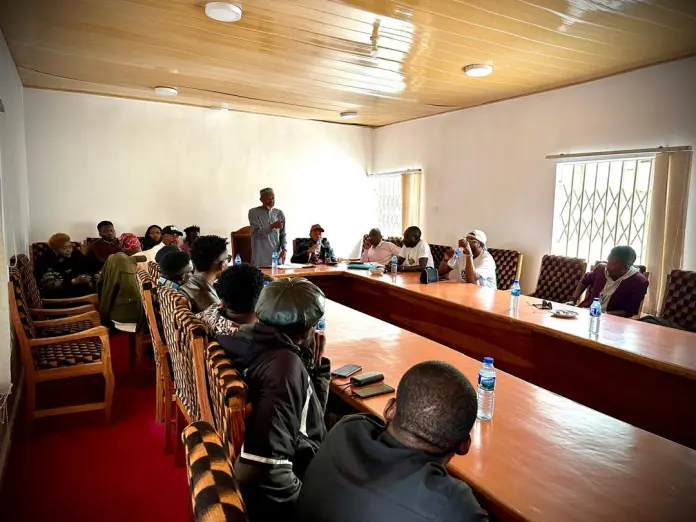
The Plateau State Chapter of the Performing Musicians Association and Employers of Nigeria (PMAN) has taken a firm stance against the recent Plateau Got Talent event, expressing deep disappointment and raising concerns over the legitimacy of the competition and its representation of the vibrant music culture that thrives within Plateau State.


The controversy surrounding Plateau Got Talent centers on its recent winner, whose abilities have come under scrutiny, calling into question the competition’s ability to identify and promote genuine talent within the state.


In response to these developments, Plateau PMAN has issued a ban on the organizers of Plateau Got Talent, COA Media, preventing them from hosting similar events until a thorough evaluation and upgrade to meet accepted standards have been undertaken and approved by PMAN.


Comrade Color Humphery Iroegbu

Governor, Performing Musicians Association and Employers of Nigeria (PMAN) made this known through a press statement issued in Jos on Wednesday 25th October and made available to journalist.


Read here:


The Plateau State Chapter of the Performing Musicians Association and Employers of Nigeria (PMAN) under the leadership of State PMAN Governor, Comrade Color Humphery Iroegbu, wishes to express our deep disappointment and profound concern regarding the recent controversial event, Plateau Got Talent.


Plateau Got Talent’s questionable winner has become a symbol of this disappointment, raising doubts about the talents that abound in the state and legitimacy of the competition and its capacity to promote and nurture true talent.


*In light of these developments, Plateau PMAN hereby bans the Organizers (COA Media) of Plateau Got Talent from holding such events pending proper scrutiny and upgrade to meet accepted standards for such events, and with the approval of PMAN.*


Plateau State is a place rich in musical history and talent, having served as the nurturing ground for some of Nigeria’s most celebrated and globally recognized musical icons, including 2baba, Mi Abaga, Ruby Gyang, Ice Prince, and many others. The state has always been renowned for its vibrant and diverse musical culture.


Unfortunately, Plateau Got Talent has fallen far short of representing the true essence of the remarkable talent that thrives within our great state. It is with a heavy heart that we, as representatives of the Plateau State music community, are compelled to denounce the recent proceedings of this talent show.


We believe that talent competitions should serve as platforms for the genuine discovery, nurturing, and promotion of our homegrown talents, giving them the recognition and opportunities they truly deserve. However, the recent events surrounding Plateau Got Talent have left us with a sense of disappointment and frustration.


This disappointment is not only on behalf of the talented artists of Plateau state but also on behalf of the broader Plateau community. The event organizers have, regrettably, missed the mark by not upholding the high standard of artistic excellence for which our state is known. Instead, they have seemingly prioritized sensationalism and profit over the genuine advancement of our local talent.


The Plateau State PMAN Chapter was taken by surprise as we had no prior notice of such an event. We have been diligently working in collaboration with the State government to create an enabling environment for entertainment on the Plateau. The union’s commitment remains unwavering, and we will not rest until such selfish and unprofessional event organizers are effectively scrutinized and removed from the Plateau’s entertainment landscape. We are dedicated to upholding the highest standards of talent promotion and representation in the state.


Comrade Color Humphery Iroegbu, the State PMAN Governor, strongly asserts that Plateau Got Talent must realign its values and reflect upon its responsibility to the Plateau State artistic community and to uphold the integrity of talent competitions in our region, just as it has in the past with the rise of music legends. The Plateau PMAN is readily available to lend our thoughts, insights and support when called upon. Our state’s rich musical history deserves nothing less than an event that nurtures and elevates the next generation of musical stars, and we hope to see the organizers and others commit to this objective moving forward.


We believe that by collectively working towards the promotion of true Plateau talent, we can create a vibrant, inspiring, and sustainable musical environment for our artists and the broader community.


Signed.


Comrade Color Humphery Iroegbu

Governor, Performing Musicians Association and Employers of Nigeria (PMAN)

Plateau State Chapter

Continue Reading
Click to comment

Leave a Reply

Your email address will not be published. Required fields are marked *

Business

How Bauchi Accountant-General Transferred State Funds to PrivateCompany – Witness

info

Published

on

By

Trial of the Accountant-General of Bauchi State, Sirajo Muhammed Jaja continued on Monday, September 21, 2026 at the Federal High Court in Abuja presided over by Justice Obiora Egwuatu with a witness revealing how Jaja diverted state funds to a private company.

Jaja is facing prosecution by the Economic and Financial Crimes Commission, EFCC ,  alongside Aliyu Abubakar, Abubakar Muhammed Hafiz, Ari Manga and Muhammed Aminu Bose, for alleged corruption.
The defendants are being prosecuted by the EFCC on an amended five-count charge ofmoney laundering, diversion of public funds, and criminal misappropriation of funds to the tune of N1,635,270,350.9 (One Billion, Six Hundred and Thirty-five Million, Two Hundred and Seventy Thousand, Three Hundred and Fifty Naira, Nine Kobo).
Prosecution counsel, Ekele E. Iheanacho, SAN told the court that the matter was for trial before calling in the first witness, PW1to testify in the court. The prosecution witness, Williams Abimbola, a compliance officer with the United Bank for Africa, UBA, said her line of duty include among others receiving requests from law enforcement agencies, responding to enquiries and any other duty assigned to her by the bank’s Chief compliance officer.
The EFCC produced the state account statement and written statement of the bank to support its claim in the court.
It is alleged that the defendants, as signatories to Bauchi State sub-treasury accounts transferred monies from the state Sub-Treasury Accounts to JASFAD Resources Enterprises managed by the first defendant, Aliyu Abubakar.
When the prosecution counsel asked the witness to explain the transaction that happened on 29 October 2024, as well as further transactions, she said, “My Lord, on the 29 of October 2024, we have three credit transfers into the account of JASFAD from the Sub-treasury Bauchi Account. We have a transfer of N13,144,500, we also had a transfer of N17,169,300, and there is a transfer of N46,030,500.
Providing details of the transactions in the account, the UBA staff said: “On the seventh of November 2024, we had a credit transfer of N17,886,250, but the teller’s details were not captured.  It just showed that transfers were made. On 15 November, we had two credit transfers transferred by order of the Sub-treasury, Bauchi Account the amount is N12,215,000 and N16,919,750 respectively.
“ On 19 November, 2024, we had another transfer by order of the sub-treasury Bauchi account for N90,373,550. On November 22,2024, we had a credit transfer from sub-treasury Bauchi account for N140,087,500. Then on 24 December, 2024, we had two credit transfers by order of sub-treasury Bauchi Account, the first one is for N24,192,000 and the second transfer is N48,892,500. On 27 December, 2024, we had two credit transfers by order of sub-treasury Bauchi account into JASFAD, the first is N335,040,000 and the second transfer is for N300,000,000.
“On the 31 December, we had two transfers by order of the Sub-treasury Bauchi Account of N14,285,527.20k. The second transfer is for N26,975,000.
On 25 February, 2025 we had a credit transfer by order of sub-treasury, Bauchi Account to JASFAD Resources of N19,840,000, and N13,020,000. On March 3, 2025, we had a credit transfer by order of sub-treasury, Bauchi account for N16,105,223.70k. On March 5, 2025, we had a credit transfer of N56,642,500. On March 7, 2025, we had a credit transfer of N45,923,790, on March 10, 2025, we had a transfer of N11,253,500. On March 12 2025, we had two credit transfer from sub-treasury Bauchi account to JASFAD Resources Enterprises, the first transfer is for N49,280,000, the second transfer is for N30,720,000, while  on March 14, 2025, we had a credit transfer by order of sub-treasury, Bauchi account of N28,262,500.
The witness informed the court that on 25 February, 2025, there were two credits from the Subtreasury Bauchi account to JASFAD Resources account

The post How Bauchi Accountant-General Transferred State Funds to PrivateCompany – Witness appeared first on Business Today NG.

Continue Reading

News

Smartphone data boom raises cybersecurity risks across Africa – Technology Times

info

Published

on

By

Internet boom.jpg

Cybersecurity experts have warned smartphone users across Africa to strengthen their digital security practices as mobile devices increasingly become the primary gateway to the internet and repositories for sensitive personal and professional information.

The warning follows a survey by cybersecurity firm Kaspersky, which found that almost 60% of respondents across the Middle East, Türkiye and Africa (META) now regard smartphones as their main devices for accessing the internet, with computers increasingly becoming secondary tools.

The survey, conducted by Kaspersky’s Market Research Centre in March 2026, covered 7,200 respondents across 18 countries. Younger users are driving the shift, with 67% of respondents aged 18 to 28 identifying smartphones as their primary internet-connected device, according to the survey.

For Nigeria, where smartphones are increasingly central to banking, social media, work and access to government services, the trend creates a larger security surface for users and organisations. Nigeria had 157 million internet users as of July 2026, with mobile devices serving as a major channel for accessing online services.

Cybersecurity experts have warned smartphone users across Africa to strengthen their digital security practices as mobile devices increasingly become the primary gateway to the internet and repositories for sensitive personal and professional information. Image credit: AI.

Kaspersky said the amount and variety of sensitive information stored on smartphones has expanded significantly as users increasingly rely on the devices for both personal and professional activities.
Personal photographs and videos remain the most common categories of data stored on smartphones, with nearly two-thirds of users keeping visual memories on their devices.
Other commonly stored information includes contact details, reported by 51% of respondents; text messages and chat histories, 45%; and personal documents such as identity cards and passports, 43%.

Smartphones hold growing volumes of sensitive data

Kaspersky said the amount and variety of sensitive information stored on smartphones has expanded significantly as users increasingly rely on the devices for both personal and professional activities.

Personal photographs and videos remain the most common categories of data stored on smartphones, with nearly two-thirds of users keeping visual memories on their devices.

Other commonly stored information includes contact details, reported by 51% of respondents; text messages and chat histories, 45%; and personal documents such as identity cards and passports, 43%.

The survey also highlighted the growing overlap between users’ personal and professional digital lives.

According to Kaspersky, 37% of respondents store work emails on their smartphones, while 22% keep calendars and 17% store credentials for corporate systems on their devices.

Financial information and login details were found on 40% of smartphones, while newer categories of digital information are also becoming part of users’ mobile data footprints.

The survey found that 30% of respondents store AI chat histories on their devices, while 26% keep gaming account information.

The findings suggest that a compromised smartphone could provide access to multiple categories of personal, financial and professional information rather than a single type of data.

“Now our smartphones serve as full-featured assistants that touch every aspect of our lives. The data we entrust to them goes far beyond photos, phone numbers or text messages,” said Anton Kivva, cybersecurity expert at Kaspersky.

“Consequently, the main question is no longer what we store, but how we protect it, requiring security to become as integral to the device as the data it carries,” he said.

Nigeria faces growing mobile security threats

The increasing dependence on smartphones comes as Nigerian cybersecurity authorities continue to warn about threats targeting mobile devices and online users.

Nigeria’s Computer Emergency Readiness and Response Team, ngCERT, and the National Information Technology Development Agency (NITDA) have issued warnings about malware threats affecting Android devices, including malicious software capable of causing data loss, financial fraud and device compromise.

ngCERT has also warned of cyber incidents affecting organisations in Nigeria, including phishing, ransomware, business email compromise and data breaches.

The risks are particularly significant as smartphones become gateways to financial services, education, employment and government platforms.

A compromised device could expose users to identity theft, financial losses, account takeover and privacy breaches, depending on the information and applications accessible from the device.

Kaspersky blocks millions of mobile attacks

Kaspersky said its security systems prevented more than 2.67 million attacks involving malware, adware and unwanted mobile software globally during the first quarter of 2026.

The company also reported discovering more than 306,000 malicious mobile application installation packages during the period.

The figures underline the scale of threats targeting mobile users as smartphones become more deeply integrated into everyday activities.

Kaspersky said many users nevertheless continue to overlook basic security measures, including regular backups, device protection and safe browsing practices.

It advised users not to keep important information in only one location and recommended maintaining backups of sensitive files, including identity documents and financial information.

The cybersecurity company also recommended using security tools capable of detecting malicious applications and phishing attempts.

Other measures include enabling automatic software updates, using screen locks and activating device-tracking features to help locate or secure lost smartphones.

Kivva urged users to regularly assess how they would respond if their devices were lost, stolen or compromised.

“When was the last time I backed up my photos or notes? What’s my plan if my phone goes missing? Do I verify links before I click them?” he said.

Mobile security becomes a digital hygiene priority

For many Nigerians, smartphones now provide a single access point to financial services, communication platforms, education, employment opportunities and government services.

That concentration of personal and professional activity makes mobile security an increasingly important part of digital hygiene.

Kaspersky’s findings point to a shift in the role of smartphones from communication and entertainment devices to repositories for identity, financial, professional and increasingly AI-generated information.

As smartphone adoption and mobile internet use continue to expand, users are being urged to strengthen basic protections, including unique passwords, multi-factor authentication, timely software updates, secure screen locks, regular backups and greater caution when opening links or installing applications.

The broader message from cybersecurity experts is that smartphones now require the same level of security attention traditionally given to computers because a single compromised device can provide access to multiple aspects of a user’s digital life.

Continue Reading

Trending