Connect with us

News

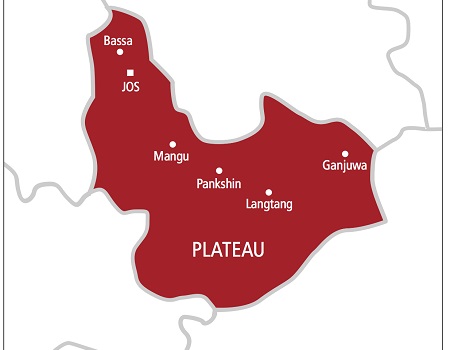
Plateau Court Sentences Two to Death for 2010 Murder

editor

Published

on

A Plateau State High Court has sentenced two men, Thomas Danboyi and Pam Lang, to death by hanging for their roles in the killing of Chung Bot.

Delivering the verdict in Jos on Wednesday, the state Chief Judge, Justice David Gwong Mann, found the defendants guilty of criminal conspiracy and culpable homicide in the case State vs. Thomas Danboyi & Pam Lang (Charge No. PLD/J112C/2010).

He said the  offences were punishable under the Penal Code Law of Northern Nigeria, 1963 (then applicable to Plateau State).

According to the prosecution, led by the Plateau State Attorney General and Commissioner for Justice, P.A. Daffi and a team of lawyers, the crime occurred on April 26, 2010, at Tahai Gyel Bukuru in Jos South Local Government Area.

The prosecution had told the court that the victim, Chung Bot, and his family had gone to their farmland in Ta Hei, Gyel, to cultivate when they were attacked by the accused persons with other persons (now at large).

Evidence presented before the court revealed that the first accused, Thomas Danboyi, restrained the victim by holding his hands behind his back while the second accused, Pam Lang, repeatedly struck Bot on the head with a stick.

It was learnt  that the victim was later rushed to the Plateau Hospital, Jos, where he succumbed to his injuries while receiving treatment.

The court found both defendants guilty beyond a reasonable doubt, leading to their conviction.

According to Justice Mann, the evidence before the court was “overwhelming” and that the prosecution through its witnesses and Exhibits tendered “established, beyond any reasonable doubt, that the defendants conspired to commit this crime and intentionally caused the death of the victim.”

Following their conviction, their counsel both pleaded that the court to temper justice with mercy, being that the convicts are responsible family men and had been of good conduct in the course of their trial.

Justice Mann exercised his discretion only in respect of the criminal conspiracy by handing out the sentence of three years imprisonment.

However, on the offence of culpable homicide, Justice Mann handed over the mandatory sentence, which is the death penalty as he had no discretion to reduce the penalty.

The case has drawn significant attention, given its prolonged duration since the crime was committed in 2010.

The judgment is seen as a strong statement against violent crimes and resort to self-help by the public in Plateau State and reinforces the commitment of the judiciary to ensuring justice is served.

Legal experts note that the convicts still have the right to appeal the judgment to the Court of Appeal and Supreme Court as the case may be. However, unless a higher court overturns the verdict, the sentence will be carried out as prescribed by law.

Continue Reading
Click to comment

Leave a Reply

Your email address will not be published. Required fields are marked *

Business

Court Restrains NAICOM from Revoking Universal Insurance License

info

Published

on

By

BY NKECHI NAECHE-ESEZOBOR—The Federal High Court sitting in Lagos has granted leave to Universal Insurance Plc to commence legal proceedings against the National Insurance Commission (NAICOM) and other respondents regarding the purported cancellation of the company’s operating license and the appointment of a Receiver/Manager.

This is contained in a notice signed by its Company Secretary, Chinedu Onyilimba, to Nigeria Exchange Limited, dealing members and investing public released yesterday on the trading floor.

The notice added that “In Suit No. FHC/LAG/CS/1179/2026, the court directed the regulatory body and co-respondents to show cause why an interim order staying any further action on the revocation of the insurer’s license should not be granted. To protect the company’s interest, the court explicitly restrained the respondents from taking any steps that could create a fait accompli or render the ongoing proceedings nugatory pending the determination of the application.

The case has been adjourned to 3 September 2026 for the respondents to show cause.

The company assured that it will provide updates on material developments in line with applicable regulatory requirements.

This is coming on the heels of the company’s inability to comply with the new minimum capital requirements for general business set by NIIRA Act 2025!which ended July 31st, 2026. This led to NAICOM’s  decision to revoke its operating license.

The post Court Restrains NAICOM from Revoking Universal Insurance License appeared first on Business Today NG.

Continue Reading

News

Nvidia closes in on Hugging Face acquisition

info

Published

on

By

GettyImages 2192223928.jpg

Nvidia has agreed to buy Hugging Face for $12.9 billion, The Information reported Wednesday night, citing a source familiar with the matter. Business Insider, which first reported over the weekend that Hugging Face was fielding takeover interest, reported Wednesday night that the talks — which would value the company at more than $13 billion — had not yet produced a signed agreement and could still atomize.

TechCrunch reached out earlier to both Nvidia and Hugging Face for comment, and neither has yet responded. (Nvidia’s silence is particularly noteworthy here as the company has moved quickly in the past to address reports it considers inaccurate.)

Maybe it was destined from the start. Hugging Face, founded in 2016, is one of the most popular hubs where developers share and download open-source AI models. Buying it would give Nvidia a strong foothold in the world of open-source AI, right as open-source developers are doing their level best to catch up to closed AI systems from companies like Anthropic and OpenAI.

Why would Nvidia want that? Most obviously, it comes down to protecting its dominance in AI chips, which, from the outside at least, appears increasingly at risk, even with Nvidia’s aggressive chip-release schedule. Pretty much all of the biggest closed-source AI labs (OpenAI, Google, Amazon, and Anthropic) are now in the process of building their own AI chips to lessen their reliance on Nvidia. A thriving ecosystem of open-source AI models gives customers more alternatives to those closed labs, which in turn keeps more of the market dependent on Nvidia’s hardware. That’s also why Nvidia has already poured tens of billions of dollars into building its own open-source AI models.

Should we be surprised that Hugging Face’s days as an independent outfit appear numbered? Not really. Hugging Face CEO Clem Delangue has spent much of this year publicly aligned with Nvidia’s open-source push, amid a debate that has been building for months, as Washington officials reportedly weighed restrictions on open-weight models. (After Chinese labs like Moonshot AI released systems like its Kimi K3 model that matched leading U.S. models on benchmarks while costing a lot less to run, talk of competitive and national-security concerns appeared to grow in Washington, with some critics of closed labs — like White House advisor David Sacks — suggesting the fears were being fanned by the “duopoly” of Anthropic and OpenAI.)

In an appearance on CBS’s “Face the Nation” earlier this month, for example, Delangue said Hugging Face used an Nvidia-modified version of a Chinese open-source model to defend itself after a cyberattack and pointed to a recent letter — signed by Nvidia CEO Jensen Huang and 24 other companies, including Hugging Face — urging the U.S. government to support open models rather than restrict them. In a separate CNBC interview in late July, Delangue made similar points, citing that same letter while warning that China is “clearly dominating” open-source AI.

The deal would also mark something of a comeback for Nvidia in cloud computing. Nvidia reportedly scaled back its own cloud business, called DGX Cloud, about a year ago. But according to The Information, owning Hugging Face — which already helps developers run their AI models using rented computing power — could give Nvidia a way back into that market without starting from scratch.

There’s also a financial safety net at play. Nvidia has promised to help cover the cost of tens of billions of dollars in cloud computing deals for its customers. If those customers end up not using all the computing power they signed up for, Nvidia could get stuck with it. Owning Hugging Face would give Nvidia the ability to sell that unused capacity to Hugging Face’s customers.

The price marks a huge jump from Hugging Face’s last known value. The company raised $235 million in 2023 in a funding round that valued it at $4.5 billion. That round was led by Salesforce Ventures, with money also coming from Alphabet’s GV, IBM Ventures, and Nvidia itself, among others.

This wouldn’t be Hugging Face’s first brush with an Nvidia offer, either. Hugging Face turned down a $500 million investment offer from Nvidia late last year that would have valued it at $7 billion, the Financial Times previously reported. Hugging Face said at the time it didn’t want a dominant investor that could sway its decisions.

As for why it would say yes now, one could argue that a buyout is different from taking on one giant backer — a scenario that often means ceding control while being pressured to continue growing.

Hugging Face is also still a comparatively small business by revenue in the world of AI. The Information reported it was recently generating about $150 million a year in revenue, up from roughly $100 million just two months earlier.

That growth has enabled the company to get “close to profitability,” as Delangue told TechCrunch last month. Still, a price near $13 billion would be a massive multiple for a company this size and hard to resist.

Not last, the deal would give Hugging Face access to Nvidia’s much deeper pockets just as other, AI infrastructure competitors start to get pulled into other outfits, as suggested by Stripe’s recent deal to acquire OpenRouter, a startup founded in early 2023 that helps customers select different AI models to perform different tasks depending on their needs and budget.

OpenRouter was valued at just $1.3 billion back in May during its Series B round. Stripe reportedly paid more than $7 billion to make it its own earlier this month.

When you purchase through links in our articles, we may earn a small commission. This doesn’t affect our editorial independence.

Continue Reading

Trending