News
Nigerian Railway Corporation raises alarm over renewed nationwide attacks on rail infrastructure


The Nigerian Railway Corporation (NRC) has raised concerns over renewed and coordinated attacks on rail infrastructure in some parts of the country.
The Managing Director/Chief Executive Officer of the NRC, Kayode Opeifa, raised the concern in a statement on Saturday in Lagos.
Mr Opeifa said the concern followed fresh incidents of vandalism recorded in Plateau and Bauchi states.
He described the development as disturbing and a direct attack on critical national infrastructure.
He added that the vandalism was an affront on public safety, economic growth and national security.
He said, “In one of the latest incidents recorded on May 21, a truck reportedly loaded with vandalised railway materials became stuck between Kuru and Science School in Plateau State.
“This exposed the dangerous activities of criminal elements involved in the destruction and illegal movement of railway materials.
“Similarly, along Zango in Bauchi State, between Kilometer 878 and 889, railway slippers were completely removed on both sides of a level crossing, leaving behind few disjointed rail pieces.
“The corporation warns that such acts can result in catastrophic train accidents, disruption of rail services, loss of lives and destruction of government investments worth billions of naira.”
He emphasised that railway tracks, slippers, clips, fastenings and signaling materials were critical national assets built with taxpayers’ money to facilitate transport, trade and national development.
Mr Opeifa advised that these should never be treated as scraps for illegal business.
According to him, the increasing incidents of vandalism indicate a dangerous pattern that requires urgent collective action from security agencies, state governments, traditional rulers, community leaders and citizens living on railway lines.
Mr Opeifa appealed to Nigerians to see railway infrastructure as a national symbol and a strategic economic asset that must be protected at all times.
He warned vandals, scrap dealers and individuals involved in illegal purchase, movement or destruction of railway materials to desist from such acts.
He said that anyone caught would face the full weight of the law.
He also called on security agencies to intensify surveillance and enforcement operations around railway corridors nationwide.
“Members of the public are urged to remain vigilant and promptly report suspicious activities around railway facilities,” he said.
(NAN)





News
Cross River Ikan Sports Fight Back To Beat Gateway Horns 25-19 In Showtime Bowl Series XV Flag Football

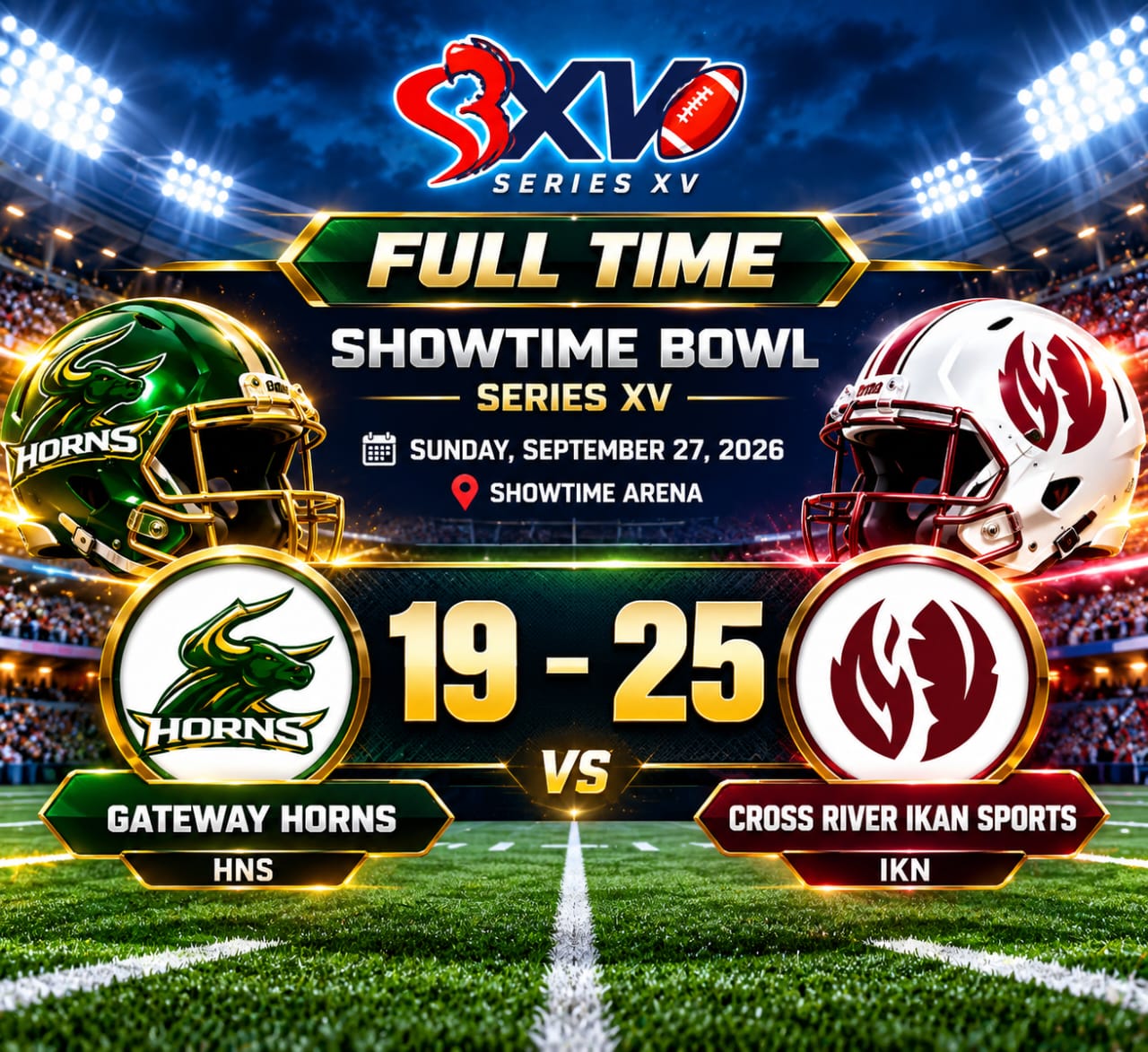
Cross River Ikan Sports bounced back from their heavy opening-week defeat with a spirited second-half performance to beat Gateway Horns 25-19 in Week 2 of the Showtime Bowl Series XV Flag Football season at Showtime Arena on Sunday.
After suffering a 56-13 defeat to Lagos Rebels in Week 1, Ikan Sports needed a response and made the perfect start when quarterback Timothy Atibile connected with Praise Miene for a 28-yard touchdown to establish a 6-0 lead.
Gateway Horns, however, gradually found their rhythm. Awosika Oluwafikunmi found Adewole Mosimiloluwa for the tying touchdown before connecting with Odimbu Awele Gift for another score. A successful extra point to Mosimiloluwa gave the Horns a 13-6 advantage.
Ikan Sports immediately hit back through one of the biggest plays of the contest as Atibile connected with Abayomi Agbayewa for a 45-yard touchdown, reducing the deficit to 13-12 before halftime.
Gateway entered the break with the narrow advantage, but Ikan Sports turned the contest around in the second half, scoring 13 points while restricting the Horns to six to complete a 25-19 comeback victory and secure their first win of the season.
Praise Miene was named Match MVP after finishing with 33 receiving yards and a touchdown, earning a 7.4 rating. Atibile also played a central role in the victory and topped the fantasy standings with 4.3 points, while Gateway quarterback Oluwafikunmi recorded 4.0.
The result represents an important recovery for Cross River Ikan Sports following their difficult Week 1 outing, while Gateway Horns will be left disappointed after surrendering a 13-12 halftime advantage.
For Ikan Sports, however, Week 2 delivered exactly what they needed — a response, a comeback and their first victory of the Showtime Bowl Series XV campaign.
-

 Business3 days ago
Gambia asks GTB, Access Bank, others to dismiss non-Gambian employees
-
News3 days ago
Everything new coming to Meta’s AI agent Muse
-
Health3 days ago
WHO expands recommended contraceptive options, backs longer-lasting methods
-
News4 days ago
America won’t allow Tinubu rig 2027 polls in Nigeria – US firm