Connect with us

News

JISRA Partners Convene Peace Town Hall in Bassa to Tackle Insecurity and Foster Religious Harmony


editor

Published

on

Bassa LGA JISRA

Jos, Plateau State — July 31, 2025:
In a renewed effort to strengthen peaceful coexistence and promote freedom of religion or belief, RURCON—an implementing partner of the Joint Initiative for Strategic Religious Action (JISRA)—convened a strategic town hall meeting bringing together key stakeholders in Bassa Local Government Area.

Held at the NBTT Hall in Jos, the meeting carried the theme: “Faith Communities Transforming Conflict Situations in Bassa LGA in Synergy with Security Actors.” The event served as a platform for critical dialogue on community conflict resolution, security collaboration, and inclusive peacebuilding.

Participants included traditional leaders, local government officials, youth and women representatives, ward and village heads, as well as leaders of local vigilante groups.
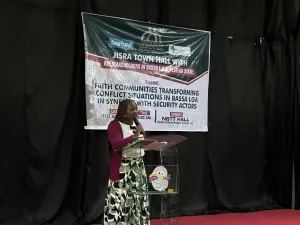

Elizabeth Onu, RURCON’s Peacebuilding Officer, stressed the purpose of the gathering as a space for transparent dialogue and solution-building.

“Town hall meetings are essential platforms for transparency, engagement, and joint problem-solving. Today’s gathering aims to unearth the root causes of conflict, give voice to marginalized perspectives, and co-create actionable solutions that can be presented to authorities at all levels,” she said.

She further emphasized that understanding the deeper roots of conflict, rather than just its surface-level symptoms, is critical to achieving lasting peace in Bassa and beyond.

Representing Bassa LGA Chairman Hon. Sunday Riti, Mrs. Grace Goler, Director of Social Services, decried the alarming rise in youth drug abuse, which she linked to local insecurity. She also made a passionate appeal for unity among Bassa’s three major chiefdoms.

“Peace cannot thrive where disunity persists. We must deliberately bridge our divides—religious, ethnic, or political—to build a more stable and harmonious society,” Goler stated.

Addressing tensions between farmers and herders, she called for mutual respect and dialogue-driven conflict resolution.

“Allowing children to herd large cattle unsupervised leads to avoidable clashes. Responsibility must be shared on both sides,” she added.

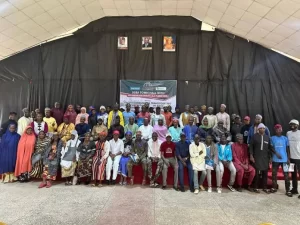
On security, Hon. Riti, through his representative, urged for better coordination of vigilante operations, calling for proper profiling and community accountability instead of retaliatory responses to incidents.

Traditional leader Ardo Bako Abubakar of Dutsen Kura praised the dialogue’s depth, noting that it spotlighted often-overlooked factors such as political exclusion and the impact of fake news.
Acting District Head of Igbak, Adik Adankanla, echoed the sentiment, applauding JISRA and RURCON for their interventions.

“The efforts of JISRA and RURCON in Bassa have begun to yield results. We must now focus on youth development and strengthening farmer-herder understanding to reduce recurring violence,” he said.

Women’s leader Laraba Sunday of Dutsen Kura advocated for healing through forgiveness and community reflection.

“We must remember the peaceful past of our communities and work intentionally to return to that path,” she said.

Moderated by Umar Farouk Musa of JNI and Dan Maren of CORP-PIN, the panel discussions emphasized early warning systems, collective security responsibility, and the importance of local ownership in peacebuilding efforts.

In her closing remarks, Tearfund Peacebuilding Officer Stephanie Taffy encouraged participants to actively apply insights gained from the town hall in their respective communities.

“We must continue to harness the momentum of advocacy to influence policies and practices that promote peace. Our collective efforts will shape a future of inclusive and resilient communities,” she concluded.

The meeting marked another milestone in JISRA’s work of bridging religious and ethnic divides, empowering grassroots actors, and building a foundation for long-term peace in Plateau State.

Continue Reading
Click to comment

Leave a Reply

Your email address will not be published. Required fields are marked *

Business

Senate Clears Customs of ₦62.2BN Under-remittance Allegation

info

Published

on

By

Images 1 1.jpeg

BY JAMES OBIOMA—The Senate Public Accounts Committee (SPAC) has officially cleared the Nigeria Customs Service (NCS) of a N62.2 billion under-remittance allegation originally raised by the Office of the Auditor-General of the Federation in its 2019 audit report.

The clearance followed an investigative session on Tuesday, 16 June 2026, during which the Comptroller-General of Customs, Adewale Adeniyi, successfully defended the Service by proving that the alleged shortfall was a misclassification of revenue by auditors.

The original query, read by a representative of the Auditor-General under the direction of SPAC Chairman, Senator Ibrahim Dankwambo, had alleged that out of N691.242 billion generated by Customs in 2017, only N629.23 billion reached the Federation Account, leaving a balance of N62.2 billion.

Defending the Service’s financial integrity, CG Adeniyi explained that the multi-billion naira deficit was completely non-existent.

“The under-remittance of N62.2 billion levelled against Customs in the 2019 audit report was wrongly arrived at through misclassification of levies collected,” Adeniyi stated. “While most of the levies are to be collected and remitted into the federation account, others like the ones on local production of wheat, textiles and wines, etc do not go into the federation account, the totality of which accounted for the alleged unremitted N62.2 billion.”

Following identical, convincing clarifications on the first three major queries, a member of the committee, Senator Babangida Hussaini, wondered why the issues had not been ironed out sooner. He noted that as a former civil servant, such straightforward technicalities should have been resolved at the preliminary audit level rather than escalating to a full Senate investigation.

The post Senate Clears Customs of ₦62.2BN Under-remittance Allegation appeared first on Business Today NG.

Continue Reading

News

Telegram ban in India sparks a rush to VPNs, rival apps

info

Published

on

By

Telegram image.jpg

As India cut off access to messaging app Telegram for a week over concerns about exam-related fraud, users turned to virtual private networks (VPNs) and alternative messaging apps in unusually large numbers.

App intelligence firm Appfigures told TechCrunch that Tuesday, the day India announced the Telegram restriction, marked the biggest day for VPN app downloads in the country since at least the start of 2025. Downloads of major VPN apps rose 49% from a recent daily average of 139,000 to 208,000, the firm said.

Proton VPN and Turbo VPN recorded some of the largest increases. Downloads of Proton VPN on Apple’s App Store in India jumped 113%, while Turbo VPN downloads rose 85%. On Google Play, downloads of Proton VPN climbed 64% and Turbo VPN downloads increased 35%. NordVPN’s App Store downloads increased 41%, while ExpressVPN downloads on Google Play rose 31%.

The surge also pushed several VPN services up India’s app-store charts. Proton VPN climbed from 18th to 5th in Apple’s Utilities rankings between June 16 and June 18, while its Google Play ranking rose from 8th to 2nd in the Tools category, according to Appfigures.

The spike in VPN demand followed India’s decision to temporarily restrict Telegram until June 22 over concerns that fraudsters were using the platform to target candidates ahead of a re-test for the National Eligibility cum Entrance Test (Undergraduate), the country’s largest entrance examination by applicant volume. The Indian government said the measure was needed to prevent the spread of fake exam papers and related scams. Telegram has challenged the order in the Delhi High Court, arguing that authorities should target specific content rather than block the entire platform.

The response extended beyond app-store download data. Proton said daily registrations from India rose 120% above baseline levels on Wednesday, after hourly registrations had already spiked 150% on Tuesday evening following the Telegram restriction. The company described the increase as “extremely noteworthy” given its existing scale in the country.

Canadian VPN service provider Windscribe reported a similar trend. The company told TechCrunch that signups from India peaked roughly 100% above baseline levels, while first-time downloads of its iOS app in the country rose about 89%.

“The spike in India follows the same general trend we see in areas that ban specific apps, introduce age bans or verification requirements, or otherwise restrict internet access,” Rebecca Rosenberg, growth operations manager at Windscribe, said.

Image Credits:Windscribe

The trend was not limited to a handful of VPN providers. Sensor Tower told TechCrunch that downloads across the VPN app category in India rose 10% day-over-day on June 17, reversing a decline seen over the previous two weeks.

Users also appeared to be exploring alternatives to Telegram. Appfigures said downloads of Signal in India rose 72% on Apple’s App Store and 322% on Google Play following the restriction, while Viber’s App Store downloads increased 216%.

Telegram-linked messaging app iMe recorded one of the sharpest jumps. Its Google Play downloads rose from a recent daily average of about 827 to 50,900 on June 16, Appfigures said.

Yet the restriction did not immediately translate into lower Telegram usage. Sensor Tower said Telegram’s daily active users in India rose 17% on the day the measure was announced — the app’s largest day-over-day increase in the country since a widespread outage of Meta’s services in 2021.

Other data points also suggest heightened efforts to access Telegram following the restriction.

Cloudflare Radar Lead Lai Yi Ohlsen told TechCrunch that DNS requests for Telegram domains in India increased sharply over the two days after the measure was announced. The company cautioned that higher DNS traffic does not necessarily indicate successful access to the platform, and could reflect users repeatedly attempting to reach Telegram after it was blocked.

Image Credits:Cloudflare

Telegram pointed to its efforts to cooperate with authorities during hearings in the Delhi High Court this week. Its lawyers said the company had removed channels identified by authorities and questioned the need for a platform-wide restriction affecting what Telegram says are over 150 million users in India.

Government lawyers defended the measure as a temporary, event-linked response tied to the NEET re-test. Solicitor General Tushar Mehta told the court that a permanent ban could raise proportionality concerns but argued the current restriction had a “logical nexus” to the objective being pursued.

After hearing arguments from Telegram and the government on Thursday, the Delhi High Court reserved its order and is expected to deliver its verdict on Friday.

The debate echoes questions raised elsewhere when governments restrict access to major online platforms. Sensor Tower said VPN downloads in the U.S. rose more than 40% week-over-week when TikTok was briefly removed from U.S. app stores in 2025, while Windscribe said it has observed similar patterns following restrictions in countries including Iran and Russia.

When you purchase through links in our articles, we may earn a small commission. This doesn’t affect our editorial independence.

Continue Reading

Trending