Connect with us

Business

IMF Revises Nigeria’s 2026 Growth Forecast Downward to 4.1%

info

Published

on

IMG 5890.jpeg

The International Monetary Fund (IMF) has lowered Nigeria’s economic growth projection for 2026 to 4.1 per cent as the economic consequences of the ongoing conflict in the Middle East continue to take a toll.

The updated forecast was revealed during the IMF and World Bank Spring Meetings held in Washington, D.C., where officials cautioned that energy and supply chain disruptions caused by the war are weakening economic recovery across the region.

IMF Chief Economist Pierre-Olivier Gourinchas explained that the downgrade highlights the wider challenges confronting countries that rely heavily on imported energy.

“For Sub-Saharan Africa, we are observing a downward revision in growth and a rise in inflation in several countries within the region,” Gourinchas stated. “The effects are largely consistent with what we are witnessing globally, particularly for nations that depend on energy imports.”

He further noted that the Fund is actively engaging with several countries to assess their needs under the current circumstances and is working closely with the International Energy Agency and the World Bank to address disruptions in the energy market.

Also speaking on the issue, Denz Igan, Chief of the IMF Research Department’s World Economic Studies Division, said the 0.3 percentage point reduction reflects multiple economic pressures.

“Higher costs of fuel and fertiliser caused by the war, along with increased shipping expenses, are expected to slow non-oil economic activities in Nigeria,” Igan said. “Although rising oil prices provide some support, the overall outlook points to slower growth in 2026, with a projected improvement in 2027.”

The IMF also forecasts that median inflation across Sub-Saharan Africa will increase from 3.4 per cent in 2025 to 5 per cent in 2026, driven by elevated oil and fertiliser prices, possible fuel supply shortages, and rising operational costs.

Regarding Nigeria, she emphasised that maintaining a tight monetary policy will be essential for meeting the inflation target set by the central bank.

Additionally, the IMF pointed out that bilateral aid to Sub-Saharan Africa declined by 16 to 20 per cent in 2025, removing an important financial cushion at a time when commodity and shipping costs are surging.

Continue Reading
Click to comment

Leave a Reply

Your email address will not be published. Required fields are marked *

Business

Finance must break developing countries from ‘debt and disaster’ loop – UN climate chief

info

Published

on

WhatsApp Image 2026 11 13 at 21.43.24.jpeg

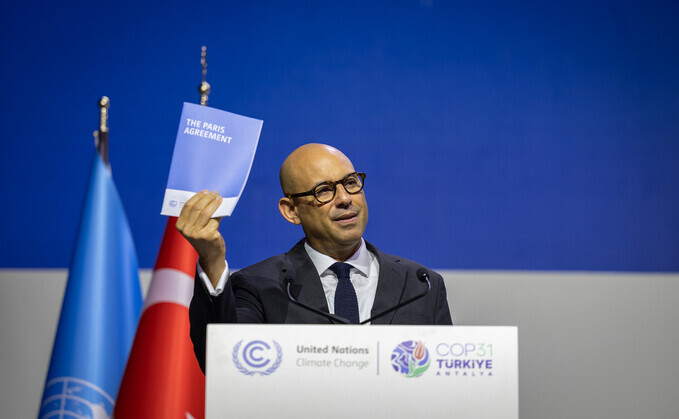
The executive secretary of UN Climate Change, Simon Stiell, told the ministers at COP31 that climate finance must be redesigned to lift developing countries out of a cycle of debt and disaster, adding that meeting a headline figure will not do it.

“Meeting a financial target does not always meet countries’ needs. To do that, we need to look at how finance is delivered,” Mr Stiell said on Friday at the opening of a high-level ministerial dialogue on climate finance in Antalya, Turkey.

Countries agreed at COP29 that developed nations would lead in providing $300 billion a year by 2035, as part of a wider effort to raise $1.3 trillion annually from all sources.

Mr Stiell said the roadmap for reaching those sums “must become reality”, but that the terms of the money mattered as much as the amount.

“Many developing countries are trapped in a downward loop of debt, disaster, and devastating capital costs,” he said. “The threat of floods, fires, storms and droughts hangs over them, pushing up the price of borrowing even before disaster strikes.”

He stated that the terms of finance should reflect each country’s debt position.

PT WHATSAPP CHANNEL
Dangote Refinery AD

“Private finance, loans and guarantees are essential to achieving our collective goals. But grant-based and highly concessional finance will remain critical, particularly for Least Developed Countries, Small Island Developing States and other very vulnerable economies,” he said.

According to him, broader action on debt is also needed to prevent countries from being forced to choose between repayments and resilience.

International climate finance for developing countries reached about $137 billion in 2024, and almost 70 per cent of it came in the form of loans, according to a UN Women flagship report released on Tuesday in Antalya.

Countries in sub-Saharan Africa paid more than twice as much in external debt service between 2021 and 2023 as they received in climate finance, according to an analysis published by the Heinrich Böll Foundation.

The analysis found that interest payments consumed more than 10 per cent of government revenue in 27 African countries in 2024.

The chair of the African Group of Negotiators, Nana Antwi-Boasiako Amoah, has said that a transition could not be called just if poorer countries have to “mortgage their futures” to pay for it.

The group lost a bid on Monday for a separate agenda item on tripling adaptation finance. It now wants the target prioritised in the summit’s cover decision.

Nigeria is not on the UN’s list of least developed countries, which places it among the states the UN climate chief expects to rely more on loans, guarantees and private capital.

It needs about $337 billion between 2026 and 2035 to implement its climate commitments, according to the National Council on Climate Change.

Omotenioye Majekodunmi, the agency’s director-general, said more than 80 per cent of that will have to come from private investment, commercial debt, and international carbon finance.

About $2.5 billion a year went to climate action in Nigeria in 2021 and 2022, counting domestic and international sources, according to the Climate Policy Initiative’s tracking.

The dialogue was the last in a series that began in 2013, and its conclusions will go to COP32 in Ethiopia next year, Mr Stiell said.


Discover more from Premium Times Nigeria

Subscribe to get the latest posts sent to your email.

Continue Reading

Business

FRSC Reaffirms Commitment to Stronger Insurance Partnerships, Better Staff Welfare

info

Published

on

The Federal Road Safety Corps (FRSC) on Thursday held its 2026 Second Bi-Annual Meeting with Corps Underwriters and Brokers,

The Federal Road Safety Corps (FRSC), has reaffirmed its commitment to strengthening insurance partnerships and improving welfare for its personnel.

It disclosed this  at the 2026 Second Bi-Annual Meeting with Corps Underwriters and Brokers, held at the FRSC National Headquarters, Abuja.

Present at the event were members of the Corps Management and representatives of insurance companies and brokerage firms.

The engagement was aimed at reviewing existing insurance partnerships, strengthening collaboration, enhancing service delivery and ensuring prompt and seamless processing of insurance claims.

Deliberations focused on promoting transparency, operational efficiency and accountability in the management of the Corps’ insurance schemes, as well as improving the welfare of personnel.

The Corps Marshal, Shehu Mohammed, who was represented by Deputy Corps Marshal in charge of Training, DCM Aboidun Akinlade.

Discussions centred on openness, streamlined operations and answerability in how the agency runs its cover arrangements, alongside better conditions for its staff.

Attendees also looked at how to strengthen the ties already in place between the FRSC and the firms that supply its cover, so that policy benefits reach officers more smoothly.

The agency restated its dedication to a professional approach, sound handling of its coverage plans and reforms driven by joint efforts that seek to make the organisation run better.

It added that continued cooperation with insurers and intermediaries is vital to improving the wellbeing of its workforce, while backing its duty of making highways safer for every Nigerian.

The post FRSC Reaffirms Commitment to Stronger Insurance Partnerships, Better Staff Welfare appeared first on Business Today NG.

Continue Reading

Trending