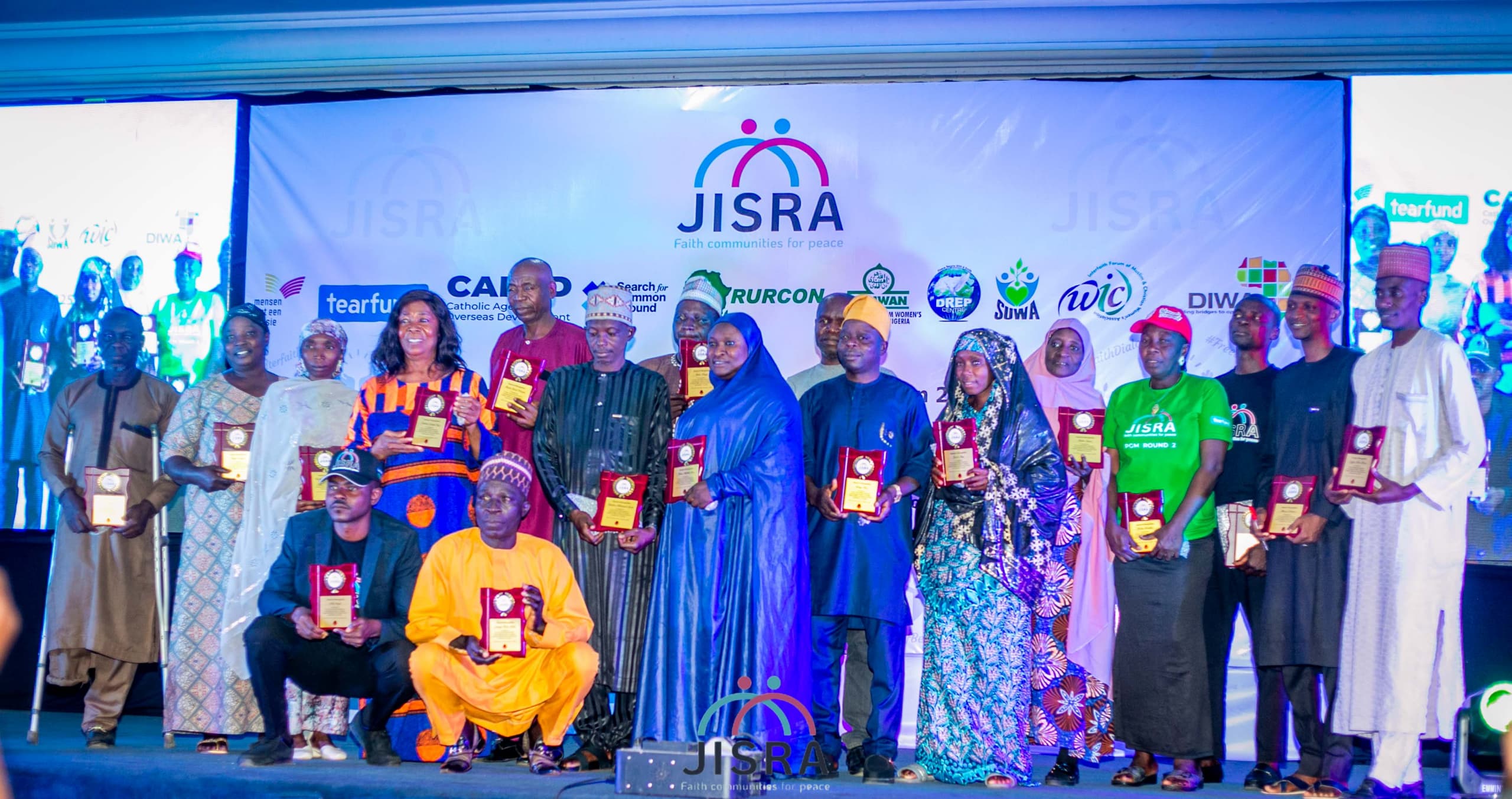
The Joint Initiative for Strategic Religious Action (JISRA) has officially closed its five-year peacebuilding programme in Nigeria, marking the end of an initiative that redefined interfaith engagement, strengthened community structures, and amplified the voices of women and youth across Plateau and Kaduna States.
The colourful close-out ceremony, held on Thursday at Novel Suites Hall in Jos, celebrated the achievements of the programme, which began in 2021 with the goal of addressing religious violence and discrimination by fostering dialogue and collaboration across faith communities.
In his opening remarks, JISRA Country Coordinator, Jude Likita, reflected on the journey of the consortium and its partners. “The journey of a thousand miles begins with a step. Together, we took that step with great support from diverse stakeholders. Today, women are stronger in traditional councils, harmful practices are giving way to positive values, and communities have maintained peace through dialogue and early warning systems,” he said.
Likita emphasized that while the programme has formally ended, its work is far from over. “Religion should never be a force of division but a tool for peace. This is not the end—it is the beginning of another chapter,” he declared.
Faith leaders commended the initiative for its transformational contributions. The Revd Dr. Gideon Para-Mallam highlighted how JISRA facilitated critical conversations on peace and security, urging citizens to take ownership of community safety. Similarly, the Chief Imam of Jos Central Mosque, Sheikh Ghazali Isma’ila Adam, praised JISRA’s practical manuals on peace promotion. “I have personally sampled the manual, and it is a practical guide to coexistence. We must extend such community engagements beyond Plateau so that other states can learn from this model,” he stated.
Beyond community engagement, JISRA also prioritized structural reforms. Reuben Emmanuel, Head of the Lobby, Advocacy, and Communication Working Group, outlined milestones in advocacy and accountability. “We now have women included in traditional councils, and communities are better equipped to advocate for themselves. Even at the state level, we collaborated with institutions to push for frameworks on state and community policing, ensuring inclusivity of women, people with disabilities, and religious leaders,” he explained. He added that JISRA also advanced Nigeria’s commitments on minority rights and religious freedom at international forums, including the United Nations’ Universal Periodic Review in 2023.
The programme’s impact extended to the media sector as well. Delivering a goodwill message, Mr. Matthew Tegha, Coordinator of the Plateau Peace Media Network, applauded JISRA for recognizing the role of the press in promoting peace. “Through the trainings and engagements facilitated by JISRA, our network has been empowered with tools to report responsibly, amplify peace narratives, and foster religious tolerance,” he said. Tegha pointed to the July 2024 three-day media workshop in Plateau and Kaduna as transformative, noting that it helped strengthen peace journalism and personally contributed to his recognition as an international Freedom of Religion or Belief fellow.
Stakeholders also affirmed that the seeds sown by JISRA would continue to thrive. Mr. Nenmak Bali, President of the Plateau Peace Practitioners Network, described the programme as a model for interfaith dialogue and peaceful coexistence. “The seeds planted through this project will continue to bear fruits long after today,” he remarked.
The event also featured awards to outstanding community representatives for their dedication to peacebuilding, symbolizing JISRA’s emphasis on inclusivity and sustainability.
The Plateau gathering followed a similar close-out event in Kaduna, underscoring the consortium’s wide reach and long-term impact.
As the curtain closed on JISRA’s five-year programme, one message resonated strongly: the initiative may have ended, but its legacy of peace, inclusion, and religious freedom is set to endure.

The political crisis within the All Progressives Congress (APC) in Katsina State has taken a new turn after Governor Dikko Umaru Radda’s Aide-de-Camp (ADC) and Chief Security Officer (CSO) were invited to the Force Headquarters in Abuja.
The development has raised fresh concerns about the growing rivalry between groups supporting Governor Radda and those loyal to Ibrahim Kabir Masari, Special Adviser to President Bola Ahmed Tinubu on Political Matters.
Sources told PRNigeria that the two officers were taken to the Force Headquarters on August 20, 2026, where they remained for questioning. The police have not publicly explained the specific reasons for the invitation.
Some sources claimed the move followed a directive from the Inspector-General of Police, Tunji Disu, over complaints linked to powerful political interests within the APC.
Recommended
However, the claim could not be independently confirmed.
The governor’s ADC and CSO handle important aspects of his personal security, making their invitation to Abuja a sensitive issue in Katsina’s political and security circles.
Sources familiar with the situation said the development should be viewed against the background of the growing struggle for political control within the Katsina APC.
According to party sources, tensions between the Radda camp and Masari’s supporters have increased in recent months, particularly over control of the party structure and its political direction ahead of 2027.
A senior APC member, who spoke anonymously, said the disagreement had moved beyond normal political competition.
“The disagreement is no longer limited to party politics. It is now affecting institutions that should remain completely insulated from political contests,” the source said.
Party stakeholders have also raised concerns about the increasing use of petitions, invitations and security investigations in settling political disagreements.
They alleged that petitions against political opponents were increasingly being used as part of internal party battles, sometimes leading to invitations or questioning before any allegations were proven.
However, the police have denied reports that the two officers were arrested over a criminal allegation.
The Force Public Relations Officer, CSP Anietie Iniedu, told PRNigeria that the governor’s ADC and CSO were invited to Abuja by the Inspector-General of Police for questioning over issues originating from Katsina State.
Iniedu said the officers were not invited over any alleged criminal offence.
He added that preliminary investigations had established that neither officer had committed a crime.
Benue State Governor, Hyacinth Alia, has rejected any attempt to allocate land in the state for ranching without the approval of his administration and the consent of the people.
Alia made the position clear on Monday during a town hall meeting with stakeholders from the Sankera bloc, which covers Katsina-Ala, Ukum and Logo Local Government Areas.
The governor’s statement comes less than two weeks after the Federal Government named Benue among the locations selected for the pilot implementation of its National Ranching Policy.
The policy, announced by the Minister of Livestock Development, Idi Mukhtar Maiha, is aimed at promoting modern livestock production and reducing the movement of large herds of cattle across communities.
Benue, Plateau, Nasarawa, Kaduna and Adamawa states, alongside the Federal Capital Territory, were identified for the initiative.
The Federal Government said the selected areas were chosen because of their history of farmer-herder conflicts. The pilot programme is expected to begin at the Wase Grazing Reserve in Plateau State.
But the announcement has triggered strong reactions in Benue.
Governor Alia has now made it clear that his administration will not permit the compulsory use of Benue land for pastoral activities.
“Nobody will force us to cede even an inch of our land to the pastoralist for any purpose. If that must happen, I can assure you, it will not be this time that I am still the governor of Benue State,” Alia said.
His comment places the state government firmly against any arrangement that would involve taking over land without local approval.
The Sankera axis, in particular, has remained one of the areas facing serious security challenges.
Communities in Katsina-Ala, Ukum and Logo have suffered attacks, killings and kidnappings over the years.
Many residents have also been forced to leave their homes and farms because of insecurity.
It was against this background that Alia announced fresh measures to improve security in the area.
The governor said three military operational units would be established at strategic locations across Sankera.
One of the units will be located in Agu, Katsina-Ala Local Government Area. Another will be stationed in Anyiin, Logo, while the third will be based in Azendeshi, Ukum.
Alia also announced that 30 motorcycles would be provided to security agencies operating in the area.
According to him, the motorcycles are expected to improve movement, patrols and the ability of security personnel to respond quickly when emergencies occur.
Armed Fulani Herdsmen
Alia said his administration would continue to take steps aimed at protecting residents and restoring confidence in communities affected by insecurity.
The governor also spoke about infrastructure during the meeting.
He announced plans for the construction of a new dam with a projected capacity of 460 megawatts.
The project, according to him, is expected to provide water and support electricity generation in the state.
The town hall meetings are being held across Benue’s 11 federal constituencies.
Benue Groups Had Earlier Rejected Ranching Plan
In a related development, Mzough U Tiv, Ochetoha K’Idoma and Omi Ny’Igede had earlier rejected the Federal Government’s proposed ranching programme in the state.
The three groups represent the Tiv, Idoma and Igede communities respectively.
At a press conference in Makurdi earlier this month, the organisations said they were not against modern ranching as an agricultural and commercial activity.
However, they opposed any plan that would impose ranches on communities without their consent.
They also called for the safe return of internally displaced persons before any major allocation of land for ranching is considered.
The groups argued that thousands of Benue residents displaced by violence are still unable to return to their ancestral communities.
They maintained that securing the affected areas and restoring displaced farmers should come before committing large portions of land to a new livestock programme.
The organisations also stressed the importance of protecting farmland and food production in the state.
Benue already has its Open Grazing Prohibition and Ranches Establishment Law, 2017, which prohibits open grazing and provides a legal framework for ranch establishment in the state.
The state government has repeatedly maintained that livestock production can be developed through ranching, but that such development must follow existing laws and respect the rights of communities.