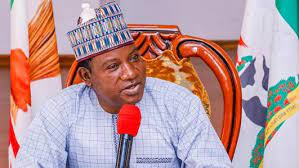
Governor Simon Lalong has debunked the allegation being made by some people that some villages have been taken over by herdsmen in the State and that the government has not done anything about it.
The Governor stated this at the interdenominational church service to commemorate the 2023 Plateau Day of Forgiveness and Reconciliation held at St. Monica’s Catholic Church in Rantya Jos.
He stated that there is no report on his table that any village has been taken over, adding that the government took proactive steps to prevent such from happening by passing and signing into law the Anti-Land Grabbing Law in 2020.
“By this law, anyone whose land has been forcefully taken is expected to write to me, his traditional ruler, the Local Government Chairman, an elected representative, or even approach the court directly for redress.
“So far, no one or any community has done so rather, some people sit here in their homes and elsewhere to engage in politics and blackmail. I want the world to know that what we have been doing is returning displaced persons who fled their homes due to attacks back to their ancestral lands.
“For example, the site for the construction of a police mobile barracks in Kakuruk, Gashish District, Barkin Local Government, has been handed over to the contractor, who will start work immediately to provide security for the people to return to their lands.
“Another village, Jong Community in Ropp District of Barkin Ladi, was returned to its abode two months ago. “Similarly, the Shonong Community in Bachit District of Riyom Local Government has also been returned to their homes,” he said.
Governor Lalong said anyone who has such a complaint should write to the government or go to court to protest such an infraction if it happens, promising that he will not spare anyone who tries to lay claim to any inch of Plateau that does not belong to him.
Governor Lalong further stated that Taraba under his watch has put behind its dark days that were characterized by violence and destruction and “is now coasting to prosperity, unity, and peaceful coexistence” as a result of the decisive actions taken by his administration “to provide a platform for the citizens to drive the peace and reconciliation process.
The governor said the people have broken down the barriers to peaceful coexistence by engaging one another and uniting against crisis merchants.
BY NKECHI NAECHE-ESEZOBOR—The National Drug Law Enforcement Agency (NDLEA), on Sunday said it has intercepted a Saudi Arabia-bound consignment of skunk concealed in a gallon of palm oil at the Mallam Aminu Kano International Airport.
It also announce search of a shipment at the Apapa port in Lagos uncovered 8,725 kilograms of powdered tramadol worth over N6.98 billion in street value.
The agency also seized thousands of kilograms of cannabis and large quantities of opioids in Lagos, Edo, Ondo, Bauchi, Kano and Kaduna states, arresting dozens of suspects, including an 85-year-old grandmother.
At the Kano airport, NDLEA officers on Friday 16th October 2026 intercepted a female passenger, Fatimah Ahmad, with a gallon of palm oil containing parcels of cannabis weighing 511.75 grams during the outward clearance of an Ethiopian Airlines flight to Jeddah, Saudi Arabia, via Addis Ababa. Fatimah told operatives the gallon was given to her by her cousin, Abubakar Yahaya, who was promptly arrested at the airport car park.
Following a joint examination with the Customs Service and other agencies at the APM terminals in Apapa, Lagos, NDLEA operatives on 2nd October uncovered a large shipment of powered tramadol from India, declared as maize starch. A confirmatory test at the NDLEA forensic laboratory showed the cargo to be tramadol hydrochloride powder. When it was separated from its concealment on Wednesday 14th October, it came to 349 bags with a gross weight of 8,725kg, worth over N6.98 billion.
In a separate operation at the Tincan port in Lagos on Monday 12th October, NDLEA officers in the course of a joint examination of a container with Customs and others, discovered 55kg of Canadian Loud worth N165 million. The drugs were packed in brown cartons and hidden inside a Toyota Sienna vehicle conveyed in the 40-foot container.
Elsewhere in Lagos, NDLEA operatives on Wednesday 14th October, raided Idumota market where they arrested Elizabeth Chidera Kalu, and recovered 10,600 ampoules of diazepam injection and 6,500 tablets of Molly from her store. The following day, Thursday 15th October, two 35-year-old men were arrested in the Mushin area of the state: Idowu Daudu, with 59.95kg of skunk, and Ahmed Oniyinde, with 61.23kg of same substance.
In another interdiction operation in Lagos, operatives acting on credible intelligence on Thursday 15th October intercepted a truck coming from Trade Fair market with illicit drug consignments along Iyana Oba. Two suspects: Tajudeen Adeduntan, the loading manager and his assistant, Azeez Sikiru.
A search of the truck led to the recovery of 18,000 pills of tramadol 250mg, concealed in cartons labelled as Rambo insecticide.
In Edo, NDLEA operatives raided Warake, Ivhiaro and Ewe/Irue communities in Owan East LGA between 15th and 16th October, arresting six suspects. They include 85-year-old Grace Ehimeka, arrested with 179kg of skunk at Warake; Ayo Aigberadion, 53, with 220.8kg at Ewe/Irue; Ali Garba, 57, with 5.852kg; Habib Braimoh, 45, with 100 grams; Musa Mubid, 35, with 2kg of cannabis, cannabis seeds, tramadol, Swinol and diazepam; and Hope Okoro, 35, with 237 grams of loud.
Acting on credible intelligence, NDLEA operatives on Saturday 17th October raided a cannabis farm in Okemoro Isinbode camp forest, Ondo State, and destroyed 7,500kg skunk on three hectares. Five suspects were arrested: Asikpo Ekpeyoung, 43; Solomon Okpani, 22; Ubong Friday, 35; Joseph Friday, 22; and Ekenimi Seth, 35. Exhibits recovered included 92 bags of skunk weighing 1,267kg, 11kg of cannabis seeds and 3kg of fresh stems, a total of 1, 281 kilograms. In Owo area of the state, operatives on Friday 16th October, trailed 53-year-old Okunebe Ndidi to his hideout in Ameyinti where they recovered 25 bags of cannabis weighing 375kg.
Not less than 894,800 pills of tramadol capsules and exol-5 tablets were recovered from
Shamsu Garba, 35, at Ragwam village, Katagum LGA, Bauchi state when NDLEA officers intercepted his Volkswagen Golf wagon car on Wednesday 14th October. The same day, operatives on patrol along the Bauchi-Gombe road recovered 291 blocks of cannabis weighing 265kg from an abandoned car at Tudun Natsira village.
In Kano, two suspects, Ali Abdullahi, 38, and Ibrahim Adamu, 23, were arrested on Tuesday 13th October, along the Zaria-Kano road, with 30,100 tablets of tramadol 225mg seized, while a 54-year-old Murtala Dayyabu was arrested at Niger Street, Malan Kato, with 100,000 tablets of Exol-5 on Wednesday 14th October.
A raid by NDLEA operatives at Kayimi village, Kaduna state led to the arrest of Mohammed Sani, 48, Zaharadeen Shafiu, 29, and Yakubu Abdullahi, 20, with 496.5kg of cannabis. In a separate raid at Food Palace, Ali Akilu Road, Kaduna, John Ayo David, 39, was arrested with 49,500 tablets of tramadol 225mg, while a 42-year-old suspect, Odo Jonas Ejike was arrested with 29,500 capsules of tramadol at Utako area of Abuja on Saturday 17th October.
With the same vigour, Commands and formations of the Agency across the country continued their War Against Drug Abuse (WADA) sensitization activities to schools, worship centres, work places and communities among others in the past week. These include: WADA enlightenment lecture to students and staff of Nawar-Ur-Deen High School, Ogboro, Oyo state; Elf Junior Secondary School, Bojude, Gombe; Cherubim and Seraphim Primary School, Ikorodu Lagos; Harmony Secondary School, Lokoja, Kogi; Government Secondary School, Ikot Ansa, Calabar, Cross River; Rivers State College of Health Science and Management Technology, Port Harcourt; Mesh International School, Benin City, Edo; and Abu Hanifa Academy, Kano Municipal, Kano state, among others.
While commending the officers and men of Apapa, Tincan, MAKIA, Lagos, Edo, Bauchi, Ondo, Kano, and FCT Commands for their professionalism and intelligence-driven approach to the various successful operations, Chairman/Chief Executive Officer of NDLEA, Brig. Gen. Mohamed Buba Marwa (rtd) urged them and their colleagues across the country to sustain the onslaught against drug trafficking networks, while continuing with the current balanced approach to the drug control efforts of the Agency.
The players sometimes change. I sat down with four of Benchmark’s partners three years ago, and three of those individuals are no longer with the firm. The capital commitments have changed, too. This summer, Benchmark announced $2 billion across two funds, marking only the second time in its 31-year history that it has veered from raising a far smaller vehicle.
But at this week’s TechCrunch Disrupt, the venture firm’s five partners convincingly portrayed a close-knit team that’s not about to put the pedal to the metal, even as many of their rivals do exactly that. The world may be speeding up, but they’re investing at the pace Benchmark always has: just two or three new bets per year per partner. The world is drowning in information, yet their Monday partner meetings still have no agenda. And while economic indicators point to trouble ahead, they don’t seem too bothered, seeing many of the warning signs as products of X-fueled hysteria.
Here’s what Benchmark’s five general partners — gathered together on our stage — had to say at the show. Some of the comments below have been edited for length and clarity; you can watch the full interview at the end of the article.
Benchmark has evolved in some ways, including a bigger core fund and a new growth fund. How do you think about adapting without losing what makes you Benchmark?
Peter Fenton: The craft that hasn’t changed is the core fund: working closely with founders at the beginning. It’s usually a 10-to-15-year commitment, [working] shoulder to shoulder, and that doesn’t scale. There’s also been inflation. We held the core fund at $500 million for 20 years, and it has just inflated to be consistent with the existing economy, which we hadn’t done and that was probably a tactical error on our part.
[As for the growth fund] it’s an expansion of our mandate. In some ways, we get permission from the ecosystem to do more than just the core early-stage business. [Not having this previously] was a fork in our eye. A number of opportunities that came to Benchmark would have returned somewhere between 10 and 1,000x to Benchmark, and we were constricted by our early-stage focus.
Are you thinking to make handful of bets with that $1.25 billion growth fund?
Fenton: We all have different answers, which is the beauty of a partnership. I’d love for us to have, as that great J.P. Morgan paper puts it, the agony and ecstasy of a concentrated portfolio. If the fund is successful, one or two investments will generate 90% of the returns. So I think it’s four to six, maybe seven to eight.
Ev, you joined Benchmark late last year. You’ve worked at Founders Fund, Bond, and Kleiner Perkins. How does Benchmark differ?
Ev Randall: Every firm is ultimately a collection of the people within the firm and how they work together. Some are very hierarchical, with a 50- or 60-person investment team and investment processes that are federated into product groups. And then you have small partnerships. Very early in my career, I was drawn to small partnerships because they allow a higher level of throughput and fidelity in your conversations, where you don’t feel like you’re making decisions through some Byzantine corporate structure. You’re going out on the field together, like a sports team.
And then the other piece is: You have to find your people, You have to find people who you not only like but admire. With Benchmark, with the current crop of GPs, it was obvious that everyone liked each other and got along, but it went deeper than that. It’s a group that admires each other and learns from each other. That mix of attributes is very rare, and when I saw it, I immediately wanted to join, and I think Jack felt the same way also as a newcomer.
Jack, you joined in February, but it was just a year ago that you raised a second, $275 million fund for your own firm in what you told the Wall Street Journal took one week. You have a hugely popular podcast. Why join Benchmark?
Jack Altman: It’s funny. I did the podcast with these guys at the start of this year, and during that podcast, obviously we talked about the commitment to being a small fund, but more than that, what I heard was that they want to be the first people who founders call, they want to be concentrated, and they just care. So much in this industry gets tied up in money and status, and what I felt from the Benchmark team then, and ten times more as I’ve gotten to know them so well, is it’s a group that really cares about founders and helping companies. And I did enjoy being an individual investor. . .but in a market this crazy, I don’t know how I’d feel, figuring it out on my own. Having a group of people who are so smart and focused and driven to learn it with and from has been awesome. There’s no better place to learn.
I’m told you meet on Mondays with no agenda.
Chethan Puttagunta: Jack tried to make an agenda. [Laughs.]
Altman: I’ve got an agenda for next Monday.
Eric Vishria: It’s weirdly arbitrary, honestly. It’s an ongoing conversation. In a time of rapid change, you’re trying to figure out what’s becoming possible that wasn’t possible six months ago, and who’s bending light. We talk about what companies we’re meeting, what piqued our interest and why, what we’re seeing in board meetings. You can try to systematize it, but one of the beauties of five people is you don’t have to. It’s a decades-long conversation that only works if you’re small and actually enjoy spending time together. After this session, we’re having dinner with one of the very few entrepreneurs who has built a multi-hundred-billion-dollar company, someone we’re not invested in, just to stretch our thinking.
Puttagunta: Part of not having an agenda is you need space to be reactive. If a founder needs help landing an executive or a strategic partnership, the five of us can be at their disposal.
You’re an equal partnership. Can one person put the kibosh on a deal?
Puttagunta: Nobody knows. We don’t have rules around it.
Altman: I actually don’t know. I was waiting to see what someone else [said].
It’s never happened?
Altman: Because the firm is structured around a low volume of deals, you don’t actually want to have all of this rigor. If we invested in 100 or 200 companies a year, you’d want a CRM and a formal voting process. Because it’s so rare, the lack of structure is a huge asset.
Fenton: One of the differentiating aspects of our brand is we’re not so cocksure to come in and say ‘winner’ or ‘loser.’ It’s not Shark Tank. We sort of feel awe, for lack of a better term, at all the possibilities . . . The occasional case where someone comes in who’s polarizing — the entrepreneurs feel that. If someone in the room doesn’t like you, we’re not a great partner.
Companies are growing faster than ever. I’d think it’s easier to feel you’re missing out on opportunities if you don’t invest with greater frequency. Have you picked up the pace?
Puttagunta: I think the pace is consistent. I think part of the reality of venture capital in our business is that we are not going to be part of every successful company, and that’s okay. There are companies that we identify, we find that the entrepreneur has some great strength, and we want to amplify that strength. And it’s our job to find a way to work with that person. It kind of doesn’t matter how much capital they want to raise, or what structure, or where they are. You just have to work through all that stuff.
One thing that founders are interested in as a trend is VCs backing competing companies. Has that VC-founder pact changed because companies are growing so quickly and expanding into one another’s territory?
Vishria: One of the things we have an ethos around is, we are making a commitment to an entrepreneur, and through that commitment, we’re saying we’re going to work with you in this thing, and whatever that thing is, and we are working closely enough where it matters, and it should matter to them, and as it matters to us. The harsh reality of this world is every company is evolving very quickly, and so you do have companies that will naturally evolve from one thing to another, or pivot or change, and you are going to get conflicts. That’s just the reality of the of the kind of current dynamic. . .
Of course, we’re maintaining confidentiality and doing those things and fortunate to not end up in in that type of insane direct conflict [as happened recently with rival companies Factory and Cognition]. . . that commitment of exclusivity in that area is really important. But things are evolving. There’s no doubt about that.
Puttagunta: And I think people are ultra ambitious in this AI era. As the cost of coding new products effectively goes to zero, founders see a surface area and they want to attack the surface area, and so I think it’s probably going to happen more, where you start to run into each other. But there’s a way to be there’s a way to maintain that relationship and be respectful.
Jack, have you made an investment for Benchmark yet, and if so, did you feel a lot of pressure with that first deal?
Altman: I have, a few, and some are recent, so not all are disclosed. My background was software, but since joining, I’ve done chips, robotics and infra. Someone asked me when I joined, ‘How was the onboarding?’ And I was like, ‘It was perfect. There was no onboarding.’ Either Chethan or Eric told me early on, ‘Hey, you’re going to feel tight on your first one. Don’t. You’re going to make many investments while you’re here. This whole game includes crazy power laws. The odds of it being your first are low.’ . . . I trusted they understood what my shape was as a person, as an investor, and I was going to just try to stay as consistent to that as I could.
It really is a group dynamic on a lot of these. The investments I’ve made, I don’t think we would have won them if I didn’t have my partners. I don’t know that I would have been able to know how to get to a yes without them.
Eric, the AI chip company Cerebras was an unusual bet for Benchmark at the time it was made. What persuaded you to move forward with it?
Vishria: We invested in the spring of 2016, in the first round. We hadn’t made a hardware investment in 10 years. The founders seemed good, they had a very simple thesis, and I didn’t understand most of the rest. On the Sunday night before they came back to pitch the partnership, Peter told me it went against everything he’d learned in venture. Then, after the Monday pitch, he had flipped. A big part of it is understanding each other’s instincts. That began a journey of lots of ups and downs and many potential deaths of the company along the way, and it’s far from over. The romanticism of falling in love with a founder and an idea is why we do this.
Fenton: Andrew and his co-founders are heretics. What they were saying was unorthodox, and you see it today, with people dumping on the stock because it’s polarizing. That’s exactly where we have to be as investors. If it’s consensus, why is there a startup?
On that point, Cerebras priced at $185 when it went public earlier this year, jumped to $350, and is back near $185. Why?
Vishria: About six weeks before the IPO, I showed the company stock chart after stock chart: CoreWeave, Datadog, DoorDash, Amazon. Peak to trough, it’s insane how many of them move 500% in a year, up and down. So who knows? You control what you can control, and you update the public markets every 12 weeks. Being a public company takes a stomach of titanium, and the employees have to understand that.
Your former colleague, Bill Gurley, long argued that the traditional IPO process is broken, that that IPO ‘pop’ benefits bankers and their clients — not the company. He’s a proponent of direct listings. Does anyone here agree with that thinking?
Vishria: I think maybe of this group, I’m the only one who’s worked on a direct listing. It can for sure make sense. I think the reality is for this crop of AI companies, it’s going to be unlikely because they need capital, and they need a lot of capital. At the end of the day, IPOs raise money. Cerebras raised $6 billion. That matters, so I think it’s probably unlikely for this crop just because most of them need capital.
Could a severe correction be coming? A lot of AI companies have exhausted their free cash flow. It’s very expensive for companies to borrow. We also just saw the first AI bankruptcy with Character AI.
Randall: Macro is always a fool’s errand to predict with precision. What has changed most since I started investing is the information environment. Character.AI was the leftover corpse of a company whose founder and team were acqui-hired into Google a year and a half ago, and it was already sold for $2.3 billion; its Chapter 11 being read as an AI chill effect shows that the info environment for public equities in tech has been drawn so much into this, like, hyperactive X echo chamber.
If you look at the market today and you see where CoreWeave and Nebius and all these things are trading, those numbers are are due to the ARR figures of two private companies that will probably be public in the next 12 months . . .There’s so much capex and there’s so much investment that runs through the estimated and projected health of OpenAI and Anthropic.
Our companies see so much demand that they can’t get enough compute to serve customers who are willing to pay them at good gross margins. There’s nothing inherently unhealthy about the AI ecosystem. What’s unhealthy is the volatility from data points that are often untrue or exaggerated for clicks. I do think OpenAI and Anthropic going public would be healthy, so the market stops swinging 5% to 10% every time an anonymous account updates an estimate.
Those two companies have also really pulled the center of gravity back to San Francisco. Do you have to be in San Francisco to be a founder now? Are you interested in companies outside of California?
Altman: I don’t know that you have to be here as a founder, but I think it is right now by far the easiest place to get talent, capital, and customers. Probably everyone [on the team] works with companies that are not in San Francisco, but we’re also here in San Francisco every day, so I wouldn’t say you have to, but I’d say: strong bias for our particular setup.
Fenton: Historically, 90%-plus percent of the capital returns have come from companies founded here. There are beautiful stories outside that dense probability distribution — Shopify is a great example, Ramp — but the ecosystem effect that occurs when you have a successful company and that leads to a background of great executives [and] ambitious people, the bar of success gets raised. I don’t think it has systemically happened anywhere quite like here.
Randall: I’m trying to think of a non-SF based company that I’ve met with in the last 18 months that wasn’t actively saying that they were spending time in San Francisco. They’ve either opening an office in San Francisco, they’re spending half of their time in San Francisco, or they’re planning to move out to San Francisco. Iron sharpens iron. If you want to be around peers who are going to make you the best version of yourself, and it’s hard to think of a city that does that better than San Francisco in the current era that we’re in now with AI here.
When you purchase through links in our articles, we may earn a small commission. This doesn’t affect our editorial independence.








 Health4 days ago