Business
Dangote retains Africa’s most admired brand title for eighth year



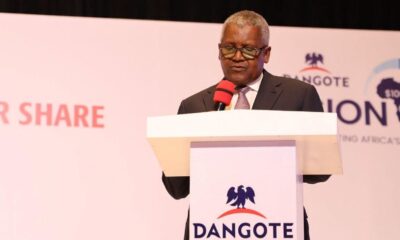
Dangote Industries Limited has emerged as Africa’s Most Admired African Brand for the eighth consecutive year, reinforcing its dominance across industrial, sustainability and social impact rankings.
The company disclosed this in a statement on Sunday, noting that the recognition was announced at the 16th annual Brand Africa 100: Africa’s Best Brands rankings, unveiled in Addis Ababa, Ethiopia.
According to the company, the survey described as Africa’s most comprehensive consumer-led brand study — covered 30 countries representing more than 85 per cent of the continent’s population and economic output.

In the latest rankings, Dangote emerged as Africa’s Most Admired Brand in aided recall, ahead of MTN and Vodacom. In the spontaneous recall category, it ranked second among African brands behind MTN and ahead of Trade Kings.
The conglomerate also retained its position as Africa’s Most Admired Industrial Brand and emerged as the leading African brand contributing to a better Africa, ahead of MTN, DStv, Shoprite/Checkers and Trade Kings.

The rankings reflect Dangote’s growing influence as one of Africa’s most recognisable corporate brands, driven by investments spanning cement, fertiliser, petrochemicals, energy, sugar, salt, packaging and logistics.
Brand Africa, however, noted that despite modest improvements in African brand recognition, indigenous brands continue to lag behind foreign competitors, accounting for only 15 per cent of Africa’s 100 most admired brands.
Speaking on the findings, Brand Africa Founder and Chairman, Thebe Ikalafeng, said strengthening African brands remains a critical economic priority for the continent.
“Converting goodwill towards African contribution into admiration for African brands is the most urgent commercial opportunity for the continent. It is not enough for Africans to believe in Africa; they must buy Made-in-Africa,” he said.
Dangote also ranked second among brands recognised for contributing positively to society, people and the environment.
 Despite the dominance of international brands across Africa, Dangote remained among the continent’s highest-ranked indigenous brands alongside MTN and Ethiopian Airlines.
The three companies emerged as the leading African brands in the 2026 rankings, which were dominated by global brands such as Nike, Adidas, Samsung, Apple, and Coca-Cola.
According to the company, African brands accounted for only 15 per cent of the top 100 rankings, compared with 38 per cent for European brands, 28 per cent for North American brands and 19 per cent for Asian brands.
Further strengthening the group’s profile, its Group Chief Branding and Communications Officer, Anthony Chiejina, was named among the inaugural Africa CMO 100 (ACMO100) list, which recognises influential marketing, branding and reputation management professionals across the continent.
The initiative, launched by Brand Africa in partnership with African Business magazine, MIPAD and the African Media Agency, honours executives shaping Africa’s business narrative and driving brand growth.
Mr Chiejina was among 20 executives selected from West Africa and one of 17 Nigerians recognised for contributions to brand building, corporate reputation management and strategic communications.
READ ALSO: Dangote cuts petrol, diesel ex-depot prices
Brand Africa said the selection process was based on independent research, industry impact, leadership influence, and contribution to the growth of brands that shape consumer perceptions and economic outcomes.
The latest recognition adds to Dangote Industries’ growing list of accolades, including its induction into the Brand Africa Hall of Fame last year for consistently ranking among Africa’s most admired brands.
Its President and Chief Executive Officer, Aliko Dangote, also received a Lifetime Achievement Award for his contributions to industrialisation and building one of Africa’s largest indigenous business empires.




A passenger has died aboard a Kenya Airways flight from Nairobi to Lagos after becoming unresponsive about 20 minutes before the aircraft landed at the Murtala Muhammed International Airport, Lagos.
Kenya Airways confirmed the incident in a statement on Wednesday, saying the medical emergency occurred at about 9:20 p.m. Nigerian time on Tuesday.
The airline said its crew administered first aid to the passenger in line with their training and followed emergency procedures before the aircraft landed at 9:41 p.m.
“Upon landing at Murtala Muhammed International Airport at 21:41 hrs, the aircraft was met by medical personnel, and upon further examination, the medical personnel confirmed that the passenger had passed away,” the airline said.
Kenya Airways expressed condolences to the passenger’s family and friends and said it was providing support in coordination with the family, local authorities and aviation regulators.
The airline did not disclose the identity of the passenger or the cause of death, saying it would respect the privacy and dignity of those involved.

NCAA responds
Responding to the incident, Michael Achimugu, Director of Public Affairs and Consumer Protection at the Nigeria Civil Aviation Authority (NCAA), said the police have taken over the investigation.
Mr Achimugu said he was briefed by Kenya Airways’ country manager on Wednesday morning.
According to him, the passenger had reportedly been picked up in Madagascar after authorities there denied him entry and was being returned to Nigeria by Kenya Airways.
He said the airline was expected to return the passenger because it had transported him to Madagascar.
“The country manager said he was picked from Madagascar, after customs had earlier denied him entry into the country, and as expected, the airline that brought him into the country must take him back,” Mr Achimugu said.
He further said the passenger allegedly became restless and aggressive during the return flight, attempted to gain access to the cockpit and later tried to open the rear door of the aircraft.
He explained that the passenger was subsequently restrained by members of the crew.
“When he got into the aircraft, he became restless and aggressive inside the aircraft, wanted to enter the cockpit and later wanted to open the rear door, but was later tied down. His hands were tied to his back to ensure that he stopped the troubles,” he said.
Mr Achimugu said the passenger was pronounced dead after the aircraft arrived in Lagos.
“But when he got to Nigeria, he was declared dead on arrival. I don’t want to pre-empt the police investigation, but they have taken it over for now,” he said.
He added that the deceased’s family could request an autopsy as the investigation progresses.
Police begin investigation
The spokesperson for the Airport Command of the Nigeria Police Force, Muhammed Adeola, confirmed that an investigation had commenced.
Mr Adeola said the incident involved an “inadmissible passenger” and that complications reportedly developed during the return flight.
“Yes, it’s true, and investigations have commenced. It’s an issue of an inadmissible passenger, and the said complications arose on their way back,” he said.
He said the passenger became unable to breathe before medical personnel were alerted ahead of the aircraft’s arrival.
Mr Adeola said the police have taken statements from members of the flight crew, including the captain.
He added that the body had been deposited at a morgue in Ikeja.
Similar incident
The death is not the first reported case of a passenger dying aboard an international flight bound for Lagos.
In March 2019, a 54-year-old passenger aboard a Delta Air Lines flight from Atlanta, United States, to Lagos was found unresponsive shortly before the aircraft landed at the Murtala Muhammed International Airport.
The passenger was confirmed dead after the aircraft landed, with medical personnel meeting the flight at the airport.
Medical emergencies have also led to international flights returning to Lagos.
In September 2025, PREMIUM TIMES reported that a United Airlines flight from Lagos to Washington, D.C., returned to Lagos after a passenger suffered a medical emergency about 90 minutes into the journey. Medical personnel attended to the passenger after the aircraft landed.
Kenya Airways said it is providing the necessary support in coordination with the deceased passenger’s family, local authorities and aviation regulators.
The airline also apologised for any inconvenience the incident may have caused other passengers.
Discover more from Premium Times Nigeria
Subscribe to get the latest posts sent to your email.
-

 News3 days ago
2027: El-Rufai’s detention could hurt APC, generate sympathy – SEDSAC director, other analysts express views
-
News4 days ago
Nigerians warned as AI creates new sextortion threat – Technology Times
-
News2 days ago
Lucid Motors’ EV output falls to lowest level in almost 2 years
-
Business3 days ago
NAIPE 11th Annual Conference Moves to 12 Noon as 28 Stakeholders Back Event