News
TCN Announces Two-Day Blackout in Six Northern States

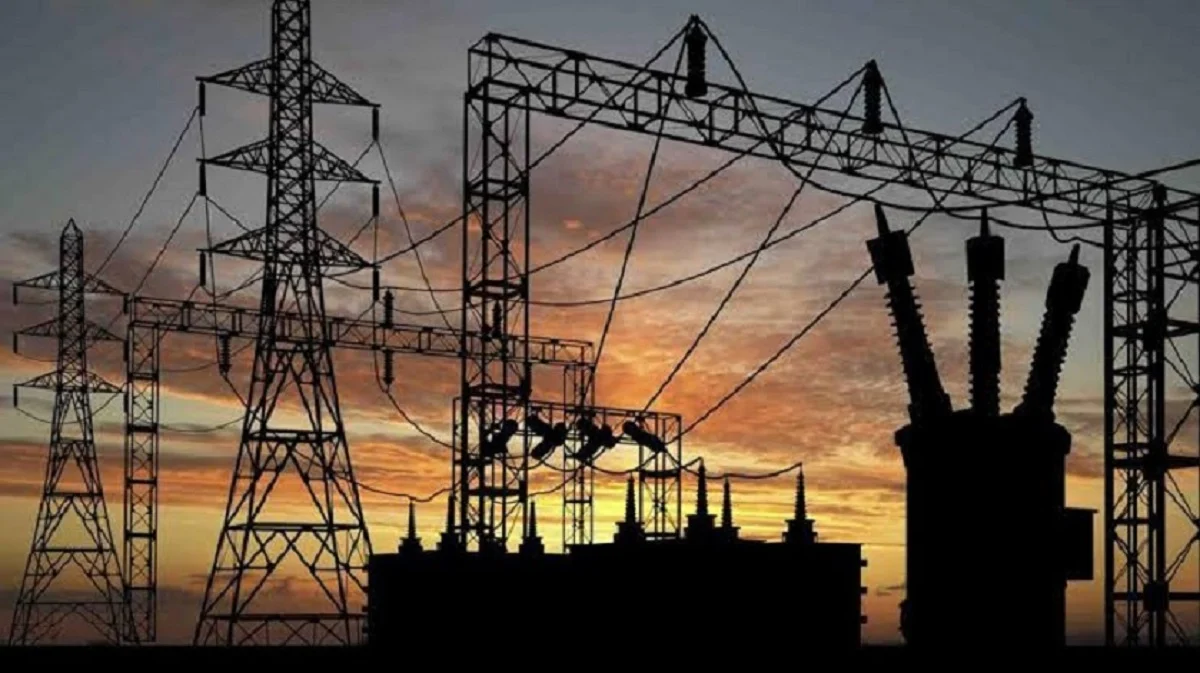
Residents of six northern states will experience a temporary power outage this weekend following a planned maintenance exercise by the Transmission Company of Nigeria (TCN).
The affected states are Bauchi, Gombe, Yobe, Borno, Adamawa and Taraba, with major cities including Bauchi, Damaturu, Maiduguri, Yola and Jalingo expected to be impacted.
In a statement issued on Saturday, TCN’s General Manager, Public Affairs, Ndidi Mbah, said the blackout is necessary to enable the installation of an Optical Ground Wire (OPGW) on the 330kV Jos–Bauchi–Gombe single-circuit transmission line at the Bauchi 330/132/33kV transmission substation.
According to the company, the maintenance work will affect bulk electricity supply to the Yola Electricity Distribution Company (YEDC) and the Jos Electricity Distribution Company (JEDC), preventing both distribution companies from supplying electricity to customers in the affected areas during the exercise.
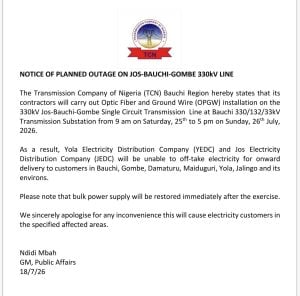
“As a result, Yola Electricity Distribution Company (YEDC) and Jos Electricity Distribution Company (JEDC) will be unable to off-take electricity for onward delivery to customers in Bauchi, Gombe, Damaturu, Maiduguri, Yola, Jalingo and their environs,” the statement read.
TCN assured residents that the outage is temporary and that electricity supply will be restored immediately after the installation work is completed.
“Please note that bulk power supply will be restored immediately after the exercise,” the company added.
The planned outage is part of ongoing efforts by TCN to strengthen the nation’s transmission infrastructure and improve the reliability and efficiency of electricity supply across the country.








The Independent National Electoral Commission (INEC) says it has deployed artificial intelligence (AI) auditing tools and multi-layer firewalls to protect its electoral databases against cyberattacks as Nigeria prepares for the 2027 general election, placing cybersecurity and digital system integrity at the centre of its preparations.
The commission says the measures are designed to protect its systems against cyber intrusion, distributed denial-of-service (DDoS) attacks and unauthorised data injection, while additional upgrades to biometric voter accreditation devices and electronic result-transmission infrastructure are intended to strengthen voter authentication and the integrity of election results.
Lagos State Resident Electoral Commissioner, Professor Ayobami Salami, disclosed the measures on Thursday while delivering a keynote address on behalf of INEC Chairman, Professor Joash Amupitan, at the 10th annual conference of the Guild of Corporate Online Publishers (GOCOP) in Lagos. The conference was held under the theme, “2027 Elections: Trust, Transparency and Shared Responsibilities.”
Amupitan said INEC had undertaken structural, technological and logistical upgrades over the preceding 14 months, describing technology as central to efforts to reduce manipulation and administrative fraud during elections.
“Technology remains our primary weapon against human manipulation and administrative fraud,” according to INEC Chairman, noting that the electoral umpire has established strategic partnerships with global technology companies, including Google and Microsoft, as part of its efforts to strengthen cybersecurity and electoral integrity. He did not provide further details of the partnerships or specify the technologies and services being supplied by the companies.

“Technology remains our primary weapon against human manipulation and administrative fraud,” according to INEC Chairman, noting that the electoral umpire has established strategic partnerships with global technology companies, including Google and Microsoft, as part of its efforts to strengthen cybersecurity and electoral integrity. He did not provide further details of the partnerships or specify the technologies and services being supplied by the companies.
The deployment of AI-assisted auditing tools and layered network security comes as election management increasingly depends on digital databases, biometric verification and electronic transmission of polling unit results. Protecting these systems against unauthorised access, disruption and data manipulation is therefore an important component of INEC’s preparations for the next general election.
However, the effectiveness of the safeguards will depend on their implementation, independent testing, incident response capabilities and the commission’s ability to maintain system availability throughout the electoral process. INEC’s announcement did not include technical performance data or independent audit findings demonstrating the effectiveness of the newly deployed measures.
INEC upgrades biometric accreditation devices
Beyond database security, INEC Chairman said the electoral umpire had undertaken hardware optimisation, battery calibration and software upgrades on its biometric voter accreditation devices to improve facial and fingerprint authentication.
The upgrades are intended to strengthen verification and reduce the risk of voter impersonation or attempts to bypass biometric checks. The commission has also commenced a nationwide audit of the devices to assess their operational readiness and procured additional units based on its requirements.
The condition and reliability of accreditation devices are significant operational considerations for an election involving a large electorate. Device failures, power problems or authentication difficulties at polling units can disrupt voting procedures and affect voters’ experience, making testing, maintenance and contingency arrangements important alongside software upgrades.
INEC says the nationwide audit is intended to ensure that the devices are functional before deployment. The commission has not provided a breakdown of the number of devices being audited, the additional units procured or the results of the readiness exercise.
Electronic results transmission and verification
The commission has also enhanced its electronic result-transmission infrastructure following lessons from previous general elections and more recent off-cycle polls, according to Amupitan.
He said polling unit results would be digitised after votes had been counted, cryptographically signed and transmitted to INEC’s public portal. The process is intended to create an electronic record that can be used to verify results and reduce opportunities for manual alteration between polling units and the final collation process.
Cryptographic signatures can help establish whether a digital record has been altered and support verification of its origin. Their effectiveness, however, depends on how the system manages authentication, access controls, transmission failures and the relationship between electronic records and the original polling unit result sheets.
The practical test will be whether the process operates consistently across polling units, including locations with unreliable electricity or telecommunications connectivity, and whether voters, political parties and observers can access and verify the relevant records.
INEC did not provide further technical specifications for the enhanced transmission infrastructure or details of the safeguards that would apply if devices or networks fail during the election.

He said polling unit results would be digitised after votes had been counted, cryptographically signed and transmitted to INEC’s public portal. The process is intended to create an electronic record that can be used to verify results and reduce opportunities for manual alteration between polling units and the final collation process. Cryptographic signatures can help establish whether a digital record has been altered and support verification of its origin. Their effectiveness, however, depends on how the system manages authentication, access controls, transmission failures and the relationship between electronic records and the original polling unit result sheets.
Technology alone cannot guarantee credible elections
INEC’s preparations extend beyond cybersecurity, biometric accreditation and electronic results. Salami said the commission had commenced procurement and distribution of non-sensitive election materials, acquired additional vehicles and begun readiness assessments across the six geopolitical zones.
The assessments are expected to cover infrastructure, storage security, logistics routes, voter card distribution and emergency response arrangements. The commission is also conducting staff training and intensifying voter education through traditional, digital and grassroots channels, with targeted programmes for women, young people and persons with disabilities.
Amupitan stressed that the credibility of an election depends not only on the systems deployed but also on the conduct of officials and the commission’s ability to implement electoral procedures consistently.
“A beautifully drafted law does not deliver a credible election on its own, nor does sophisticated technology guarantee integrity in a vacuum,” he said.
He added that election officials would be required to take binding oaths of loyalty and neutrality, warning that those who compromise their responsibilities could face dismissal and prosecution.
The emphasis on human accountability highlights a continuing challenge for election administration: technical safeguards must operate alongside transparent procedures, disciplined officials, reliable logistics and clear communication with voters.
INEC seeks partnership with online publishers
The commission has also identified misinformation as a threat to public confidence in the electoral process, warning that unverified reports, synthetic media and AI-generated fake content could influence public perceptions of the 2027 election.
Amupitan urged online publishers to prioritise accuracy over speed and avoid circulating unverified claims about results, security incidents or electoral procedures for online engagement.
INEC is proposing a three-point operational partnership with GOCOP covering dedicated digital fact verification, stronger editorial self-regulation and a national voter education initiative.
Under the proposed arrangement, the commission would provide participating publishers with verified information on field reports, security incidents and technical issues during the election period. GOCOP members would be expected to strengthen verification practices and discourage the publication of unverified polling unit results or speculative reports.
The proposal remains a proposed arrangement, rather than evidence that a formal pact has already been concluded. Its effectiveness would depend on implementation, timely access to authoritative information and the willingness of publishers to apply verification standards consistently.
INEC has also called on online publishers to support public awareness of voter registration, permanent voter card collection and voting procedures. The commission says Nigeria’s voter register has reached 103 million registered voters following three phases of continuous voter registration.
Countdown to the 2027 general election
INEC’s technology, security and logistics preparations are taking place ahead of the presidential and National Assembly elections scheduled for January 16, 2027, followed by governorship and state Houses of Assembly elections on February 6, 2027.
The commission’s stated approach combines cybersecurity safeguards, biometric verification, electronic result transmission, staff accountability, logistics planning and voter education. These measures are intended to reduce vulnerabilities across different stages of the electoral process.
For the 2027 election, the central issue will be whether the announced upgrades can be translated into reliable performance at polling units and across the wider results-management system. The credibility of the process will depend not only on the presence of AI tools, firewalls and electronic systems, but also on their tested reliability, transparency, effective oversight and consistent application of electoral rules.
-

 News3 days ago
Mirror Particle is building a ‘world model’ of human behavior
-
News4 days ago
I Never Prayed for Tinubu, Shettima to Win 2027 Election – Plateau Cleric
-
News3 days ago
FCCPC reviews rules for Nigeria’s online sales promotions, giveaways – Technology Times
-
Business3 days ago
Nigeria has reduced reliance on oil revenue