News
Ambassador Obi Lifts Falconets’ Spirits After Spain Defeat, Brings Taste of Home to Poland

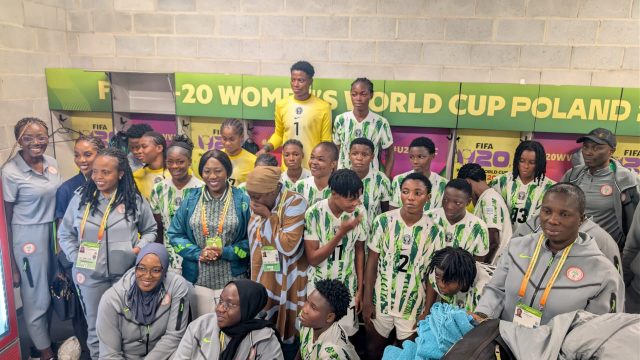
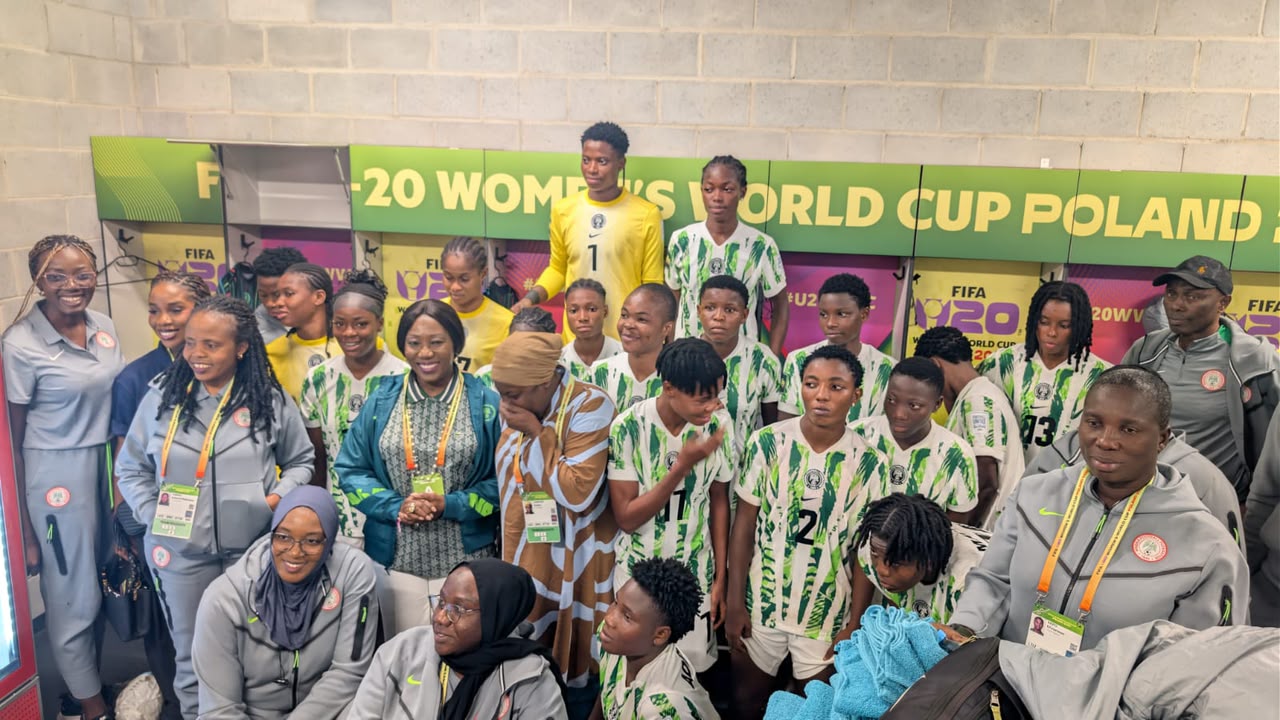
Nigeria’s Ambassador to Poland, Ambassador Margareta Mary Obi, has moved to lift the spirits of the Falconets following their disappointing 0–2 defeat to Spain in their opening game of the 2026 FIFA U-20 Women’s World Cup on Monday.
Rather than allow the result to dampen the team’s morale, Ambassador Obi watched the encounter at the Stadion Sosnowiec alongside officials of the Nigerian mission and remained with the team after the final whistle to offer words of encouragement.
The Nigerian diplomat took time to interact with the players and members of the technical crew, urging them not to allow the opening defeat to affect their confidence ahead of their crucial second Group F fixture against China.
Obi reminded the young players that despite the result, they had shown enough quality on the pitch and should focus on the positives while preparing for the next challenge.
Her message was simple: the defeat to Spain must be put behind them, and the Falconets must believe in their ability to respond.
In a particularly thoughtful gesture, the Ambassador also brought Nigerian food for the players, giving the squad a comforting taste of home while competing thousands of kilometres away from Nigeria.
The gesture helped create a more positive atmosphere around the team as the Falconets began preparations for what has now become a crucial encounter against China.
The two-time FIFA U-20 Women’s World Cup silver medallists will return to the Stadion Sosnowiec on Thursday evening to face a Chinese side brimming with confidence after opening their campaign with a commanding 5–0 victory over New Caledonia.
That result has placed China at the summit of Group F, ahead of Spain on goal difference, while Nigeria must now fight for a result to keep their hopes of progressing to the knockout stage alive.
History offers a mixed record between the two nations at this level.
Nigeria and China have met twice previously at the FIFA U-20 Women’s World Cup. China won their first encounter 3–0 in Russia in 2006, before the Falconets secured a 1–1 draw in France in 2018, with a late own goal from a Chinese defender helping Nigeria advance to the quarter-finals.
Coach Moses Aduku insists the team has already moved on from the disappointment against Spain and is fully focused on the next assignment.
“We have put the match against Spain behind us and are focusing totally on the clash with China. The players are ready to come out stronger for the match against China,” Aduku said.
With the stakes now significantly higher, the Falconets will need to turn the encouragement they have received into a strong performance on the pitch.
And while the result against Spain left the Nigerian camp disappointed, Ambassador Obi’s intervention has offered the young players a timely reminder that they are not alone in their fight for World Cup glory.
From the stands to the dressing room, and even with a taste of home on the table, Ambassador Obi has made sure the Falconets know that Nigeria is behind them — now the response must come on the pitch against China.







Airtel Mobile Commerce N.V. (Airtel Money), the mobile money business of Airtel Africa, has set the offer price for its planned initial public offering (IPO) at £1.96 per share, implying an estimated market capitalisation of £5.3 billion ($7.0 billion) at admission.
Airtel Africa disclosed this in a statement on Thursday, saying Airtel Money intends to list its ordinary shares on the London Stock Exchange, with admission currently expected on 14 October.
The planned listing followed Airtel Africa’s announcement on 23 September of its intention to undertake an IPO for Airtel Money, which operates mobile money services across several African markets.
Listing offer
Under the offer, certain existing shareholders of Airtel Money are expected to sell 270 million existing shares. Also, an additional 27 million shares may be sold if the over-allotment option is fully exercised.
Airtel Africa said it does not expect to sell its existing Airtel Money shares in the offer, except pursuant to the over-allotment option.
The telco said it would remain a “long-term strategic shareholder” in Airtel Money and support the business as it moves into its next phase as an independently listed company.


Based on current indications from existing shareholders, approximately 16.5 per cent of Airtel Money’s issued ordinary share capital is expected to be held in public hands if the over-allotment option is not exercised.
This could rise to approximately 17.5 per cent if the maximum additional shares are sold, according to Airtel Africa.
Airtel Money expects the level of public ownership to make it eligible for inclusion in the FTSE UK indices.
The company said it intends to apply for admission of its ordinary shares to the equity shares category of the Official List of the UK Financial Conduct Authority and for trading on the London Stock Exchange’s Main Market.
Airtel Money said further details of the offer would be contained in its prospectus, which it said would be made available on Airtel Money’s IPO website, subject to applicable access restrictions, on Thursday.
READ ALSO: What Dangote IPO signals – NGX Chairman
Airtel Africa has been planning to spin off its mobile money business from its core telecoms operations following the financial subsidiary’s performance in previous years.
Its mobile money unit, Airtel Money, logged a strong performance in 2025, recording $1.4 billion in turnover, more than one-third higher than what it reported a year before.
Airtel Africa is a leading provider of telecommunications and mobile money services, with operations in 14 countries in sub-Saharan Africa.
Airtel Africa provides an integrated offer to its subscribers, including mobile voice and data services, as well as mobile money services, both nationally and internationally.
Discover more from Premium Times Nigeria
Subscribe to get the latest posts sent to your email.

TechCrunch Disrupt 2026 is built around one question: How do you build an enduring company in the AI era? Our programming and speaker lineup reflect that, based on the feedback we’ve gotten from the community and the reality on the ground.
Last year at Disrupt, we spoke with founders about their experiences and discovered the results of their attendance firsthand. One founder saw a 3x oversubscription rate after their confirmation for Startup Battlefield and more than 100 investor inbounds helping fuel conversations about a future fundraising round. Another founder had nearly 30 back-to-back conversations with investors who flocked to them after a pitch onstage and followed them to their booth.
That’s not the exception at Disrupt — that’s the point. And those opportunities aren’t just available for Battlefield finalists. Every conversation in the Expo Hall or in a Side Event can create an opportunity for your startup. For years, whether it’s been held in New York, San Francisco, or elsewhere, Disrupt has brought together thousands of founders, investors, startup team members, and tech leaders.
We’re keeping that mission alive at SF’s Moscone West, this October 13-15 with a packed lineup of speakers, more than 200 expert sessions, a wealth of organized and serendipitous networking opportunities, and most of all, the chance to be in the same room as the person who could change your nascent idea for a company or your current startup’s trajectory.
This guide is for the founders out there who are just learning about Disrupt, who need a refresher, or are skeptical of whether it’s worth it. TechCrunch has been around for more than 20 years; we can take it. And before you dive in, we have two discounts that run up until Disrupt begins you should be know about. Founders can bring a team member along for 50% off their ticket by following this link, or you can help laid off members of your network find their next opportunity at Disrupt with our steep discount of Expo+ passes.

The reality of what makes Disrupt, Disrupt
If you’re asking Claude or ChatGPT if TechCrunch Disrupt is worth it, you’re not alone. The reality is that Disrupt is a unique event, and it’s happening at a unique time for the startup community.
This year’s Disrupt isn’t about predicting the future of AI; it’s about building companies in it. Across six editorially curated stages, founders will hear practical lessons from the CEOs, investors, engineers, and operators shaping the next decade of technology.
Whether you’re raising your first round, scaling your team, or deciding how AI changes your product, every session is designed to answer one question: “What can I take back to my company on Monday morning?”
The founders Disrupt empowers
Disrupt works a bit differently, depending on where you are in your founding journey, with different tracks you can follow to make the most of the three days:
Pre-seed and idea stages
You’re here to pressure-test your thesis, meet your first angel or pre-seed investors, and figure out who else is building in your space. Prioritize the Builders Stage, the Startup Battlefield semifinalist pitches, and the Expo Hall, along with roundtables tied to your industry and conversations you’ll want to learn more from.
Early revenue or actively raising
You’re here for capital and validation above all else, and your time is valuable. Prioritize our investor-matchmaking tools and the connections that come with your Founder Pass, including the networking tools in our app. You also get access to the Deal Flow Café, where we foster one-on-one conversations between founders and investors.
And when your schedule isn’t packed with dealmaking, learn from VC perspectives and fundraising-focused sessions at the Builders Stage.
Scaling, hiring, in search of partnerships
You’re here in search of talent, strategic partners, and market visibility. Those same networking tools and opportunities can help you meet potential hires and partners and deepen those connections or make new ones. Disrupt’s Side Events aren’t to be missed — there’s one for every industry, interest, or post-event vibe you could be looking to find.
Startup Battlefield: The most iconic pitch competition
The Startup Battlefield winner’s reveal packs the Disrupt stage and is each year’s capstone event. But it’s the lead-up to that $100,000 check and the deluge of attention the winner receives that’s the most valuable for founders attending Disrupt.
The 200 startups chosen on August 20 to compete go through a rigorous prep process and get the opportunity to pitch onstage in front of top-tier VCs and the Disrupt crowds. You’ll also get to watch those pitches, take notes, learn from the peaks and valleys, and potentially meet the teams behind the ideas and innovations. It could be in a follow-up meeting or just walking through the halls of Moscone.
And if that all leaves you inspired, here’s an insider tip: Most Battlefield participants, and several winners, have gone through the process multiple times. We’re no longer taking applications for 2026’s competition, but we’re expanding the program to more international markets, and the 2027 process will be similar to this year’s, so take note for the future!
The founder-focused programming
Disrupt 2026 spans several stages, each built around a different founder need:
- Disrupt Stage: The biggest conversations in technology, featuring the founders, CEOs, and industry leaders defining what’s next. These are the conversations you’ll be talking about long after Disrupt ends.
- Builders Stage: The tactical playbook for building a startup. From fundraising and hiring to GTM, product, and scaling, every session is designed to give founders practical advice they can put to work immediately.
- AI Stage: AI isn’t the future — it’s the present. Learn how the fastest-growing startups are building, deploying, and monetizing AI, with practical lessons on agents, models, infrastructure, and what it takes to win in the AI era.
- Real World AI Stage: AI is moving beyond the screen and into the physical world. Explore how robotics, autonomous systems, manufacturing, healthcare, and defense are turning AI breakthroughs into real-world products and businesses.
- Smart Money Stage: Follow the money. From fintech and stablecoins to payments, embedded finance, and AI-driven financial services, this stage explores how technology is reshaping the movement of capital.
- Smart Systems Stage: Every AI breakthrough depends on the infrastructure behind it. Discover the innovations in chips, compute, energy, networking, and data centers that will determine the next generation of technology companies.

Conversations you can only get at Disrupt
- RJ Scaringe (Rivian): Building a generational company.
- Panos Panay (Amazon): Designing products people love.
- Paolo Ardoino (Tether): Money, AI, and infrastructure.
- Toni Schneider and Rose Wang (Bluesky): Can social start over?
- Amjad Masad (Replit): Every founder becomes technical.
- Andrew Feldman (Cerebras): Winning the AI compute race.
And that’s just the beginning — we’ll have more speakers to announce as we get closer to Disrupt. Check out the full lineup of speakers across all stages and events here.
How to get the most bang for your buck at Disrupt
Disrupt’s prices increase as we get closer to the event, but we have a couple of promotions for Founders looking to save. You can save 50% on a second ticket by following the link here, and bring a coworker or co-founder along for the ride.
If there are colleagues in your network who have been impacted by layoffs who you’d like to have join up, we have an option for them as well, with a special $75 Expo+ Pass available at a limited volume for those impacted by cutbacks this year.
Your time at Disrupt is valuable, too, so before you head there, check on our regularly updated schedule of speakers and Side Events, get ahead of competitors’ schedules by booking your networking opportunities in advance, and get your own elevator pitches in order to make the most of those magical Disrupt moments that can come at any point October 13-15!
When you purchase through links in our articles, we may earn a small commission. This doesn’t affect our editorial independence.
-

 News17 hours ago
Plateau Specialist Hospital Celebrates Nigeria at 66, Salutes Mutfwang’s Health Initiatives
-
News17 hours ago
Nigeria At 66: Rotjimwa Yilyok Salutes President Tinubu, APC Leadership and Plateau Government
-
 News3 days ago
TikTok Access Disrupted in Parts of Northern Nigeria as Users Turn to VPNs
-
Business3 days ago
Court orders NMDPRA to continue issuing fuel import licences to Matrix, AA Rano, AYM Shafa