News
From Jos Plateau state Where Dreams Take Flight: MTN CHAMPS Ignites a Sporting Revolution in Nigeria.


There are days when a city simply comes alive — not just with movement, but with meaning. Today 26th march 2026 was one of those days in the breathtaking city of Jos, as MTN CHAMPS transformed the iconic New Jos Stadium along Zaria Road into a grand stage of speed, hope, and rising stardom.
This is indeed a thing of pride as MTN as a brand in Nigeria are sustaining “MTN Champs” consistently for the fourth time since its inception.
From the very first light of day, the stadium in Jo’s wore a festive look. Buses rolled in, different school from the plateau arrived in excitement, and the stands gradually filled with students in uniform, their teachers guiding them, and government functionaries lending their presence to the occasion. It was more than a competition — it was a gathering of People united by belief in youth, talent, and opportunity.


The atmosphere was nothing short of electric. Cheers rang out even before the first race began, as anticipation built with every passing moment. When the events finally kicked off, the energy surged to a whole new level. Athletes took their marks, hearts pounding, eyes fixed ahead — and within seconds, the tracks came alive.
Sprinters blazed down the lanes with breathtaking speed, their movements sharp and determined, each stride carrying the weight of dreams. Distance runners followed with incredible endurance, pushing through every lap with discipline and resilience. In the field events, athletes soared through the air and powered through throws, drawing gasps and applause from a captivated audience.


Yet, beyond the thrill of competition, something deeper unfolded on that track.
MTN CHAMPS once again proved to be a powerful platform — one where young talents are not only seen but celebrated. For many of these students, this was their moment in the spotlight, a rare and valuable opportunity to showcase their abilities in front of coaches, scouts, and key stakeholders. Their teachers watched with pride, cheering louder with every stride, jump, and finish, knowing they were witnessing potential in its purest form.
The presence of government officials further underscored the importance of the event. It sent a strong message: that youth development, sports, and grassroots empowerment matter. Their attendance was not just ceremonial — it was symbolic of a growing recognition that the future of Nigerian athletics lies in nurturing young talent from the ground up.

The spectators, too, played their part beautifully. The stadium echoed with chants, applause, and encouragement, creating an environment that lifted every athlete. Strangers became supporters, competitors became inspirations, and the entire arena pulsed with a shared sense of purpose.
What stood out most was the raw passion on display. These were not just track and field events— they were stories unfolding in real time. Stories of discipline, sacrifice, ambition, and hope. Every finish line crossed was a small victory, every effort a step toward something greater.


MTN CHAMPS is steadily building more than just athletes — it is building confidence, character, and community. By investing in grassroots sports, it is helping to uncover hidden talents and shaping them into future champions who may one day represent Nigeria on the global stage.
As the sun dipped gently over Jos, painting the sky in warm golden hues, the excitement began to settle, but the impact of the day remained. Athletes walked away with more than medals — they carried new belief in themselves. Students left inspired. Teachers departed proud. And the city itself seemed to glow with renewed energy.
Today at the New Jos Stadium was not just a sporting event.
It was a celebration of youth.
It was a showcase of potential.
It was a reminder that greatness often begins in moments like these.
And in the heart of Jos, on the tracks of Zaria Road, the future of Nigerian athletics didn’t just appear — it announced itself, loudly and brilliantly.
The first day of the 3 days event went well and much is expected for the second day 27th March, 2026
News
Cross River Ikan Sports Fight Back To Beat Gateway Horns 25-19 In Showtime Bowl Series XV Flag Football

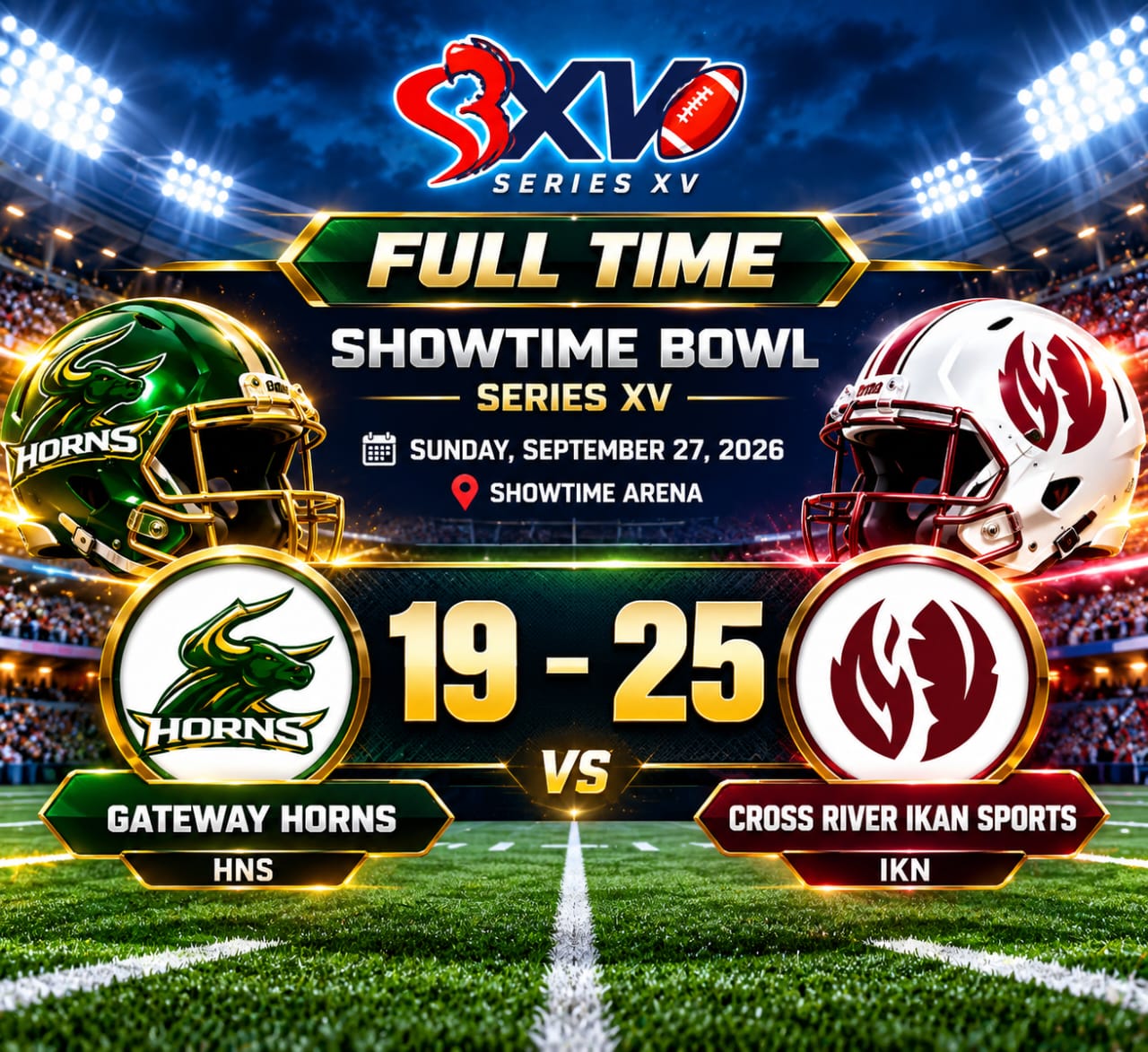
Cross River Ikan Sports bounced back from their heavy opening-week defeat with a spirited second-half performance to beat Gateway Horns 25-19 in Week 2 of the Showtime Bowl Series XV Flag Football season at Showtime Arena on Sunday.
After suffering a 56-13 defeat to Lagos Rebels in Week 1, Ikan Sports needed a response and made the perfect start when quarterback Timothy Atibile connected with Praise Miene for a 28-yard touchdown to establish a 6-0 lead.
Gateway Horns, however, gradually found their rhythm. Awosika Oluwafikunmi found Adewole Mosimiloluwa for the tying touchdown before connecting with Odimbu Awele Gift for another score. A successful extra point to Mosimiloluwa gave the Horns a 13-6 advantage.
Ikan Sports immediately hit back through one of the biggest plays of the contest as Atibile connected with Abayomi Agbayewa for a 45-yard touchdown, reducing the deficit to 13-12 before halftime.
Gateway entered the break with the narrow advantage, but Ikan Sports turned the contest around in the second half, scoring 13 points while restricting the Horns to six to complete a 25-19 comeback victory and secure their first win of the season.
Praise Miene was named Match MVP after finishing with 33 receiving yards and a touchdown, earning a 7.4 rating. Atibile also played a central role in the victory and topped the fantasy standings with 4.3 points, while Gateway quarterback Oluwafikunmi recorded 4.0.
The result represents an important recovery for Cross River Ikan Sports following their difficult Week 1 outing, while Gateway Horns will be left disappointed after surrendering a 13-12 halftime advantage.
For Ikan Sports, however, Week 2 delivered exactly what they needed — a response, a comeback and their first victory of the Showtime Bowl Series XV campaign.

-

 News4 days ago
Commercial drivers demand complete ban of VIO in Plateau
-
Business3 days ago
Gambia asks GTB, Access Bank, others to dismiss non-Gambian employees
-
News3 days ago
Everything new coming to Meta’s AI agent Muse
-
Health3 days ago
WHO expands recommended contraceptive options, backs longer-lasting methods