
News
Sam Altman’s project World looks to scale its human verification empire. First stop: Tinder.

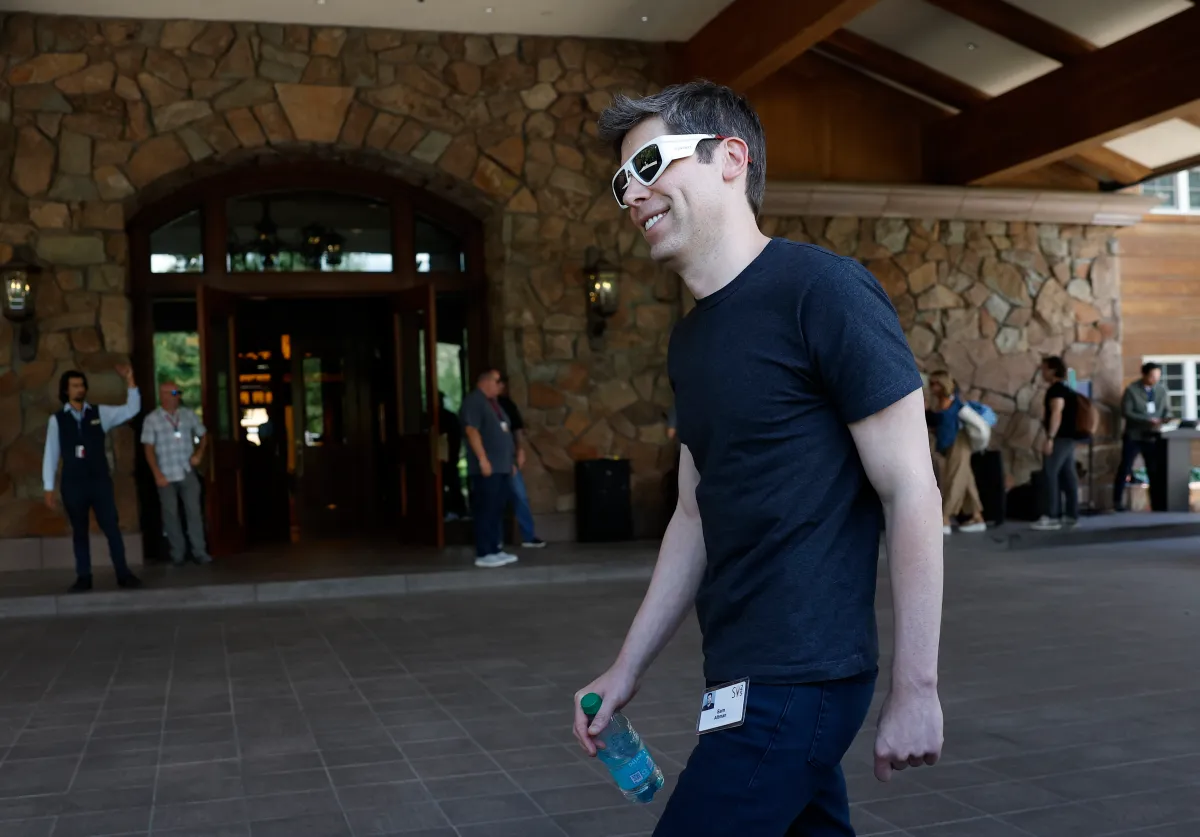
At a trendy venue near the San Francisco pier, Sam Altman’s verification project World celebrated its next evolution and rapid expansion of its ambitions. And it’s starting with Tinder.
Tools for Humanity (TFH), the company behind the World project, announced Friday plans to integrate its verification tech into dating apps, event and concert ticketing systems, business organizations, email, and other arenas of public life.
“The world is getting close to very powerful AI, and this is doing a lot of wonderful things,” said Altman, speaking before a packed crowd at The Midway. “We are also heading to a world now where there’s going to be more stuff generated by AI than by humans,” he added. “I’m sure many of you [have had moments] where you’re like, ‘Am I interacting with an AI or a person, or how much of each, and how do I know?”
World (formerly Worldcoin) distinguishes itself from many of its ID verification peers by offering the ability to verify that a real, living human is using a digital service while still protecting that person’s anonymity. There is some complex cryptographic alchemy behind this (something called “zero-knowledge proof-based authentication”). The upshot: The company is creating what it calls “proof of human” tools, which are mechanisms that can verify human activity in a world rife with AI agents and bots.
Its chief tool for verification is a spherical digital reader called the Orb that scans a user’s eyes, converting their iris into a unique and anonymous cryptographic identifier (known as a verified World ID). This can then be used to access World’s services, although users can also access World’s app without one.
Altman kept his remarks brief on Friday (TFH’s co-founder and CEO, Alex Blania, was absent due to a last-minute hand surgery, Altman said). He then turned much of the presentation over to World’s chief product officer, Tiago Sada, and his team.
Sada explained that World was launching the newest version of its app (the last version was launched at an event in December), along with a plethora of new integrations for its technology.
World has been preparing, for some time, to deploy a verification service for dating apps — most notably, Tinder. Last year, Tinder launched a World ID pilot program in Japan. That pilot was apparently a success because World announced that Tinder would be launching its verification integration in global markets —including the U.S. The program integrates a World ID emblem into the profiles of users who have gone through its verification processes, thus authenticating them as a real person.

World is also courting the entertainment industry by launching a new feature called Concert Kit, where musical artists can reserve a certain number of concert tickets for World ID-verified humans. This is designed to ensure that fans are safe from scalpers who often use automated ticket-buying bots to scarf up seats. Concert Kit is compatible with major ticketing systems, including Ticketmaster and Eventbrite, and the company is promoting it via partnerships with 30 Seconds to Mars and Bruno Mars — both of whom plan to use it for their upcoming tours.
The event was full of many other announcements, including some aimed at businesses. A Zoom/World ID verification integration seeks to battle a supposed deepfake threat to business calls, and a Docusign partnership is designed to ensure signatures come from authentic users.
The company is also working on a number of features in anticipation of the Wild West of the agentic web, including one called “agent delegation,” in which a person can delegate their World ID to an agent to carry out online activities on their behalf. A partnership with authentication firm Okta has also created a system (currently in beta) that verifies that an agent is acting on behalf of a human. The system is set up so that a World ID can be tied to a specific agent and then, when the agent goes out into the web to operate on that person’s behalf, websites will know a verified person is behind the behavior, said Okta’s chief product officer, Gareth Davies, at the event.
So far, it’s been difficult for World to scale, due largely to the verification process itself. For much of the company’s history, to get its gold standard, you had to travel to one of its offices and have your eyeballs scanned by an Orb — a fairly inconvenient (not to mention weird) experience.

However, World has continually made moves to increase the ease and incentive structure for verification. In the past, it offered its crypto asset, Worldcoin, to some members who signed up and has distributed its Orbs into big retail chains so that users can verify themselves while they’re out shopping or getting a coffee. Now the company is announcing that it is significantly expanding its Orb saturation in New York, Los Angeles, and San Francisco. The company also promoted a service where interested users could have World bring an Orb to their location for remote verification.
In a conversation with TechCrunch, Sada also shared that World has attempted to solve the scaling problem by creating different tiers of verification. The highest tier is Orb verification, but below that, World has previously offered a mid-level tier, which uses an anonymized scan of an official government ID via the card’s NFC chip.
The company also introduced a low-level tier, or what Sada called “low friction”— meaning low effort, I guess, but also “low security” — which involves merely taking a selfie.
Selfie Check, which Sada’s team presented during the event, is designed to maintain user privacy.
“Selfie is private by design,” said Daniel Shorr, one of TFH’s executives, during the presentation. “That means that we maximize the local processing that’s happening on your device, on your phone, which means that your images are yours.”
Selfie verification obviously isn’t new, and fraudsters have long managed to spoof it. “Obviously, we do our best, and it’s like one of the best systems that you’ll see for this. But it has limits,” Sada told TechCrunch. Developers looking to integrate World’s services can choose from the three different verification tiers depending on the level of security that’s important to them, he noted.
The Publicity Secretary of the African Democratic Congress, ADC, in Kwara State, Abubakar Kabir Basambo, has resigned from the party, accusing some of its leaders of hypocrisy, dishonesty and double standards.
Basambo announced his decision in a resignation letter dated October 23, 2026, addressed to the state party chairman through the Magaji Are 1 ward chairman and the chairman of Ilorin East Local Government Area.
He said his decision followed careful consideration of the party’s direction in the state ahead of the 2027 general elections.
In the letter, Basambo criticised some party leaders and members of the state executive committee, accusing them of failing to practise the values they publicly claim to uphold.
“This decision was not taken lightly. After deep reflection, I can no longer cope with the direction the party is going in the state.
“There is so much hypocrisy, lies, and double standards amongst some party leaders and State Excos who parade themselves as loyal leaders,” he stated.
The former spokesman also criticised the party’s governorship candidate, Zakari Mohammed, alleging that his arrogance, alongside the conduct of some members, had contributed to his decision to leave.
He warned that the alleged behaviour of some party leaders could prevent the ADC from growing if it was not addressed.
“If this situation does not change, it will surely bring the party down. This party cannot grow with hungry and hypocritical people parading themselves as leaders,” he wrote.
Despite his departure, Basambo said he had no regrets about leaving the party, describing the decision as the end of his political journey with the ADC.
He also expressed disappointment that he would no longer be working with his political leader, Abubakar Kannike, whom he said he had grown to respect over the past year.
Basambo described Kannike as a man of honour and sincerity, adding that his regard for him would remain unchanged despite his resignation.
He also wished the state chairman, secretary and woman leader success in their respective positions.
While thanking those who supported him during his time in the party, he said he had no apology to offer to those who disliked him.
Basambo further clarified his meeting with the governorship candidate of the Peoples Democratic Party, PDP, Bolakale Kawu, insisting that it was not intended to work against the ADC.
“For the purpose of clarity and to exonerate myself from any anti-party allegation, my meeting with Mallam Bolakale Kawu was purely an act of brotherhood and that of a committed member trying to canvas for the party,” he stated.
He added that some ADC leaders had also been involved in similar activities privately.
News
From Super-Sub to World Cup Superstar! Kanyinsola Yusuf Wins FIFA Player of the Match as Flamingos Stun North Korea 3-1

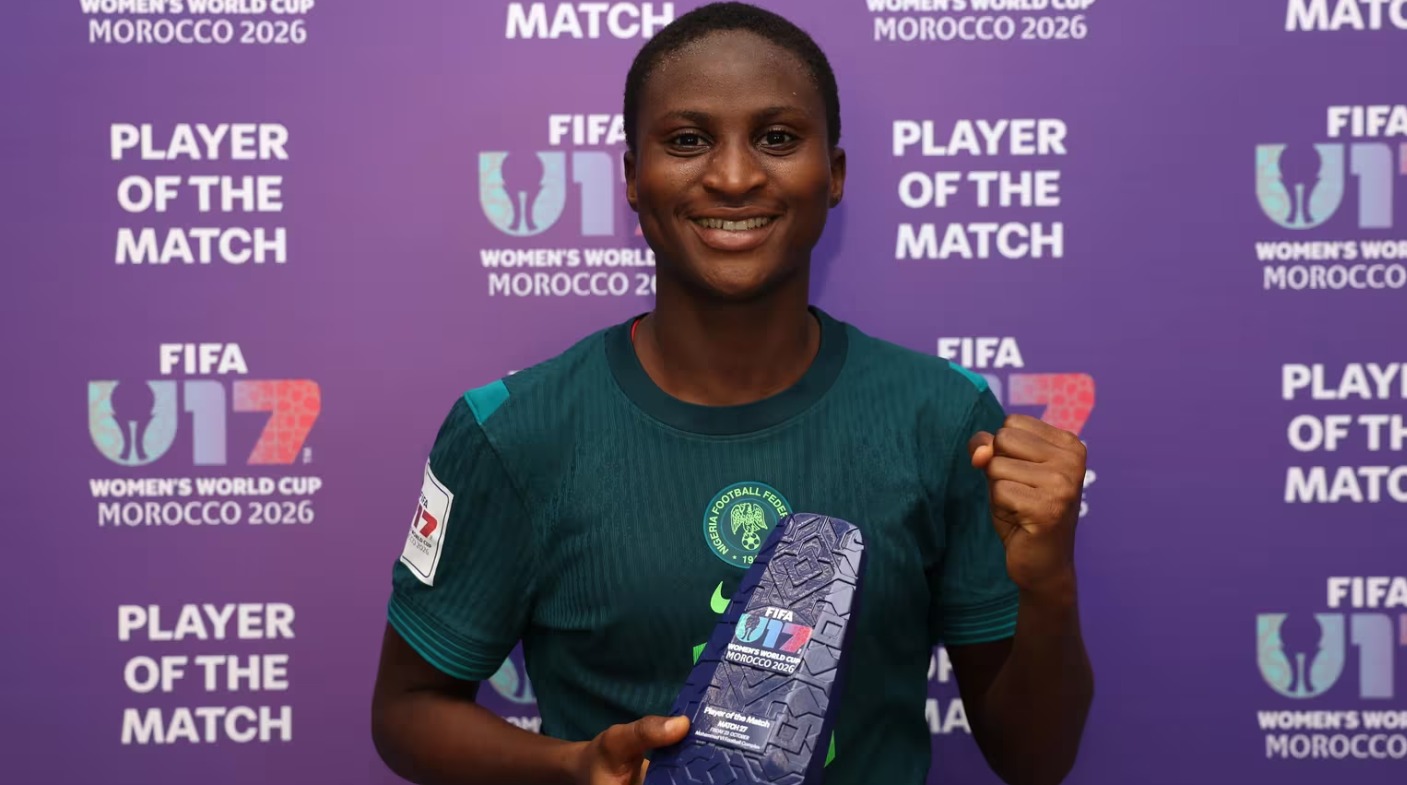
Nigeria’s teenage sensation Kanyinsola Yusuf has emerged as one of the standout performers at the 2026 FIFA U-17 Women’s World Cup in Morocco after winning the Player of the Match award in the Flamingos’ sensational 3-1 victory over defending champions North Korea on Friday.
The prestigious individual recognition crowned an unforgettable afternoon for Yusuf, whose second-half goal helped Nigeria dismantle the tournament favourites and secure a place in the Round of 16.
Yusuf struck in the 56th minute to give Nigeria a commanding three-goal advantage, completing a remarkable attacking display against opponents who had scored 12 goals in their opening two group matches.
Oluwakemi Adegbuyi had opened the scoring in the 15th minute before Oluebube Umejiaku doubled Nigeria’s lead in the 38th minute, leaving the defending champions stunned at half-time.
North Korea pulled a goal back through Yu Jong Hyang’s 82nd-minute penalty, but the Flamingos held firm to record a famous victory.
For Yusuf, the individual honour represents another significant moment in a rapidly developing World Cup campaign.
The youngster had already made an impact in Nigeria’s opening 2-1 defeat to Poland, coming off the bench and helping spark a late fightback, before playing her part in the team’s recovery.
Her emergence adds another exciting dimension to coach Akeem Busari’s squad, which has transformed its fortunes after beginning the tournament with defeat.
Nigeria followed that setback with a 2-0 victory over Puerto Rico before producing Friday’s stunning performance against the reigning champions.
Yusuf’s award also means Nigerian players have claimed the Player of the Match prize in consecutive victories, following Adegbuyi’s recognition against Puerto Rico.
With the Flamingos now through to the knockout stage, Yusuf’s growing influence could prove crucial as Nigeria chase a historic first title.
From an impact substitute against Poland to a match-winning star against North Korea, Yusuf is rapidly making her name on the world stage.
-

 News4 days ago
Mamdani says feds have abdicated on AI, urges New Yorkers to push back
-
News13 hours ago
Obi, Kwankwaso to hold Middle Belt Youth, Village Hall Meeting in Jos
-
News3 days ago
Meta’s Muse hits 10M U.S. downloads in 40 days, a milestone reached by only 11 other apps
-
Business3 days ago
How Your Side Hustle Income Ends Up in Your RSA


