Connect with us

News

Dachung Musa Bagos: One Year of Unstoppable Impact in the Season of Temporary Setback

info

Published

on

IMG 20241108 WA0005

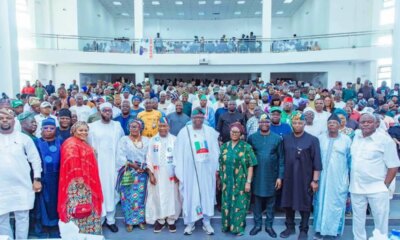
Nothing stops the sun from shining; even at night, it is the rotation of the earth that births the night, not the sun going to bed. For the sun, in spite of the circumstances of the season, the sun nature never changes. Hon. Dachung Musa Bagos, for the period of which he was unjustly removed from the office by the court of appeal, never stops intervening and equipping the next generation of leaders.

Truly, as opined by Zig Ziglar, “success means doing the best we can with what we have. Success is the doing.” Bagos’ commitment to doing his best for his people even out of office made him a phenomenal leader per excellence and crested name in the hearts of his constituents:

Since ousted from office, 8th November 2023, exactly one year ago, Hon. Bagos was able to do the following despite being out of office:

EDUCATION

*Scholarship:*
Hon. Bagos has given scholarship grants to over 100 students in primary, secondary, and tertiary institutions.

He has also given a lifetime scholarship from primary to university to some talented pupils.

He has paid WEAC and NECO registration to secondary school students to promote access to education for all.

*Donation of Instructional Materials:*

Hon. Bagos has donated learning materials, text and exercise books, a computer set, and science equipment to BECO Comprehensive High School Kwi, Riyom Local Government. This gesture has revived the science laboratories of the institution.

*Grants to Market Women and Traders:*
Hon. Bagos has given grants to over 120 market women as a means of boosting their small-scale businesses due to the effects of the inflation on their businesses.

*Community Intervention*
Hon. Bagos has intervened in the Kuru community by building a drainage system to curtail the impact of gully erosion already washing away farms. This action has arrested the looming hunger that would have engulfed the community.

*Youth Women Empowerment*
Hon. Bagos, despite being put out of office, was able to influence the training of youths and women on organic food spice processing in Plateau State at the National Board for Technology Incubation Centre (TIC), Jos, under the federal ministry of innovation, science, and technology, powered by AEON-STAR Limited.

For the past one year, Hon. Bagos, as a consultant, has been engaged as a speaker in the national and international landscape.
No doubt, it was not the office that made him; rather, he gave the office a voice. His voice has never been silent on matters for justice, truth, and the development of Nigeria and Plateau State.

As we look forward to the transformation of a better tomorrow, in his words , it’s not over until it’s over .

#movingforwardwithbagos

BAGOS SUPPORT GROUP FOR CONTINUITY

Continue Reading
Click to comment

Leave a Reply

Your email address will not be published. Required fields are marked *

Business

FG Backs Risk-Based Capital, Urges Insurance Directors to Move Beyond Passive Compliance

info

Published

on

BY NKECHI NAECHE-ESEZOBOR—The Federal Government has thrown its weight behind risk-based capital in the insurance industry and urged insurance company boards to move from passive regulatory compliance to active oversight.

The government made its position known through the Minister of Finance and Coordinating Minister of the Economy, Mr. Taiwo Oyedele, at the 2026 Insurance Directors’ Conference, themed “Recapitalisation to Resilience: Leading the Risk-Based Capital Era.” The conference was organised by the College of Insurance and Financial Management (CIFM).

The minister, who was represented by Dr. Greg Ugochukwu Ezeilo, Special Adviser on Fiscal Risk Management and Sustainability, said a resilient insurance industry is indispensable to the country’s economic transformation.

He described insurance as more than a mechanism for compensating losses, calling it an instrument for mobilising long-term capital, enabling productive investment and protecting livelihoods. He said the economy needs an insurance sector able to underwrite emerging risks, support infrastructure financing and strengthen agricultural productivity.

On the transition to risk-based capital, he said insurers must align their capital with the nature, scale and complexity of the risks they take on. He also called for a more forward-looking approach to governance, investment decisions, underwriting practices and enterprise risk management.

“Capital without governance is vulnerable,” he said. He added that governance without accountability is ineffective, and that insurance without public confidence cannot fulfil its economic value.

According to him, the transition places heightened responsibility on insurance company boards. He said directors must move beyond passive regulatory compliance to active oversight and ensure that risk appetite, capital allocation, corporate strategy and institutional capacity are consistently aligned.

He set out five priorities for the industry. The first is strong governance, with visible leadership at the top, independent oversight and transparency, noting that public confidence remains the industry’s most valuable capital. The second is wider access, with affordable, accessible and relevant products for households, small businesses, farmers and underserved communities, so that insurance becomes an everyday instrument of economic security rather than a privilege of a limited market segment.

The third is directing the industry’s long-term funds, under prudent investment frameworks, towards productive investment, infrastructure financing and sustainable economic growth. The fourth is technology and innovation, including big data analytics, machine learning, artificial intelligence and innovative underwriting models, supported by robust cyber security, consumer protection and operational safeguards. The fifth is building capacity to handle emerging risks such as climate-related disruptions, cyber threats, changing demographics and increasingly interconnected financial markets.

He said the Federal Government remains committed to a stable, competitive and inclusive financial ecosystem in which insurance contributes meaningfully to national economic development. He recognised the National Insurance Commission’s role in strengthening regulatory standards, protecting policyholders and guiding the industry through the transition.

He said sustainable reform requires collaboration among regulators, operators, investors and government, and urged stakeholders to see the transition not simply as a regulatory exercise but as an opportunity for strategic transformation.

The ultimate measure of success, he said, is how effectively the industry helps Nigerians absorb shocks, builds confidence and finds progress.

The post FG Backs Risk-Based Capital, Urges Insurance Directors to Move Beyond Passive Compliance appeared first on Business Today NG.

Continue Reading

News

Google to extend free AI training to Nigerian teachers in 2027 – Technology Times

info

Published

on

Google plans to extend its free artificial intelligence (AI) training programme to teachers in Nigeria in 2027, as the technology company steps up efforts to equip educators across Sub-Saharan Africa with skills to integrate AI into classroom teaching and learning.

The expansion, according to the technology company, will bring Nigerian educators into the Google AI Educator Series, an initiative designed to help teachers use AI responsibly to develop lessons, personalise instruction, improve classroom delivery and reduce administrative workloads.

Google said the programme would initially launch in South Africa in partnership with the South African Council for Educators (SACE), before expanding to Nigeria, Kenya and Ghana in 2027.

The training will combine virtual and in-person sessions, with a curriculum developed around the practical needs of teachers and the growing application of AI in education.

google-to-extend-ai-training-nigerian-teachers
Sundar Pichai, CEO of Google. Image credit: Google.

Google noted that more than 60% of Sub-Saharan Africa’s population is under the age of 25, highlighting the scale of the region’s young population and the potential for technology-enabled education to improve learning opportunities.

“The curriculum is designed by educators, for educators,” Google said, describing the initiative as a practical training programme to help teachers incorporate AI into their professional activities.

The curriculum will cover how educators can use AI to create engaging lessons, streamline administrative responsibilities and adapt teaching materials to accommodate students with different learning needs.

Teachers participating in the programme will also earn micro-credentials as they progress through the training, providing recognition of the AI competencies acquired.

Google said it would work with local partners, including Ubuntu Hub, to engage educators and support the planned expansion into additional African markets.

The initiative comes as technology companies increasingly explore the application of AI in education, particularly across regions where large classrooms, limited teaching resources and varying student learning needs present challenges to effective instruction.

Google noted that more than 60% of Sub-Saharan Africa’s population is under the age of 25, highlighting the scale of the region’s young population and the potential for technology-enabled education to improve learning opportunities.

Google backs AI tools for African classrooms

Beyond teacher training, Google is supporting the development of locally tailored AI-powered educational tools aimed at strengthening foundational literacy across African schools.

The company announced a partnership between Google DeepMind and Fab AI, a non-profit organisation focused on education in low- and middle-income countries, to support local innovators developing AI applications for education.

The initiative, backed by joint funding from Google.org and the Gates Foundation, will bring together a cohort of innovators from Kenya, Ghana and South Africa to develop educational solutions using Google’s open Gemma AI models.

Google DeepMind will provide computing credits and technical expertise to support the development of these applications, with an emphasis on using AI to improve teaching practices and learning outcomes.

The proposed tools will address three areas of classroom instruction: helping teachers prepare high-quality lessons aligned with national curricula, providing timely diagnostic feedback and assessments for students, and delivering practice-based coaching to strengthen teaching methods.

Google said small language models (SLMs) could make AI-powered educational applications more accessible in resource-constrained classrooms because they can operate on lower-cost devices and be adapted to local languages and national curricula.

The approach is intended to address some of the limitations associated with deploying larger AI systems in environments where reliable infrastructure and access to expensive computing resources may be constrained.

The first phase of the programme aims to support up to 500 teachers and 15,000 students, with the potential to reach more than two million learners over time.

Google also plans to make the resulting datasets, evaluation suites and open-source models publicly available, allowing researchers, developers and other organisations in the education ecosystem to adapt and scale the solutions.

What Google’s AI education plans mean for Nigeria

Although the initial AI tool development programme will focus on Kenya, Ghana and South Africa, Nigeria is among the countries scheduled to benefit from the expansion of Google’s teacher training initiative in 2027.

The planned rollout could give Nigerian educators access to practical AI skills at a time when schools and education stakeholders are exploring how emerging technologies can improve teaching methods, learning experiences and educational outcomes.

The emphasis on curriculum-aligned lesson planning, student assessment and personalised instruction also points to applications of AI that extend beyond generating educational content.

For Nigerian schools, however, the impact of the initiative will depend on how effectively teachers translate their newly acquired skills into classroom practice. Access to suitable digital devices, reliable internet connectivity and relevant educational resources will also influence how widely these tools can be adopted.

The distinction between training teachers to use AI and developing AI tools specifically for African classrooms is significant. While the educator series seeks to strengthen teachers’ capacity to work with the technology, the Google DeepMind and Fab AI partnership is designed to support locally developed applications that respond to specific educational needs.

Together, the initiatives reflect Google’s broader effort to place educators and local innovators at the centre of AI adoption in African education, combining professional skills development with technology designed around local classroom realities.

Google said stronger local partnerships and continued learning beyond initial training would be important in helping educators translate their AI knowledge into meaningful classroom practice.

Continue Reading

Trending