News
Gagdi Defends Lalong, Accuses Dasuki Nakande of Meddling in APC Affairs




News
EuroMatch NPFL: Your Television Cannot Give You This — What Fans Staying Away From The stadium Are Already Missing
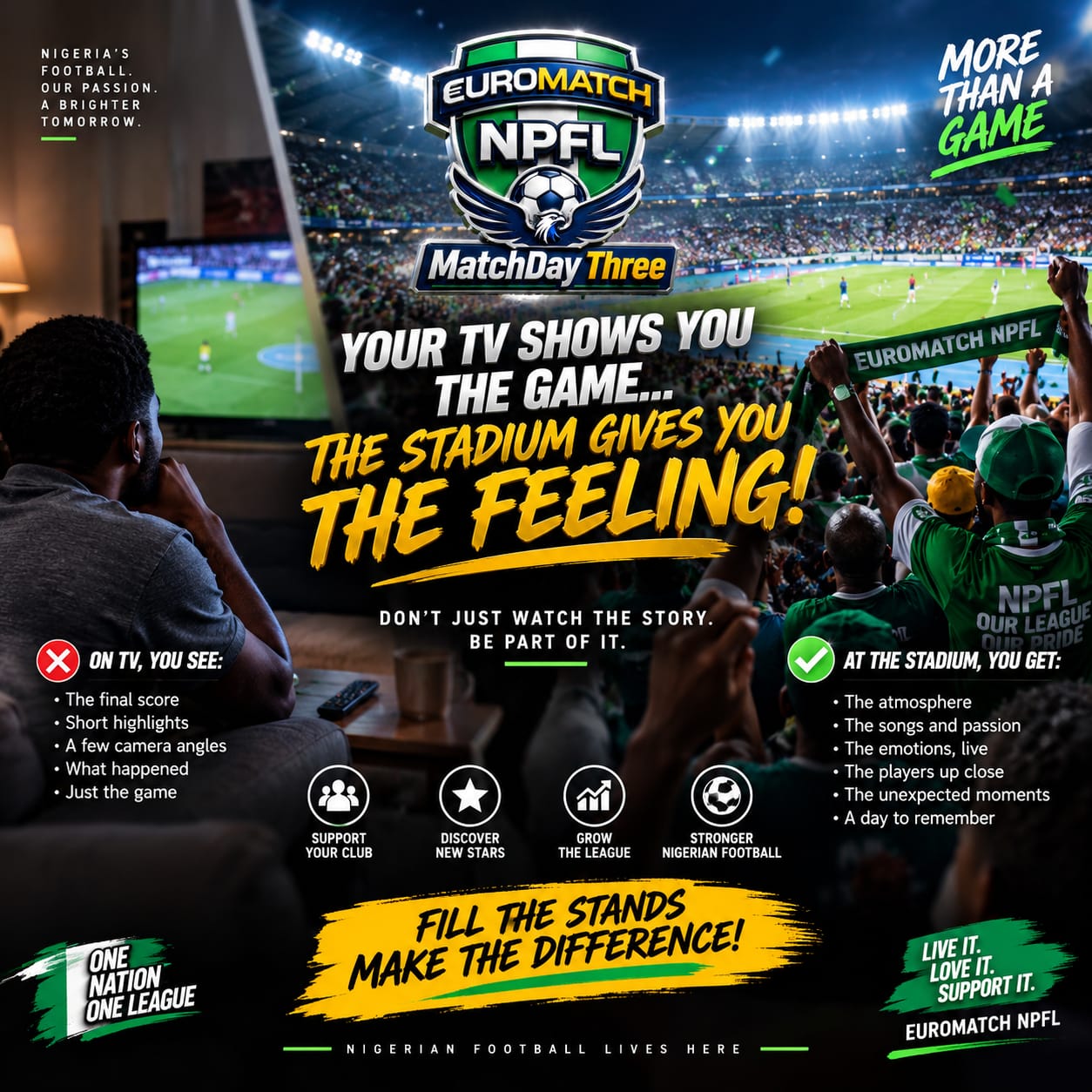
There is football you watch, and there is football you experience.
Only three matchweeks into the 2026/27 EuroMatch Nigeria Premier Football League, supporters who have decided to follow the competition exclusively through score updates, social media clips and television are already missing perhaps the most entertaining part of the new season — being there when the story happens.
A screen can show you Fabian Nworie scoring twice from centre-back for Kano Pillars.
It can replay Sadiq Rilwan’s goals for flying Doma United.
It can tell you Mohammed Rabiu Zulkifilu has already scored the season’s first hat-trick.
But a screen cannot completely reproduce the roar that follows a goal, the tension before a penalty, the noise behind an opposition goalkeeper, the songs from the terraces or that beautiful moment when thousands of strangers suddenly jump together because one ball has crossed one line.
That is what the stadium gives you.
And this EuroMatch NPFL season is already providing plenty of reasons to return.
The league is already creating characters
Two matchweeks were enough for unfamiliar names to begin turning into talking points.
Kano Pillars’ Fabian Nworie, a defender, suddenly became one of Matchday Two’s biggest attractions by scoring twice as Pillars raced into a 3-0 lead before surviving Niger Tornadoes’ comeback to win 3-2.
Imagine being inside the Sani Abacha Stadium for that.
One goal.
Another.
Then Tornadoes score.
Then they score again.
Suddenly a comfortable afternoon becomes nervous. Every clearance matters. Every whistle matters. Every second feels longer.
That emotional journey is why people go to football matches.
Elsewhere, Doma United have become the surprise early story. They returned to the top flight and immediately started winning, including a dramatic 1-0 victory over Inter Lagos at Onikan in which Ibrahim Pius produced an important save before Sadiq Rilwan headed the 71st-minute winner.
And now Matchday Three has already brought another Doma statement with their victory over Enyimba.
The supporters who were inside the ground did not merely hear that Doma had beaten one of Nigerian football’s giants.
They watched the moment become history in front of them.
You could be watching tomorrow’s Super Eagle today
Perhaps this is the biggest thing Nigerian supporters sometimes forget about their domestic league.
Before a player becomes the name everybody discusses, somebody saw him first.
Before the overseas move, before the national-team invitation, before the viral compilation and before everybody suddenly claims to have always known how good he was, there are afternoons when that footballer is simply wearing an NPFL shirt and trying to make people remember his name.
That opportunity is sitting in front of supporters again this season.
Zulkifilu has already delivered a hat-trick. Nworie has scored twice from defence. Rilwan has emerged as an early goalscoring attraction. Goalkeepers such as Ibrahim Pius and Akuchie Obinna are building their own stories.
Some will go further than others. That is football.
But imagine the satisfaction years from now of saying:
“I watched him before everybody knew him.”
That is something highlights cannot give you retrospectively.
The stadium gives football its sound
Football without supporters is still a sport.
Football with supporters becomes theatre.
The drums. The arguments. The songs. The celebrations. The man behind you who somehow believes he should be the coach. The supporter predicting a goal seconds before it happens. Children seeing professional footballers metres away instead of through a phone.
Even the collective groan when a striker misses an open chance is part of the experience.
This is not an argument against broadcasting. In fact, wider broadcasting is essential to growing the EuroMatch NPFL. The league has expanded access through its digital coverage, and Matchday Three itself has selected fixtures scheduled across the NPFL/MBI YouTube platforms, Afro Soccer and FRCN.
Broadcasting takes the league to the world.
But supporters inside stadiums give the league its soul.
The two should grow together.
This Sunday, Lagos has an especially good reason to leave the sofa
For supporters in Lagos, Matchday Three offers something that cannot be repeated.
Inter Lagos versus Sporting Lagos.
The first one.
The official NPFL describes Sunday’s encounter at the Mobolaji Johnson Arena, Onikan as the first-ever top-flight meeting between the clubs.
Years from now, if this develops into one of Nigerian football’s great city rivalries, people will talk about the first EuroMatch NPFL Lagos derby.
Somebody will score its first goal.
Somebody could become its first match-winner.
There will be a first celebration, a first heartbreak and a first set of bragging rights.
And there is only one opportunity to say:
“I was there for the first one.”
The match kicks off at 4pm on Sunday, September 13, at the Mobolaji Johnson Arena.
Supporting the league means more than posting about it
Nigerian football belongs to Nigerians.
If supporters want better clubs, bigger player profiles, stronger commercial interest, more valuable sponsorships and a domestic competition capable of commanding greater international attention, then the relationship between clubs and their communities matters.
That is also why the arrival of EuroMatch as title sponsor should be accompanied by a renewed effort to make matchday an attractive entertainment product.
Sponsors need visibility.
Players need audiences.
Clubs need communities.
And supporters need a league that feels like it belongs to them.
Going to the stadium connects all four.
A packed stand makes a player’s great moment look bigger. It makes television pictures more attractive. It gives sponsors greater exposure. It creates atmosphere around clubs. Most importantly, it turns another Sunday fixture into an event people don’t want to miss.
Don’t wait until everybody is talking about them
That might ultimately be the message of this young EuroMatch NPFL season.
Don’t wait until a player earns a national-team call-up before discovering him.
Don’t wait until a Nigerian club makes a continental run before deciding to support it.
Don’t wait for a derby to become famous before attending it.
Don’t wait until everybody is talking about the league before deciding it deserves your attention.
Go and discover the story yourself.
Matchday Three continues Sunday with Abia Warriors against Ikorodu City, Barau FC against Ranchers Bees, Bendel Insurance against Kun Khalifat, Kwara United against Katsina United, Niger Tornadoes against Plateau United and Inter Lagos against Sporting Lagos.
Different cities. Different clubs. Different characters.
But the same invitation.
Come and see your league.
Come with your friends. Bring your children where appropriate. Wear your club colours. Learn the players’ names. Pick a favourite. Sing. Celebrate. Complain about the referee. Debate the coach’s substitution all the way home.
Because somewhere in an EuroMatch NPFL stadium this season, a player you barely know today could be producing the performance everybody will be discussing tomorrow.
And when that moment arrives, there are two ways to experience it.
You can watch the clip later.
**Or you can say: “I was there.”**

-

 Featured2 days ago
Children Are Suffering in Silence: Plateau Child Protection Network Rates Abuse Crisis 9/10
-
News4 days ago
Africa’s U20 Women’s World Cup Campaign Under Pressure as Benin, Tanzania Suffer Heavy Defeats
-
Business3 days ago
CBN to prioritise terrorism financing supervision
-
News4 days ago
2027: Fubara missing as Wike, Chinda, others storm Spain for strategic meeting