News
Association Holds Trauma Healing Session For Victims Of Plateau Attacks


News
Flamingos Have To Keep Fighting Because We Are Not There Yet; Team Captain Azeezat Oduntan Acknowledges

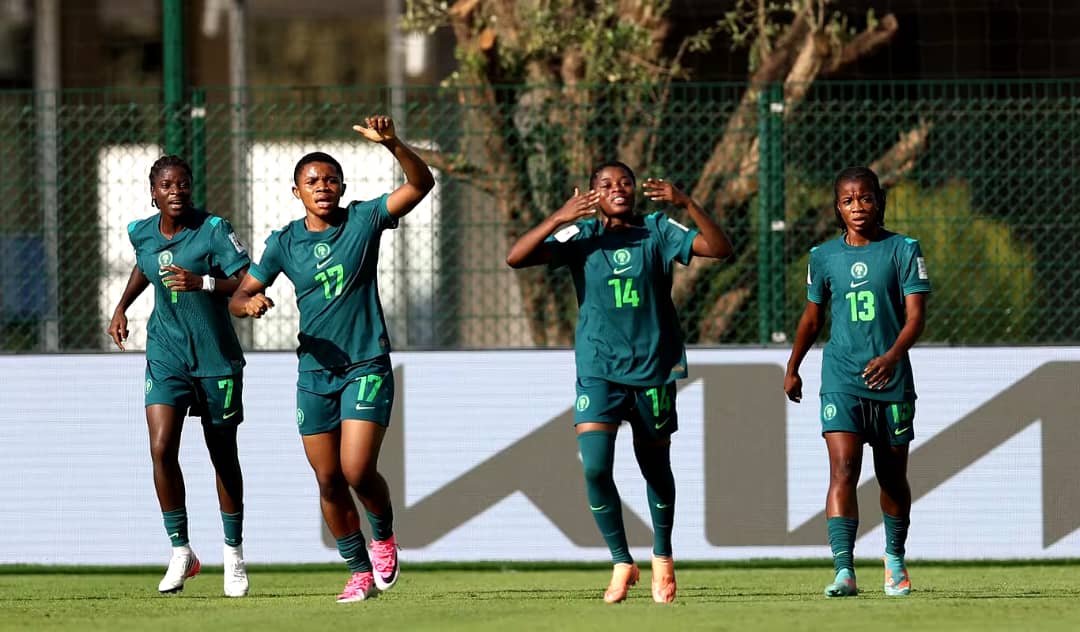
In the wake of a shock 3-1 win for Nigeria’s cadet female national team, Flamingos, over back-to-back champions, Korea DPR, at the ongoing FIFA U17 Women’s World Cup, captain of the side, Azeezat Oduntan, said they can’t relax just yet.
Sports247 reports that, rather than keep on celebrating the win that took them into the competition’s knockout stage as runners-up in their group, Sanusi said they ‘have to keep fighting’ because they ‘are not there yet.’
That surely is a reference to their first knockout fixture at the ongoing competition in Morocco, where Coach Akeem Busari’s team is now a squad to be wary of, as they edged on goal difference ahead of Poland, who defeated Nigeria 2-1 in their opening match.
While Poland eventually finished with no goal difference (following a 6-1 loss to Korea and a 6-2 win over Puerto Rico on Friday), Nigeria jumped into second spot with a plus-three goal difference (2-0 over Puerto Rico and 3-1 versus Korea).
However, while relishing how they made huge history on Friday night in Rabat, Oduntan admitted they just have to keep working hard, even as they seek to surpass the Flamingos’ set of 2022 that won bronze in India.
Expectations of a repeat now look quite realistic following Friday’s stunning win, which fifa.com captured in graphic style, while noting that Busari’s side sent a shortwave through the entire competition with their victory.
The report noted, “Nigeria pulled off a win for the ages by downing two-time defending champions DPR Korea. They opened the scoring through Oluwakemi Adegbuyi, who collected a ball down the left, muscled off a defender and finished with her right foot.
“The African side wanted more and struck for a second shortly before intermission when Oluebube Umejiaku surged through the DPR Korea half and finished past goalkeeper Kim Son-gyong.
“DPR Korea came out with a sense of urgency to start the second half, but Nigeria did well to withstand the pressure and then found a crippling third via Kanyinsola Yusuf’s exquisitely-taken free-kick. The reigning champions pulled a goal back through a late Yu Jong-hyang penalty conversion, but the day belonged to Nigeria.”
Oduntan said afterwards: “I’m super proud of my team-mates because they all came out and chose to play. We have to keep going and keep fighting. I feel excited but we are not there yet because we just qualified for the next round.”
Sports247 gathered further that Adegbuyi again slotted the ball inside Korea’s net in the 88th minute, but VAR ruled it out and, at the end of all the night of thrills, Kanyinsola Yusuf emerged as player of the match.
News
Nigeria’s Telemedicine Gap: Over 80% interested, less than 20% using services – Technology Times

More than 80% of Nigerians surveyed are willing to use telemedicine services, but fewer than 20% have ever used them, highlighting a gap between demand for digital healthcare and actual adoption in the country.
The findings were disclosed by Kashifu Inuwa Abdullahi, Director-General of the National Information Technology Development Agency (NITDA), at the Tech Outlook event in Lagos, organised by the SATH Foundation in collaboration with the agency.
The findings point to a potential opportunity for technology companies and investors seeking to expand digital healthcare services in Nigeria, while raising questions about the factors preventing more Nigerians from translating their willingness to use telemedicine into actual usage.

“Insights of this nature could help investors identify unmet needs, enable innovators to develop relevant solutions, and guide policymakers in addressing barriers to technology adoption,” the research presentation stated.
NITDA: Telemedicine insights can help investors spot unmet needs
Telemedicine uses digital communication technologies to enable patients to access healthcare services remotely, including consultations with medical professionals without necessarily visiting a hospital or clinic.
Inuwa said the research informing the Nigeria Tech Outlook could help stakeholders understand technology needs across the country and identify areas where innovation could address existing gaps.
“Insights of this nature could help investors identify unmet needs, enable innovators to develop relevant solutions, and guide policymakers in addressing barriers to technology adoption,” the research presentation stated.
The disparity between willingness to use telemedicine and actual usage illustrates the distinction between potential demand for a digital service and its adoption in practice.
For healthcare providers and technology developers, the findings could help inform decisions about the design, accessibility and delivery of digital health solutions. However, the research details presented at the event did not specify why respondents who expressed willingness to use telemedicine had not yet used the services.
Potential factors such as affordability, internet access, digital literacy, trust in remote consultations and the availability of suitable services may warrant further investigation. The available research findings, however, do not establish these factors as the reasons for the adoption gap.
The findings also highlight the importance of understanding consumer needs before developing and deploying technology products. Without evidence of what users require and the barriers they face, investments in digital solutions may fail to translate into widespread adoption.
Nigeria Tech Outlook examines five sectors
The Nigeria Tech Outlook examines five key sectors: financial services, telecommunications, commerce and trade, government services and healthcare.
The initiative seeks to provide evidence to support policy development, investment decisions and technology adoption across these sectors, with the broader objective of strengthening Nigeria’s technology intelligence.
For the healthcare sector, a better understanding of demand for remote consultations could help stakeholders assess where digital services may complement conventional healthcare delivery.
Wider adoption, however, would depend on identifying and addressing the specific challenges faced by prospective users, while ensuring that services meet appropriate healthcare and data protection requirements.
Beyond healthcare, the research reflects a wider challenge for Nigeria’s technology ecosystem: turning interest in digital products into sustained use that creates value for individuals, businesses and the economy.
Inuwa emphasised that Nigeria’s growing pool of technology talent would not, on its own, guarantee a globally competitive innovation ecosystem.
The country also needs an environment in which innovators can develop relevant products, businesses can scale and technology can contribute to economic growth.
This approach places greater emphasis on measurable outcomes, including the ability of technology solutions to meet demonstrated needs and improve productivity, rather than innovation activity alone.
Collaboration among government, industry leaders, investors and innovators is central to the initiative.
By providing a clearer picture of technology demand across major sectors, the Nigeria Tech Outlook aims to support decisions that encourage the development of homegrown solutions and sustainable economic opportunities.
The telemedicine findings offer one example of how research into user behaviour can help identify potential areas for digital innovation. The next challenge is determining what prevents interested Nigerians from using available services and how providers, investors and policymakers can respond.
Addressing that gap could help Nigeria move beyond a growing supply of technology talent towards an innovation ecosystem in which digital solutions achieve wider adoption and deliver measurable benefits.
-

 News1 day ago
Obi, Kwankwaso to hold Middle Belt Youth, Village Hall Meeting in Jos
-
News4 days ago
Meta’s Muse hits 10M U.S. downloads in 40 days, a milestone reached by only 11 other apps
-
Business3 days ago
How Your Side Hustle Income Ends Up in Your RSA
-
News3 days ago
Blacksmith hits unicorn valuation after Sequoia leads Series C