Business
Stanbic IBTC Hosts Inaugural Nigeria Business Summit, Targets Sustainable Growth


Stanbic IBTC, a leading financial services provider in Nigeria, successfully hosted the 2026 edition of the Nigeria Business Summit from Wednesday, 01 April to Thursday, 02 April 2026, at the Landmark Event Centre, Victoria Island, Lagos.
The two-day summit brought together industry leaders, policymakers, entrepreneurs and stakeholders across multiple sectors to explore sustainable business practices, foster economic growth and unlock global trade opportunities.
With the theme, ‘Nigeria Means Business: Powering Sectors, Growing Sustainable SMEs & Unlocking Global Trade’, the summit addressed critical issues across key sectors, including agribusiness, renewable energy, trade and Africa–China banking, as well as ICT and telecommunications. Additional sessions covered areas such as family business sustainability, artificial intelligence, employee value banking, insurance, pension and wealth management.
The event featured a keynote address by the Minister of Finance and Coordinating Minister of the Economy, Wale Edun, who emphasisedthe urgent need for Nigeria to reposition itself as a leading export-driven economy to achieve sustained growth.
“Our true potential lies in becoming a leading export economy,” Edun stated. “Increased participation in regional and global trade will be critical to diversifying foreign exchange earnings and driving inclusive growth.”
He noted that while Nigeria’s GDP growth has improved to approximately 4 per cent, it remains below the level required to significantly reduce poverty. According to him, the country’s economic strategy is now shifting from stabilisation to growth acceleration, with trade expansion playing a central role.
Edun highlighted ongoing reforms, including improved foreign reserves, rising non-oil revenues and renewed investor confidence, as indicators of a more resilient economy. However, he stressed that enhancing trade competitiveness would require continued investment in infrastructure, logistics and policy coordination. He also highlighted the importance of small and medium-sized enterprises (SMEs), which account for over 90 per cent of businesses, noting that inclusive growth will depend on stronger collaboration between the public and private sectors.
Participants engaged in a rich line-up of activities, including expert presentations, panel discussions and high-level networking opportunities. Highlights of the summit included the Africa Trade Barometer presentation, client testimonial showcases and insightful discussions on the state of the African economy and intra-African trade opportunities.
Breakout sessions on agribusiness, ICT and healthcare, Africa-China banking and Trade as well as renewable energy provided attendees with deeper, practical insights into some of the most critical sectors driving Nigeria’s economic future.
Speaking at the event, Chuma Nwokocha, Chief Executive of Stanbic IBTC Holdings, represented by the organisation’s Chief Finance and Value Management Officer, Kunle Adedeji, emphasised the importance of collaboration and innovation in driving sustainable growth.
“This summit has reinforced the importance of creating platforms where ideas can flourish and businesses can grow sustainably. By working together, we can unlock new opportunities and drive economic advancement across Nigeria and the African continent,” he said.
The summit also spotlighted practical strategies for integrating sustainability into business operations, encouraging organisations to adopt environmentally conscious practices while maintaining profitability and competitiveness.
Remy Osuagwu, Executive Director, Business & Commercial Banking, expressed satisfaction at the level of interest from participants, a critical element for a successful summit.
“From our conversations on energy and healthcare to the deep dives into trade, Africa-China relations, and agribusiness, Day 1 has offered perspectives that were both insightful and practical. I believe we’re all leaving with a stronger understanding of the opportunities emerging across our industries” Remy said.
He acknowledged the level of engagement, questions, contributions and willingness of participants to share experiences; describing this as the real power of the Nigeria Business Summit, and a solid foundation for tomorrow.
The Chief Executive of Stanbic IBTC Bank, Wole Adeniyi, who was represented by Bunmi Dayo-Olagunju, Deputy Chief Executive of Stanbic IBTC Bank, opened Day Two of the Nigeria Business Summit by highlighting the focus of the summit’s SME Day.
Bunmi said, “Today, we build on Day One’s momentum with conversations that are equally critical for the future – from the dynamics of family businesses to the growing influence of artificial intelligence; the evolution of insurance, and the emerging space of electric vehicle banking.”
She further added, “Our goal on Day Two is simple: to explore what’s next. To understand how these developments will shape our businesses and how we can position ourselves ahead of the curve.”
Stanbic IBTC’s inaugural Nigeria Business Summit stands as a testament to the organisation’s commitment to empowering businesses, strengthening key sectors and positioning Nigeria as a competitive player in the global economy.
The post Stanbic IBTC Hosts Inaugural Nigeria Business Summit, Targets Sustainable Growth appeared first on Business Today NG.
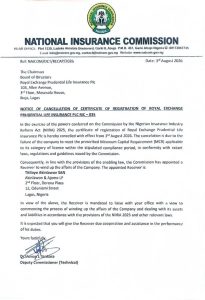
BY NKECHI NAECHE-ESEZOBOR—The National Insurance Commission (NAICOM), has revoked the certificate of registration for Royal Exchange Prudential Life Insurance PLC over its failure to meet the statutory minimum capital requirement under the Nigerian Insurance Industry Reform Act (NIIRA) 2025.
The cancellation, which took effect on Plc August 3, 2026, The regulator also ordered the immediate winding up of the firm’s operations.
The action was executed under the legal powers granted to the regulatory authority by the Nigerian Insurance Industry Reform Act (NIRA) 2025.
According to a notice signed by Deputy Commissioner (Technical) Decent Jankara, titled “Notice Of Cancellation Of Certificate Of Registration Of Royal Exchange Prudential Life Insurance Plc”, the regulator appointed Titilayo Akinlawon (SAN)as Receiver and Provisional Liquidator to oversee the winding up of its affairs.
The notice added that “The appointed Receiver is mandated to take control of the company’s affairs, liquidating its assets and settling its outstanding liabilities in strict accordance with NIRA 2025 regulations and extant insurance guidelines.”
“Relevant stakeholders and financial institutions have been instructed to cooperate fully with the Receiver during the official takeover and winding-up proceedings.”
This development comes days after NAICOM announced the completion of the insurance sector recapitalisation exercise and published a list of 43 insurance and reinsurance companies that met the July 31, 2026 compliance deadline.
The post Recapitalisation: NAICOM Revokes Royal Exchange Prudential Life Insurance License appeared first on Business Today NG.

The Director-General of the Nigeria Civil Aviation Authority (NCAA), Chris Najomo, has cautioned against any further reduction in the regulator’s statutory funding, warning that such a move could weaken Nigeria’s aviation safety oversight.
Mr Najomo spoke on Thursday at a public hearing by the House of Representatives Committee on Aviation on the proposed review of the allocation of the five per cent Ticket Sales Charge (TSC) and Cargo Sales Charge (CSC) at the National Assembly Complex in Abuja.
He said the NCAA supported adequate funding for all aviation agencies but warned that changing the existing revenue-sharing formula without considering the regulator’s responsibilities could affect its ability to discharge its statutory mandate.
According to him, the TSC accounts for about 85 per cent of the NCAA’s revenue, making the charge critical to the authority’s operations.
He contrasted this with the Nigerian Airspace Management Agency (NAMA), which generates a substantial portion of its revenue from commercial charges paid by aircraft operators for air navigation services.

Mr Najomo cited the International Civil Aviation Organisation’s (ICAO) Policies on Charges for Airports and Air Navigation Services, Doc 9082, which provides guidance on how costs associated with air navigation services should be recovered.
He said the cost of such services should principally be recovered from aircraft operators that use them rather than through passenger-based charges such as the TSC.
He explained that any further reduction in the NCAA’s statutory funding could have implications for the authority’s ability to maintain effective safety oversight across the country’s civil aviation industry.
He told lawmakers that the authority could not responsibly guarantee the same level of safety oversight if its funding was reduced without an alternative and sustainable source of revenue.
The warning comes as lawmakers consider proposals to review the distribution of the five per cent TSC and CSC among aviation agencies.
The debate has also attracted concerns from airline operators, who argue that the TSC has become a financial burden on domestic carriers and have proposed replacing the percentage-based charge with a fixed levy.
The Airline Operators of Nigeria (AON), represented at the hearing by former Managing Director of NAMA, Roland Iyayi, urged the National Assembly to abolish the five per cent TSC and replace it with a flat-rate charge similar to the Passenger Service Charge collected by the Federal Airports Authority of Nigeria.
Mr Iyayi argued that the percentage-based system places additional pressure on airlines at a time when operators are grappling with high fuel, maintenance and other operating costs.
The AON also proposed increasing NAMA’s share of aviation revenues and establishing a dedicated Aviation Development Fund to finance infrastructure and other sectoral needs.
Other aviation experts oppose equal funding treatment
Mr Najomo, however, said any additional funding required by NAMA should first be pursued through improved collection of its statutory commercial revenues, greater operational efficiency and stronger corporate governance.
He added that targeted government support could be considered for strategic capital infrastructure where necessary, in line with ICAO policies and international best practice.
Other aviation experts at the hearing also warned against treating the regulator and aviation service providers in the same way under a revised funding arrangement.
Musa Nuhu, a former Nigeria representative on the ICAO Council and immediate past director-general of the NCAA, said the regulator had a distinct responsibility that should not be weakened by changes to the funding structure.
Nigeria’s Permanent Representative to ICAO, Mahmud Ben-Tukur, similarly stressed the importance of maintaining the independence and financial capacity of the aviation regulator.
They argued that while aviation agencies perform complementary functions, responsibility for safety oversight of Nigeria’s civil aviation industry rests with the NCAA.
READ ALSO: NCAA threatens sanctions as Royal Air Maroc allegedly defies regulatory authority
Speaking virtually, Bernard Aliu, a former Nigeria permanent representative to ICAO and former president of the ICAO Assembly, and Harold Demuren, a former director-general of civil aviation, also backed the call to preserve the NCAA’s financial independence.
They said a strong and adequately funded regulator was essential to maintaining Nigeria’s aviation safety oversight system and compliance with international aviation standards.
The public hearing was attended by members of the National Assembly’s aviation committees, including their chairmen, Abdulfatai Buhari and Abdullahi Idris Garba, as well as heads of aviation agencies, airline operators and other industry stakeholders.
Discover more from Premium Times Nigeria
Subscribe to get the latest posts sent to your email.
-

 News2 days ago
Governor Mutfwang Begins Strategic Assessment to Restore Plateau’s Heritage, Boost Tourism
-
News3 days ago
Elon Musk repeatedly one-upped his execs on SpaceX’s first earnings call
-
Health3 days ago
Two deaths recorded as US battles Cyclosporiasis outbreak
-
News4 days ago
Osun political parties elect factional IPAC executive committee