Connect with us

News

Potter 7 Limited, IDEAS Project Graduate 100 NSQ-Certified Masons in Plateau

editor

Published

on

Potter 7, IDEAS Project Graduate 100 Masons

Potter 7 Limited, in partnership with the Innovation Development and Effectiveness in the Acquisition of Skills (IDEAS) Project and with support from the World Bank, has graduated 100 masons in Plateau State following the successful completion of National Skills Qualification (NSQ) Level 2 training.

The graduation ceremony, held at the Government Science and Technical College (GSTC) Bukuru in Jos South Local Government Area, also featured the presentation of starter packs to the beneficiaries to support entrepreneurship and self-employment. The event attracted government officials, traditional rulers, education stakeholders and professionals from the construction sector.
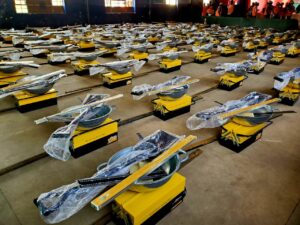
Potter 7, IDEAS Project ,Graduate 100 Masons

Speaking at the ceremony, the Managing Director of Potter 7 Limited, Bldr. Lawrence Gabriel Manggei, described the occasion as a celebration of skills, hard work and dedication. He thanked the IDEAS Project and the World Bank for their commitment to youth empowerment and skills development.

Manggei urged the graduates to make responsible use of their starter packs, stressing that the tools symbolize trust and opportunity. He encouraged them to uphold professionalism, integrity and continuous learning in their practice.

Representing the IDEAS Project Coordinator, Mr. Blessing Ogwu, Prince Iheanacho said the programme celebrates the dignity of labour, resilience and practical skills. He commended the participation of young women in the training, noting its importance in a male-dominated sector.

He disclosed that since its full launch in 2022, the IDEAS Project has renovated and equipped 38 technical colleges nationwide with over 100 modern workshops, while also training technical teachers and master craft persons. According to him, the project was restructured in 2023 to focus on market-relevant, self-reliance-driven skills, with the Plateau beneficiaries forming part of a pilot phase that has trained over 1,000 youths nationwide.

While presenting certificates and starter packs, former Plateau State Chairman of the Nigerian Institute of Building (NIOB), Bldr. Adedeji Paul Adeleye, advised the graduates to value competence above certificates. He urged them to maintain professionalism and contribute meaningfully to national development.

Speaking on behalf of the beneficiaries, Yusuf Gyang expressed gratitude to Potter 7 Limited and the IDEAS Project for the quality and practical nature of the training. Another graduate, Naomi Magaji, described the programme as empowering and expressed excitement at the opportunity provided.

In their separate remarks, the Gwom Rwei Kuru of Jos South, Da Pius Jugu, former Deputy Speaker of the Plateau State House of Assembly, Rt. Hon. Fom Dalyop Gwottson, and other dignitaries urged the graduates to apply their skills responsibly and positively impact their communities.

Also speaking, representatives from the Ministry of Education, the TVET Department, the Jos South Legislative Arm and GSTC Bukuru commended the initiative, describing it as a significant contribution to quality skills development, youth empowerment and economic growth.

The ceremony marked another milestone in Plateau State’s vocational and technical education drive, reinforcing the role of skilled artisans in improving construction standards and driving socio-economic development.

Continue Reading
Click to comment

Leave a Reply

Your email address will not be published. Required fields are marked *

Business

CPPE warns against unrestricted fuel imports

info

Published

on

By

468939862 570688608903404 8583644854384931658 n.jpg

The Centre for the Promotion of Private Enterprise (CPPE) has warned against growing calls for unbridled importation of petroleum products. It argued that such a policy could undermine Nigeria’s industrialisation drive, weaken domestic refining investments, and deepen economic vulnerability.

In a statement issued on Sunday, CPPE’s Chief Executive Officer, Muda Yusuf, said the debate around petroleum imports went beyond fuel supply and touches on the broader issues of economic sovereignty, industrial development, and macroeconomic resilience.

The advice comes amid an ongoing legal dispute between Dangote Refinery and the federal government following the issuance of fresh fuel import licences to major petroleum marketers by the Nigerian Midstream and Downstream Petroleum Regulatory Authority (NMDPRA).

On 15 May, the local refinery filed a fresh lawsuit against Nigeria’s Attorney-General, seeking the reversal of fuel import licences issued to oil marketers and the Nigerian National Petroleum Company Limited (NNPC Ltd).

In response, NNPC Ltd accused Dangote Refinery of attempting to dominate Nigeria’s downstream petroleum sector through the legal action challenging the import licences granted to competing marketers.

PT WHATSAPP CHANNEL

The national oil company maintained that existing laws allow import licences to firms holding local refining licences or those with proven experience in international crude oil and petroleum products trading.

Advocacy

The CPPE in its statement on Sunday said no country had achieved industrial greatness through excessive dependence on imports.

“CPPE is deeply concerned by the growing advocacy for unbridled importation of petroleum products at a time when Nigeria should be consolidating domestic refining capacity and accelerating its industrialisation journey.

“This debate goes far beyond petroleum products. It speaks to the very architecture of Nigeria’s economic philosophy, the future of industrialisation, the resilience of the macroeconomy, and ultimately, the preservation of the country’s economic sovereignty. No nation has ever imported its way to industrial greatness,” the group said.

CPPE argued that Nigeria’s long-standing dependence on imported fuel had contributed significantly to pressure on foreign reserves, exchange rate instability, fiscal leakages, and the collapse of local refineries.

The group warned that recreating conditions that encouraged import dependence could reverse recent economic reforms and destabilise the foreign exchange market, citing Nigeria’s expenses on petroleum imports in the past.

“At the height of the fuel subsidy era, Nigeria spent trillions of naira annually subsidising imported fuel, effectively transferring national wealth, jobs, industrial opportunities, and value creation to foreign economies and their local collaborators. The country was also spending over $10 billion annually on petroleum product imports,” it said.

The think-tank maintained that self-reliance in petroleum refining should be viewed as economic pragmatism rather than isolationism, stressing that every serious economy protects its strategic sectors.

CPPE also referenced the USA, China, and the European countries that embraced industrial policy and supported manufacturing competitiveness to transform their respective economies, saying Nigeria should not be a destination for imported goods.

“The consequences were severe and far-reaching: persistent pressure on the exchange rate, widening trade deficits, weak industrial competitiveness, massive fiscal leakages, investor uncertainty and macroeconomic fragility,” the organisation stated.

“The United States is deploying tariffs and industrial subsidies to support manufacturing competitiveness. China aggressively protects strategic industries. Europe is increasingly embracing industrial policy intervention. India continues to deepen domestic manufacturing through its ‘Make in India’ agenda.

“Industrialisation has never been built on extreme liberalisation. No nation develops by turning itself into an attractive destination for imported goods,” the group said.

The organisation also defended the need for strategic policy support for local refining investments, particularly the Dangote Refinery and modular refineries across the country.

“Nigeria has just witnessed one of the most consequential industrial investments in Africa through the establishment of the Dangote Refinery, alongside growing investments in modular refineries across the country. These investments should ordinarily be strategically supported, celebrated, and strengthened.

“Instead, there appears to be mounting pressure for unrestricted importation of refined petroleum products, a policy orientation capable of undermining domestic refining investments and discouraging future industrial commitments. This presents a troubling contradiction in policy signalling,” the think-tank said.

Unrestricted competition

CPPE argued that calls for unrestricted competition between imported and locally produced petroleum products ignore the structural disadvantages confronting Nigerian manufacturers, including poor infrastructure, high energy costs, elevated interest rates, and foreign exchange volatility.

“Competition can only be meaningful where production occurs under broadly comparable macroeconomic, structural, and regulatory conditions. In the absence of such parity, what is often presented as ‘competition’ merely becomes the institutionalisation of structural disadvantage against domestic industries.

“Local enterprises should not be subjected to destructive competition under profoundly asymmetric conditions. Such an approach would not promote efficiency; it would undermine industrialisation, weaken domestic investment, erode jobs, compromise economic sovereignty, and deepen import dependence,” CPPE said.

The organisation further noted that indiscriminate liberalisation had contributed to the collapse of several once-thriving Nigerian industries, including tyre manufacturing firms, textile mills, battery producers, and automobile assembly plants.

According to CPPE, the implementation of the African Continental Free Trade Area could also become disruptive if deliberate steps are not taken to strengthen domestic competitiveness.

Monopoly concerns

On concerns over monopoly in the refining sector, the organisation dismissed claims that Dangote Refinery posed a monopolistic threat.

CPPE said the Dangote Refinery should be acknowledged for undertaking an extraordinary industrial investment at a scale unprecedented in Africa without collapsing state-owned refineries.

“Attempts to portray Dangote Refinery as a monopolistic threat are simplistic, fundamentally flawed, and grossly unfair. The refinery did not prevent other investors from entering the sector. It did not cause the collapse of state-owned refineries. It simply undertook an extraordinary industrial investment at a scale unprecedented in Africa.

“Scale creates competitiveness. Scale lowers unit costs. Scale deepens value chains. Scale strengthens economic resilience. Scale should not be criminalised,” CPPE stated.

Industrial policies

The group concluded by urging the government to pursue consistent industrial policies that support domestic production, reduce import dependence, and strengthen local value chains.

READ ALSO: NNPC accuses Dangote refinery of seeking fuel monopoly in court filing

“Nigeria cannot achieve meaningful industrialisation without deliberate and sustained support for domestic production. Industrial transformation requires: strategic protection, policy consistency, strong domestic value chains, support for local investors, and a reduction in import dependence.

“No economy becomes prosperous by importing what it can produce domestically. The future of Nigeria’s economic resilience lies in production, refining, manufacturing, and value addition, not in the perpetuation of import dependence,” CPPE added.


Continue Reading

News

Everyone is navigating AI security in real time — even Google

info

Published

on

By

GettyImages 2266466589.jpg

I recently had the opportunity to sit down with Francis de Souza, COO of Google Cloud, backstage at an event in Los Angeles. Amid the din around us, de Souza, who speaks in the calm, measured manner of a university professor, offered useful advice for companies navigating the AI security moment we’re all living through, noting that “there’ll be a transition period, and then I think we get to this better place.”

He wasn’t speaking about Google at that moment, but it’s clear that even Google is still figuring things out.

De Souza’s core message was one security professionals have been trying to get executives to internalize for years, now made urgent by AI: security can’t be an afterthought. “As companies embark on this AI journey, they need to take a platform approach,” he said. “Security is not something you can bolt on later, and it’s not something you can leave up to employees to do on their own.” He warned specifically about “shadow AI” — employees reaching for consumer tools without organizational oversight — and argued that companies need to demand security, governance, and auditability from their platforms from the start. “There’s no such thing as an AI strategy without a data strategy and a security strategy. They need to go hand in hand.”

Worth noting: he wasn’t pitching Google Cloud alone. When I observed that his advice sounded like a Google advertisement, he pushed back. Google, he said, is committed to a multicloud approach, and he made the case that companies that think they’re operating on a single cloud almost certainly aren’t. “Even if they pick a single cloud, they’re relying on SaaS applications, there are business partners that may be using different clouds,” he said. “It’s important for companies to have a security posture that is consistent across clouds, across models.”

He also made the case that the threat landscape has changed so fundamentally that old defensive models are too slow. He noted that the average time between an initial breach and the handoff to the next stage of an attack has dropped from eight hours to 22 seconds, and that the attack surface has expanded well beyond the traditional network perimeter. “In addition to your usual estate, you have models now. You have data pipelines used to train the models. You have agents, you have prompts. All of this needs to be protected.”

One threat de Souza flagged that doesn’t get enough attention: agents moving through a company’s internal systems can surface forgotten data repositories that nobody has thought about in years. “A lot of organizations have old SharePoint servers [and access controls] they haven’t really updated, but it didn’t matter because nobody really knew where they were. But agents roaming your enterprise will find those data assets and will expose the data on them.”

The answer, in his view, is to meet machine speed with machine speed. “We’re now seeing the emergence of an AI-native, fully agentic defense where organizations can run agents driving their defense,” he said. “Instead of having a human-led defense or even a human in the loop, you can now have humans overseeing a fully agentic defense.” He added that this has become a leadership issue, not just a technology one. “This is a board-level issue and an executive team issue. It’s not just a security team’s issue.”

But even as AI takes on more of the defensive workload, the people qualified to oversee it are in short supply — and the vulnerabilities that AI itself is introducing are multiplying faster than security teams can address them. “We’re going to need people to deal with the bug-pocalypse,” LinkedIn’s chief information security officer Lea Kissner told the New York Times this week, adding that she doesn’t expect the industry to understand AI security in any sustainable long-term way for at least several years.

Which brings us back to the platform providers themselves. The Register has published a series of reports over the past several weeks documenting a wave of Google Cloud developers hit with five-figure bills following unauthorized API calls to Gemini models — services many of them had never used or intentionally enabled. The cases followed a familiar pattern: API keys originally deployed for Google Maps, placed publicly per Google’s own instructions, had quietly become capable of accessing Gemini after Google expanded their scope without clearly disclosing the change.

Rod Danan, CEO of interview-prep platform Prentus, said his bill hit $10,138 in roughly 30 minutes after attackers exploited his compromised API key. Isuru Fonseka, a Sydney-based developer whose account was similarly compromised, woke up to charges of roughly AUD $17,000 despite believing he had a $250 spending cap in place. What neither knew was that Google’s automated systems had upgraded their billing tiers based on account history, raising their effective ceilings to as high as $100,000 without explicit consent.

Google refunded both after The Register published its initial report. Still, Google told The Register it has no plans to change its automatic tier-upgrade policy, saying it prioritizes preventing service outages over enforcing users’ stated budget preferences.

In the meantime, there is the separate question of what happens when a developer tries to shut things down. The Register reported this week on research by security firm Aikido finding that even developers who catch a compromised key and immediately delete it may not be safe. According to Aikido’s findings, attackers can apparently continue using that key for up to 23 minutes because Google’s revocation propagates gradually across its infrastructure. Aikido researcher Joseph Leon told The Register that during that window, success rates are unpredictable — in some minutes over 90% of requests still authenticated — and attackers can use the time to exfiltrate files and cached conversation data from Gemini.

Leon also noted that Google’s own newer credential formats don’t appear to have the same problem: service account API credentials revoke in about five seconds, and Gemini’s newer AQ-prefixed key format takes about a minute. “Both run at Google scale,” he wrote in Aikido’s related paper. “Both suggest this is technically solvable for Google API keys, too.” In short, according to Leon, the 23-minute window isn’t an engineering constraint but a matter of priorities for the company.

That’s worth considering when reading de Souza’s advice, which is sound and should be taken very seriously. He’s not wrong, but there is currently a gap between the platforms are prescribing and how fast they are themselves adapating, and it’s good to be aware of this, too.

When you purchase through links in our articles, we may earn a small commission. This doesn’t affect our editorial independence.

Continue Reading

Trending