News
Plateau State Charts New Course for Tax Reforms with Landmark Summit on Land and Property Administration

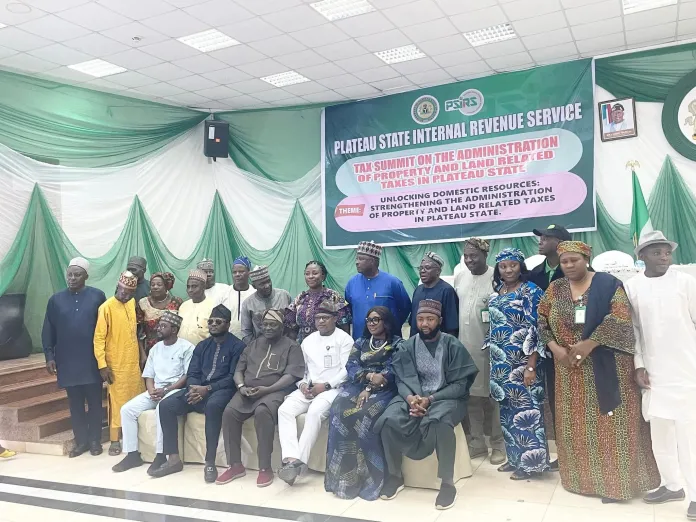
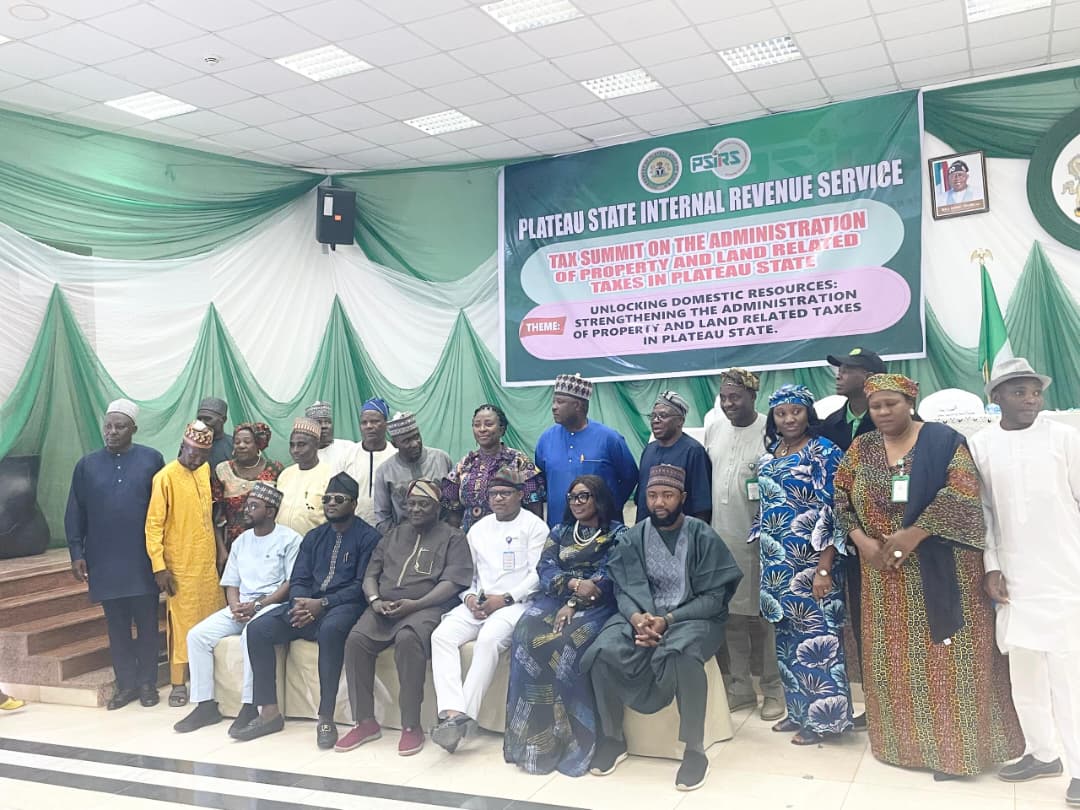
Plateau State has taken a bold step toward transforming its internally generated revenue (IGR) system by convening a two-day Tax Summit focused on property and land administration. The summit, which ended on Friday, August 22, 2025, brought together top government officials, legal experts, technocrats, development partners, and community leaders to address long-standing challenges in domestic resource mobilization.
The event, themed “Unlocking Domestic Resources: Strengthening the Administration of Property and Land-Related Taxes in Plateau State,” emphasized the centrality of land as a driver of sustainable revenue.
Governor Caleb Manasseh Mutfwang, represented by the Secretary to the Government, Arch. Samuel N. Jatau, stressed that the summit was about redefining governance and renewing the social contract between the government and citizens.
“Land is one of our greatest assets, yet it remains underutilized in driving development. What we are doing with this summit is to set a new tone—that Plateau must look inward, harness its resources, and build a transparent system of taxation that benefits every citizen. Property and land taxes are not punishments; they are contributions toward building a state we are proud to call home,” he said.
The governor pledged reforms to harmonize land administration, expand the tax net, and enforce fairness. He noted that a transparent and predictable tax regime would inspire citizens’ compliance under the Plateau Project vision.
Data presented at the summit revealed staggering underperformance: though NASA surveys identified over one million buildings across the state, only about 14,000 are currently within the tax net—just 1.4 percent of the total stock.

Dr. Jim Pam Wayas, Executive Chairman of the Plateau State Internal Revenue Service (PSIRS), described the situation as a “medical emergency,” comparing revenue to the lifeblood of government. “Plateau has been operating with just six pints of blood when it could easily have seven or more,” he said.
Legal experts highlighted the need to bridge the gap between statutory land laws and customary tenure systems. Attorney General and Commissioner for Justice, Hon. Philemon Audu Daffi, noted that the challenge was not the absence of laws, but fragmentation in Nigeria’s land administration.
The Plateau Geographic Information Service (PLAGIS), represented by Mr. Sunday Bulus, showcased how digital property mapping and spatial data could automate identification, valuation, billing, and collection. Property owners, he explained, could soon receive tax notices via SMS or email and pay electronically.
“Data has become the new oil. The question is: how do we harness it to generate wealth? That is why we are here,” Dr. Wayas emphasized.
International case studies were also presented, including Sierra Leone’s reforms in property taxation and comparative research in Kaduna, Niger, and Ekiti States that attracted interest from the Gates Foundation.

A key highlight of the summit was the inauguration of an Implementation Committee chaired by the Attorney General. A seven-point action plan was adopted to address:
- Harmonization of land tenure systems.
- Capacity building for local governments.
- Data-driven revenue forecasting.
- Technology integration across agencies.
- Community sensitization.
- Objective property valuation reforms.
- Updates to legal frameworks.
Commissioner for Lands, Survey and Town Planning, Hon. Peter Nyam Gei, assured that the reforms would simplify processes and eliminate harassment. “Once you are given a demand notice and make your payment, that’s it—you are done,” he said.
The second day of the summit examined the performance of Ministries, Departments, and Agencies (MDAs) under the theme “Appraising the Revenue Performance of MDAs and the Way Forward.” Governor Mutfwang was represented by the Commissioner for Transport, Hon. Jatau Davou Gyang.
A five-year review revealed poor performance between 2020 and 2022, with improvements in 2023 when Plateau achieved 102 percent of its revenue target and raised IGR contributions to 34 percent. Performance reached 62 percent in 2024, but mid-year 2025 data showed worrying trends: only 13.4 percent of MDAs had met at least half their targets, 63.4 percent performed below 25 percent, and 17.1 percent recorded no revenue at all.
Top-performing MDAs included the Ministry of Information & Communication (1,243.76%), Ministry of Justice (729.43%), Jos Main Market Authority (428.96%), and Plateau State Scholarship Board (125%). Underperformers included the Ministries of Agriculture, Science and Technology, ICT Development Agency, and Health.
Recommendations put forward included setting realistic targets, diversifying revenue sources, deepening automation, quarterly performance reviews, and rewarding high-performing MDAs.
Summit participants expressed optimism that Plateau’s reforms could serve as a model for other states amid shrinking federal allocations.
“This is not a talk-shop. We are moving beyond rhetoric to action,” one participant declared, as the summit closed with renewed commitment to building a fair, predictable, and transparent taxation system that underpins sustainable governance and development.





A Federal High Court sitting in Ado-Ekiti has struck out a suit seeking to nullify the nomination of Toyin Okoro as the All Progressives Congress (APC) candidate for Ekiti South Federal Constituency 1 in the 2027 House of Representatives election.
Justice Babs Kuewumi struck out the suit, marked FHC/AD/CS/19/2026, filed by Babalotin Bayo against Okoro and three others, on the grounds that the plaintiff lacked the legal standing to institute the action and that the court lacked jurisdiction to entertain it.
Bayo had approached the court seeking to invalidate the outcome of the APC primary election that produced Okoro as the party’s candidate for the federal constituency comprising Ikere, Ise-Orun and Ekiti South-West.
In his judgment, Justice Kuewumi described the plaintiff as a “meddlesome interloper” and a “busybody”, holding that he had no legal standing to challenge the conduct or outcome of the party’s primary.
The judge noted that Section 285 of the 1999 Constitution, as amended, and relevant provisions of the Electoral Act confer the statutory right to challenge a party primary on an aspirant who participated in the primary.
Justice Kuewumi further ruled that the Ekiti State chapter of the APC does not have a separate legal personality that would allow it to be sued independently of the party’s national body.
Consequently, the judge struck out the name of the APC Ekiti State chapter from the suit.
Okoro, an indigene of Ise-Ekiti, emerged as the APC candidate after defeating the incumbent lawmaker, AVM Rufus Ojuawo (retd.), in the party’s May 2026 primary. His emergence was subsequently confirmed by the party’s National Working Committee (NWC).
Reacting to the judgment, Okoro’s lead counsel, Dr Femi Ogunlade, who appeared alongside Dr K.O. Francis, described the decision as a victory for the rule of law and internal party democracy.
Ogunlade said the judgment had reaffirmed that individuals could not assume constitutional rights that were not available to them.
“The court has come out clearly to re-affirm that no individual can confer constitutional rights upon themselves where none exists. The substratum of the plaintiff’s case was defective from the outset because he was never an aspirant in the primary election,” he said.
Also reacting, a lawyer and community leader from Ise-Ekiti, Adebayo Adeji, said the judgment had brought an end to the legal dispute surrounding Okoro’s candidacy.
Adeji said Okoro had strong support across the federal constituency, which comprises Ise-Orun, Ikere and Ekiti South-West Local Government Areas.
“The court has validated the choice of the people, and the decision shows that no individual can stand in the way of a moving political train,” he said.
The ruling leaves Okoro as the APC’s candidate for the constituency ahead of the 2027 elections.
INEC National Commissioner in charge of Information and Voter Education, Mohammed Haruna, disclosed this while speaking on Trust TV’s Daily Politics programme on Wednesday evening.

Haruna said such parties would also not be allowed to substitute affected candidates, stressing that parties should not benefit from violations of the law.
“It’s like you committed an offence. And then, you come and benefit from it,” he said, citing previous cases involving Zamfara and Plateau states.
According to him, INEC was expected to make a definite pronouncement on the Supreme Court’s September 24, 2026 judgment by Tuesday next week, after obtaining legal advice on the Certified True Copy (CTC) of the judgment.
Haruna said the commission had to exercise caution because forged copies of court judgments had been presented in the past.
He added that the implication of the decision could extend to governorship and legislative candidates, saying some political parties might be unable to field candidates if they failed to meet the legal requirements.
“All the candidates, all the way to the houses of assembly, we interviewed them. If their names are not on the party register, they were not members of the party at the time that they contested for those tickets,” he said.
Haruna also expressed concern over the use of threats during political campaigns, saying such conduct should worry political parties and Nigerians generally.
“Those kinds of things, even if it’s a minority, it’s a cause for concern, because nobody should be threatened at all,” he said.
-

 News3 days ago
2027: El-Rufai’s detention could hurt APC, generate sympathy – SEDSAC director, other analysts express views
-
News3 days ago
Lucid Motors’ EV output falls to lowest level in almost 2 years
-
Business3 days ago
NAIPE 11th Annual Conference Moves to 12 Noon as 28 Stakeholders Back Event
-
News2 days ago
Mirror Particle is building a ‘world model’ of human behavior