News
Plateau: Reps condemn extrajudicial killings by security operatives, rights abuse




The Nigerian government said it has granted N24 billion in tax waivers to pharmaceutical manufacturers between 2025 and 2026 as part of efforts to increase local production of medicines and reduce dependence on imported healthcare products.
The Coordinating Minister of Health and Social Welfare, Muhammad Pate, disclosed this on Tuesday at the 2026 Nigeria Health Sector Joint Annual Review (JAR) in Abuja.
Mr Pate said the incentives were introduced under the presidential executive order signed in 2024 to support domestic manufacturing of medicines, medical equipment and other essential healthcare products.
He also disclosed that the government had secured 12 technology-transfer agreements and was pursuing prospective investments exceeding $5 billion in the healthcare manufacturing sector.
According to him, the government is working to ensure that the proposed investments translate into operational businesses capable of producing affordable healthcare products and creating employment opportunities.
“The Executive Order signed by Mr President in 2024 has supported N24 billion in tax waivers for pharmaceutical manufacturers in 2025–2026,” he said.


“We have 12 technology-transfer agreements and a prospective investment pipeline exceeding $5 billion.”
Mr Pate said the government’s priority was to translate the prospective investments into actual manufacturing activities.
“Our task is to help those prospective investments become operating businesses that supply safe, effective and affordable products and create opportunities for Nigerians,” he said.
Expansion of local manufacturing
Mr Pate said 10 factories or manufacturing lines had been commissioned under the government’s healthcare industrialisation programme, including six in 2026.
He explained that the facilities cover the production of pharmaceuticals, rapid diagnostic tests, long-lasting insecticidal nets and medical oxygen.
The minister acknowledged the contribution of the Presidential Initiative for Unlocking the Healthcare Value Chain (PVAC), coordinated by Abdu Mukhtar, to the government’s efforts to expand domestic manufacturing.
Also speaking at the review, the Minister of State for Health and Social Welfare, Iziaq Salako, reported an increase in local pharmaceutical production.
Mr Salako said locally manufactured medicines accounted for 50 per cent of Nigeria’s pharmaceutical market in 2026, compared with 30 per cent in 2023.
He said figures from the Pharmaceutical Group of the Manufacturers Association of Nigeria and the National Agency for Food and Drug Administration and Control (NAFDAC) also showed an approximately 10 per cent increase in the number of active local pharmaceutical companies.
He said the improvements reflected ongoing efforts to strengthen domestic manufacturing and reduce Nigeria’s dependence on imported healthcare products.
Meanwhile, Mr Pate said NAFDAC was strengthening regulatory measures against falsified medicines to support the development of the pharmaceutical industry.
He also disclosed that the government was working to operationalise Medipool, a group purchasing organisation designed to consolidate demand for medicines and other healthcare commodities.
According to him, the initiative would help organise government procurement while allowing other supply channels to continue operating.
The arrangement is intended to create more predictable demand for healthcare products and support local manufacturers.
Background
Nigeria has been working to expand domestic pharmaceutical manufacturing amid concerns about dependence on imported medicines and disruptions to international supply chains.
In July 2024, President Bola Tinubu signed an executive order introducing fiscal incentives to encourage local production of medicines and other healthcare products.
The order provided relief from tariffs, excise duties and Value Added Tax (VAT) on specified pharmaceutical machinery, equipment and raw materials used in manufacturing.
In May 2025, PREMIUM TIMES reported that the presidency had identified the executive order as one of the government’s major health sector reforms aimed at attracting investment and reducing the cost of pharmaceutical products.
The government said the incentives were designed to make local manufacturers more competitive and encourage increased production of essential healthcare products.
In September 2026, PREMIUM TIMES also reported that the federal government was targeting at least 70 per cent local production of essential healthcare products by 2030.
Speaking at the 8th Nigeria Pharma Manufacturers Expo in Lagos, Mr Salako said the government was using financing and tax incentives to strengthen domestic manufacturing.
He disclosed that 87 local manufacturers were benefiting from the presidential executive order granting zero tariffs on pharmaceutical machinery, active pharmaceutical ingredients and other production materials.
Mr Salako also said PVAC had secured about $2 billion in financing commitments at single-digit interest rates, with approximately 50 Nigerian healthcare companies in advanced discussions for funding.
He explained that increasing local production would help strengthen medicine security and reduce the country’s vulnerability to disruptions in international supply chains.
Sustaining local production
Despite the reported progress, Nigeria’s ambition to expand local pharmaceutical manufacturing will depend on sustained investment, access to financing and the ability of manufacturers to produce medicines that meet required quality standards.
READ ALSO: Nigeria targets 90% functional health centres, 40% health insurance coverage by 2031
At the September 2026 pharmaceutical manufacturers’ expo, Mr Salako emphasised the importance of expanding production beyond finished medicines to include active pharmaceutical ingredients, vaccines, diagnostics and other essential health commodities.
He also identified research, innovation, regulatory cooperation and access to regional markets as important areas for developing the industry.
The 2026 Joint Annual Review, held under the theme “Make the Data Count”, brings together federal and state government officials, development partners and other stakeholders to assess progress under the Nigeria Health Sector Renewal Investment Initiative.
The initiative is being implemented through the Sector-Wide Approach, which seeks to improve coordination, financing and accountability in healthcare delivery.
Discover more from Premium Times Nigeria
Subscribe to get the latest posts sent to your email.

Three members of the Peoples Democratic Party, PDP, State Executive Committee and six local government chairmen have defected to the All Progressives Congress, APC, in Sokoto State.
The defectors were received into the APC by the Special Adviser to the Governor on Political Matters, Faruku Labbo, according to a statement issued on Tuesday by the Director General, Media and Publicity, Government House, Sokoto, Abubakar Bawa.
Speaking on behalf of the defectors, Shehu Abdullahi Mai Rago said their decision to leave the PDP was influenced by Governor Ahmed Aliyu’s treatment of opposition members.
He said the governor had not intimidated or witch-hunted them despite their previous affiliation with the opposition party.
“The governor has never witch-hunted or intimidated any of us despite our previous political affiliation with the opposition party,” Mai Rago said.
He also cited government projects across the state as another reason for their decision to join the APC.
Among those listed as defectors are Aliyu Mai Shinkafa, PDP executive member in Binji LGA; Mohammed Yusuf, PDP chairman in Kware LGA; Altine Gudu, PDP chairman in Gudu LGA; Manir Tureta, PDP chairman in Tureta LGA; and Abubakar Ango Bodinga, PDP chairman in Bodinga LGA.
Others include Mu’awiyya Noma, PDP chairman in Tangaza LGA; Muntari Dan Dare, PDP chairman in Silame LGA; Bello Garba Iya, PDP secretary in Sabon Birni LGA; and Almustafa S. Tudu, PDP secretary in Tambuwal LGA.
Also listed are Balkisu Yusuf, PDP youth leader in Sokoto North LGA; Naja’atu Buhari, state PDP youth leader; Bilkisu Sidi, PDP women leader in Waziri B Ward; and Sadiya Umar, PDP Zawarawa women leader.
The statement also said members of the Amalgamated Association of ADC Traders, Youths and Students Stakeholders and executives of the ADC Tudun Wada Ward had defected to the APC.
-

 News2 days ago
Troops Arrest Suspected Gunrunner, Neutralise Two Terrorists in Plateau
-
News3 days ago
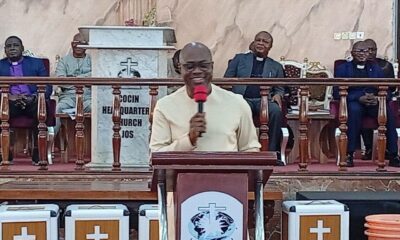
Makinde Visits COCIN Headquarters in Jos, Urges Christians to Shape Nigeria’s Political Future
-
News3 days ago
Makinde Unveils Four-Pillar Agenda to Reset Nigeria, Advocates State Police and National Unity Government
-
News1 day ago
APM holds Presidential Campaign in Plateau, Pledges Security and Economic Reset