News
Operation Enduring Peace Engages Stakeholders in Jos North, Jos East and Bassa LGA to Secure Peaceful Farming Season in Plateau

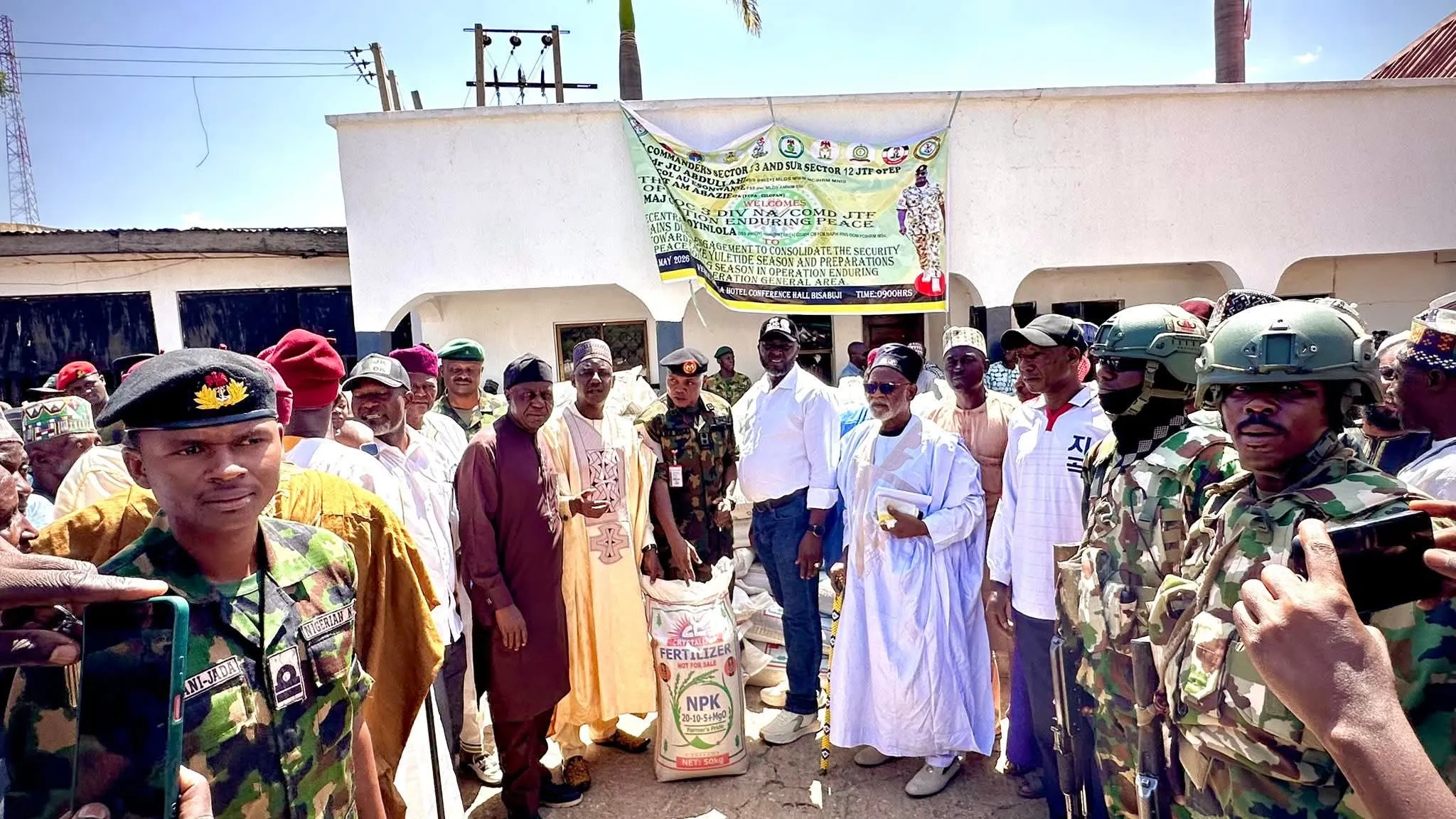
The Joint Task Force, Operation Enduring Peace, has intensified efforts to sustain peace in Plateau State by convening a broad-based stakeholders’ engagement involving leaders and representatives from Jos North, Jos East, and Bassa Local Government Areas ahead of the 2026 farming season.

The engagement, held in Jos, brought together traditional rulers, religious leaders, community representatives, youth leaders, farmers, herders, and security agencies to deliberate on practical strategies for preventing conflict and ensuring a smooth agricultural season.
Speaking on behalf of the General Officer Commanding (GOC) 3 Division and Commander of Operation Enduring Peace, Major General Folusho Oyinlola, the Chief of Staff, Brigadier General Mohammed Sule, described the meeting as timely and strategic. He said the objective was to consolidate the relative peace recorded in recent months while proactively addressing emerging threats.

He commended residents of the three local government areas for their commitment to peaceful coexistence, noting a visible reduction in violent incidents due to sustained dialogue and cooperation. However, he warned that challenges such as kidnapping, attacks on mining sites, illegal arms manufacturing, and the influx of cattle into farming communities—often leading to destruction of farmlands and reprisals—remain sources of concern.
To mitigate these risks, the GOC disclosed that both kinetic and non-kinetic approaches were being deployed. He revealed that the Chief of Defence Staff has approved the distribution of fertilizers to farmers across communal divides to boost agricultural productivity and foster cooperation, while the Chief of Army Staff, Lieutenant General Waidi Shaibu, has deployed a Special Forces Intervention Battalion to Plateau State to reinforce ongoing operations and swiftly respond to threats.
He further urged stakeholders to strengthen community-based conflict resolution mechanisms and sensitize youths against actions capable of triggering violence, such as farm destruction and cattle poisoning. He also called on media practitioners to uphold professionalism, emphasizing that unverified or sensational reports could inflame tensions rather than promote peace.
In his remarks, the Chairman of Jos North Local Government Area, Barrister John Kyohroh Christopher, commended Operation Enduring Peace for its relentless efforts in restoring calm, particularly after the recent Angwan Rukuba attack. He assured that the local government would continue to collaborate with the Joint Task Force to consolidate peace and stability in the area.

Also speaking, the Plateau State Peacebuilding Agency, represented by Celestina Avizavi on behalf of the Director General, Dr. Julie Sanda, highlighted the critical link between peace and food security. She noted that the engagement went beyond agriculture, stressing that “where there is peace, farmers plant with confidence, herders move without fear, and communities thrive together.” She described the forum as a proactive and necessary step toward preventing conflict and safeguarding livelihoods.
Traditional institutions were also represented at the meeting. Speaking on behalf of the Ujah of Anaguta, His Majesty Pozoh Dr. Johnson Jauro Magaji II, the royal father from Nabor, HRH Haruna Bala, emphasized that such engagements are vital to strengthening the peace process at the grassroots. He assured that traditional rulers would cascade the outcomes of the meeting to their communities and engage youths to support peacebuilding efforts.
From the Fulani community, Ardo Ali Mohammed of Jos North lauded the initiative for bringing together diverse groups across religious and ethnic lines, describing it as a strong symbol of unity. He pledged that the resolutions reached would be communicated to members of his community to ensure compliance and peaceful coexistence.
Other stakeholders, including community leaders and representatives of both Christian and Muslim groups, also appreciated the military’s intervention, particularly the distribution of fertilizers, noting that it would ease the burden on farmers and encourage collaboration rather than conflict.
Participants collectively pledged to work together to ensure a peaceful farming season, emphasizing the need for vigilance, dialogue, and mutual respect among all groups.
In his concluding remarks, the GOC reaffirmed that Operation Enduring Peace remains committed to protecting all law-abiding citizens without bias, stressing that security agencies will continue aggressive operations against criminal elements. He, however, emphasized that lasting peace can only be achieved through sincere cooperation and shared responsibility among all stakeholders.
The engagement ended presentation of fertilizers to various communities with a renewed call for unity, restraint, and sustained collaboration as Plateau State prepares for the farming season.


The Nigerian Army troops have rescued 28 kidnap victims in Katsina and Zamfara states.
The troops arrested three suspected pipeline vandals in Rivers State and kiled two suspected criminals in Bauchi State.
This is contained in an operational report detailing military activities across several theatres between Thursday and Friday, released in Abuja on Saturday.
The report said that troops of Operation Fansan Yamma rescued 27 victims kidnapped by suspected terrorists in Gamji community, Sabuwa Local Government Area of Katsina State, at about 12:25 a:m., on Friday.
It said the rescued victims were handed over to the community leader, Falalu Suleiman, for further action.
The report noted that troops responding to an attack on farmers in Dutsen Maru community, Maru Local Government Area of Zamfara State, forced the attackers to flee and abandon one kidnap victim.
According to the report, troops rescued the victim and recovered three motorcycles and a donkey.
It further said that in Rivers State, troops of the Joint Task Force South-South, Operation Delta Safe, arrested three suspects over an alleged vandalisation and removal of pipelines belonging to the Nigerian Pipelines and Storage Company (NPSC) along the Bonny export line serving the Port Harcourt refinery.
“The operation took place at Okochiri community, Okrika Local Government Area, on Thursday.
“The troops recovered 210 pieces of vandalised pipes, 12 boats, five motorcycles, six batteries, a generator, a fire extinguisher and two heavy-duty metal-cutting machines,” it said.
The report noted that efforts were ongoing to apprehend the suspected buyer.
It also said that troops of Operation MESA, acting on intelligence about ransom payment to kidnappers, engaged and neutralised two suspected criminals in the Ningi Local Government Area of Bauchi State.
According to the report, troops also arrested a herder and his son over an alleged killing in Jimpi village, Tafawa Balewa Local Government Area in separate operation.
The report further said that troops of Operation Enduring Peace recovered the body of a civilian kidnapped on October 14 in Gwol-Hoss community, Riyom Local Government Area of Plateau State.
“The decomposing body was discovered along the Gwol-Hoss-Makera Road on Friday and evacuated by family members for burial,” it said.
The report said that troops responding to an attack on illegal miners at Makale mining site in the Bokkos Local Government Area also found two bodies, while the assailants fled on sighting the troops.
According to the report, efforts are ongoing to apprehend the perpetrators of both incidents.
It added that troops of the 17 Brigade engaged armed terrorists on motorcycles in Kurba village, Kankara Local Government Area of Katsina state, forcing them to abandon one motorcycle.
It added, “The operations form part of ongoing efforts to rescue abducted persons, combat violent crime, protect critical infrastructure and strengthen security across the country.”
(NAN)

News
Flamingos’ Coach Akeem Busari, Star Player Harmony Chidi Catch FIFA’s Attention Ahead Of Clash With Poland

Nigeria’s cadet female national team, Flamingos’ coach, Akeem Busari and the squad’s captain, Harmony Chidi have caught global attention ahead of their tango with Poland at the FIFA Women’s U17 World Cup in Morocco.
Sports247 reports that, as both sides prepare for their opening game of this year’s Mundial on Saturday, Federation of International Football Associations (FIFA) served a detailed preview about what to expect from the two countries.
Read Also: “Every Team at the World Cup Is a Champion” — Busari Warns Flamingos Against Underestimating Opponents in Morocco
The preview, which appeared across two instalments on fifa.com some hours to the start of this year’s Female Cadet Mundial on Friday, noted that Busari is in charge of the Flamingos for the first time, while Chidi has been at this level once before.
The preview noted at length, “Fresh off the back of hosting their first FIFA U-20 Women’s World Cup, Poland are returning after missing last year’s event and will be keen to make up for lost time.
“Their path to these finals was secured by a 2-0 play-off win over England at the UEFA Women’s U-17 Championship (while) Nigeria stormed through African U-17 Women’s World Cup qualification with four straight wins.
“(The Nigerian team) will be led by Akeem Busari, following a fruitful three-tournament run under Bankole Olowookere. They defeated Benin in the final round of African qualifying.
“Participations: 9 (2008, 2010, 2012, 2014, 2016, 2022, 2024, 2025, 2026). Best U-17 World Cup result: Third place (2022). Player to watch: Harmony Chidi.
“(She) already has previous experience of these finals, having scored at Dominican Republic 2024. She was just 14 then, but returns to Morocco as captain.
“Having steered them with five goals and the WAFU B U17 Girls’ Cup in September with a further three, Chidi brings boundless energy and searing pace to the Flamingos’ frontline.
“(On the other hand, Poland qualified after winning) the UEFA Women’s U-17 Championship play-off. Participations: 2 (2024, 2026). Best U-17 World Cup result: Quarter-final. Coach: Paulina Kawalec
“Player to watch: Industrious midfielder Zofia Burzan is already making waves at club side Czarni Sosnowiec, where she has claimed four assists and a goal so far.
“She also dazzled at the UEFA Women’s U-17 Championship (and scored) all four of Poland’s goals – including both in their play-off win over England – to finish as the tournament’s top scorer.”
-

 News3 days ago
MTN, Airtel take 90% of Nigeria’s 15m new subscribers as Glo shifts ground – Technology Times
-
News4 days ago
‘2027 will be different from 2023’ – Wike says Amaechi not giving Tinubu sleepless nights
-
News2 days ago
Miners Association Seeks Support To Unlock $3bn Gemstone Export Potential
-
Health2 days ago
Katsina health professionals declare 7-day warning strike