Connect with us

News

ntel relaunches with ‘Next Frontier’ strategy to reinvent Nigeria’s 120-year telecoms lega – Technology Times


info

Published

on

1783944366 admin ajax.png

NatCom Development and Investment Limited trading as ntel is seeking to reinvent Nigeria’s oldest telecoms operator for the digital age as it relaunches its business on Monday with a strategy that shifts its focus from competing as a conventional mobile operator to becoming a digital infrastructure, wholesale connectivity and real estate company.

Branded “The Next Frontier,” the relaunch marks the beginning of a new chapter for the company, whose heritage dates back more than 120 years to Nigeria’s former Posts and Telecommunications (P&T) department and later the state-owned Nigerian Telecommunications Limited (NITEL).

The move represents ntel’s most significant strategic repositioning since acquiring NITEL’s assets, as the company seeks to leverage its legacy infrastructure and property portfolio to participate in Nigeria’s rapidly evolving digital economy.

Instead of competing directly for mass-market mobile subscribers, ntel plans to diversify into broadband services, wholesale telecommunications infrastructure, digital platforms and commercial real estate, reflecting broader changes reshaping the global telecoms industry.

Speaking ahead of the relaunch in a video reviewed by Technology Times, Soji Maurice-Diya, Managing Director and Chief Executive Officer of ntel, acknowledged that many Nigerians believed the company had disappeared from the country’s telecoms landscape, saying the relaunch is intended to demonstrate that the business is entering a new era built on innovation, partnerships and long-term investment.

ntel-relaunches-with-next-frontier-strategyntel-relaunches-with-next-frontier-strategy
ntel is relaunching with its ‘Next Frontier’ strategy, shifting from mobile services to digital infrastructure, broadband and telecoms innovation in Nigeria. Image credit: Technology Times/Rilwan Oladapo.

Instead of competing directly for mass-market mobile subscribers, ntel plans to diversify into broadband services, wholesale telecommunications infrastructure, digital platforms and commercial real estate, reflecting broader changes reshaping the global telecoms industry.

ntel: Repositioning a 120-year telco

Maurice-Diya said the company’s greatest strength lies in a heritage that predates Nigeria’s modern telecommunications industry.

According to him, ntel’s origins stretch back to the country’s earliest organised telecommunications services through the former Posts and Telecommunications department before evolving into NITEL, whose assets were later acquired by NatCom Development and Investment Limited.

“A lot of us don’t realise this. Coming from a storied past as Postal and Telecommunications, ntel is really over 120 years old,” Maurice-Diya said. “Our hope is that there’s another 120 years left in the history of this business as we reimagine, in various formats, what the future looks like.”

He said the company’s transformation strategy extends well beyond traditional telecoms.

Under the new operating model, ntel has reorganised its business into three strategic units:

  • Beam, focused on broadband and internet connectivity;
  • Titan, responsible for telecommunications infrastructure, including towers and wholesale fibre assets; and
  • Eden, which will manage the company’s property and real estate portfolio.

The structure is designed to unlock greater value from ntel’s legacy assets while positioning the company to participate in emerging opportunities across Nigeria’s digital economy.

“We think there are opportunities for us to explore a fantastic real estate business, a telecoms infrastructure provider and, ultimately, a digital player. That’s what ‘The Next Frontier’ is about,” Maurice-Diya said.

Partnerships and investment at the heart of ntel strategy

Maurice-Diya said the relaunch has been designed to serve multiple stakeholders by reassuring customers, attracting strategic partners and demonstrating the company’s long-term investment potential.

“For us, ‘The Next Frontier’ represents several different opportunities,” he said. “It gives our partners an opportunity to see into our future and tap in and help us innovate and create exciting products that we think will be special in the marketplace.”

A central objective of the relaunch is attracting fresh institutional capital to support the company’s next phase of growth.

According to the CEO, ntel has deliberately maintained lean operations while restructuring the business and is now seeking long-term investors interested in supporting the company’s transformation into a diversified digital infrastructure business.

ntel: Positioning for Nigeria’s digital economy

NatCom Development and Investment Limited acquired the assets of the former Nigerian Telecommunications Limited (NITEL), once Nigeria’s dominant national telecoms operator before the liberalisation of the telecoms sector.

Since then, the company has operated under the ntel brand and has recently restructured its board and corporate governance framework as part of preparations for its commercial relaunch.

The relaunch comes as Nigeria’s telecommunications industry continues to evolve from a voice-driven market into one increasingly defined by broadband connectivity, enterprise services, cloud computing, digital platforms and infrastructure sharing.

According to the Nigerian Communications Commission (NCC), Nigeria recorded 188.01 million active mobile subscriptions as of April 2026, while broadband penetration reached 55.67%, reflecting sustained demand for high-speed internet services.

The country’s digital footprint has also continued to expand, with more than 154 million active internet subscriptions recorded during the same period, largely driven by mobile broadband adoption.

At the same time, investment in Fibre-to-the-Home (FTTH) and other next-generation broadband infrastructure continues to grow as operators seek to meet increasing demand for high-capacity connectivity from consumers, enterprises and public institutions.

The changing market dynamics are creating new opportunities for telecoms companies to diversify beyond traditional mobile services into wholesale infrastructure, enterprise connectivity and digital platforms.

It is this transformation that ntel hopes to capitalise on through its renewed strategy.

Rather than pursuing scale in the retail mobile market, the company is positioning itself as a provider of digital infrastructure capable of supporting operators, enterprises and technology partners while leveraging one of the country’s largest portfolios of legacy telecommunications assets.

As Nigeria accelerates investments in broadband expansion, fibre infrastructure and digital transformation, ntel’s success will ultimately depend on whether it can convert its historical legacy into commercially viable infrastructure and digital services capable of competing in one of Africa’s most dynamic telecoms markets.

Stay ahead with real-time reports, breaking news, and exclusive insights delivered directly to your phone. Don’t settle for outdated information. Join TECHNOLOGYTIMES NEWS on WhatsApp for 24/7 updates.

Join Our Whatsapp Channel

Continue Reading
Click to comment

Leave a Reply

Your email address will not be published. Required fields are marked *

News

2027: I’ll scrap Office of First Lady as Nigeria’s president – Sowore

info

Published

on

By

Omoyele soworee.jpg

The African Action Congress, AAC, presidential candidate, Omoyele Sowore has vowed to scrap the office of the First Lady if he becomes president in 2027.

Sowore explained that the Nigerian constitution does not give room for the office of the First Lady.

Featuring on Channels Television’s Politics Tonight on Thursday, Sowore said being elected president wouldn’t change his marriage, but his wife would not take on an official role as First Lady.

He said: “The Nigerian Constitution does not include a position called First Lady. Becoming president won’t end my marriage, but I won’t take on the role of First Lady.”

Recommended

He said women would still have a say in his government, but argued  that keeping a job for the president’s wife was using public money for a role that isn’t officially allowed by the Constitution.

Sowore added: “Women’s voices will be heard, but I don’t think we need a First Lady who is in a position that goes against the constitution and is just spending money that should be used for moving forward and building things.

“I’m just letting you know, based on our policies, there won’t be a position for the first lady during Sowore’s presidency.”

Continue Reading

News

NCDC Unveils 20-year Devt. Plan For N’Central

info

Published

on

By

FB IMG 1789676092952.jpg


By Philomina Attah

The North Central Development Commission (NCDC) has unveiled a draft 20-year Economic, Infrastructural and Social Development Plan for the North Central region.

The plan covers 2027 to 2046 and seeks to transform Benue, Kogi, Kwara, Nasarawa, Niger, Plateau and the Federal Capital Territory (FCT) into a productive, connected, inclusive and resilient region.

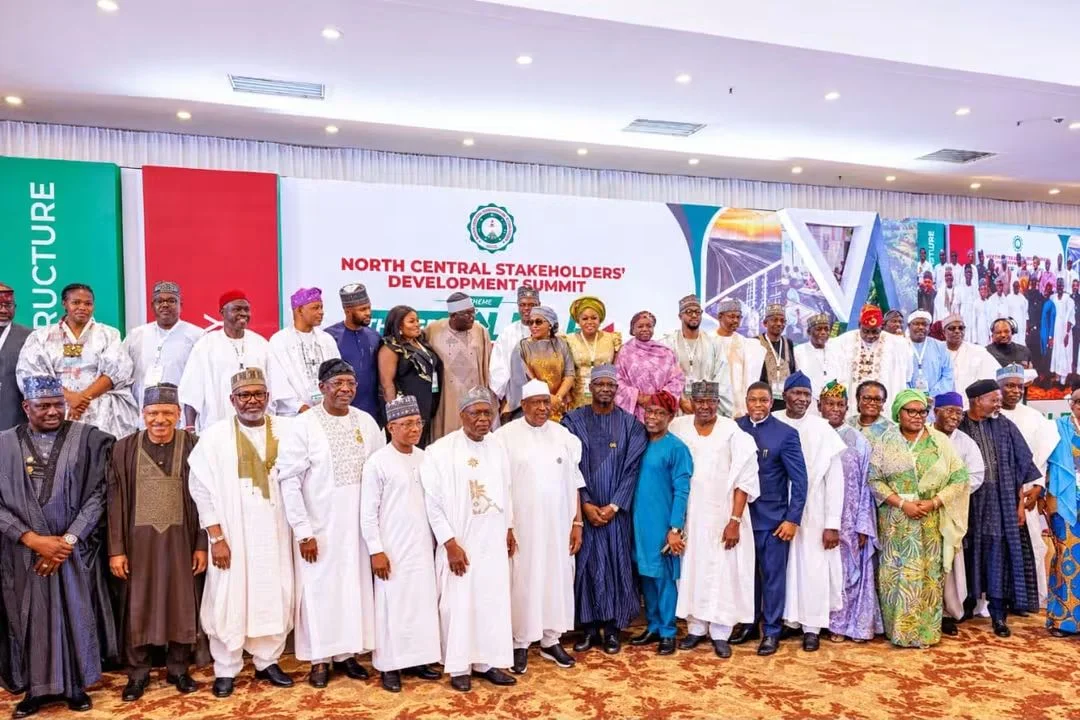
This is contained in a communique issued at the end of the NCDC Road Map and Stakeholders’ Development Summit held at the Abuja Continental Hotel, Abuja, from Sept. 14 to Sept. 15.

The communique was presented by the Chairman of the Technical Sub-Committee, Prof. Muhammad Nuhu, and adopted by participants at the close of the summit.

The theme of the summit was “The Great Leap Forward: A 20-Year Economic, Infrastructural and Social Development Plan for the North Central Region”.

The communique said the summit recorded 862 physical attendees and 49 online participants, including representatives of Federal Government, governors of mandate states and FCT, National Assembly members, traditional and religious leaders, development partners, private sector, academia, civil society and media.

It said the Managing Director of NCDC, Dr Cyril Tsenyil, welcomed participants and described the summit as beginning of inclusive, evidence-led development journey.

It added that the new NCDC logo was unveiled as symbol of unity and collective transformation.
According to the communique, the keynote speaker, Sen.

Iyorwuese Hagher, urged the region to convert its historic contributions, diversity, natural resources and human capital into shared prosperity.

It said the Governor of Nasarawa State and Chairman, North Central Governors’ Forum, Abdullahi Sule, underscored the region’s agricultural and mineral potential and formally presented the draft 20-year plan.

It said the Secretary to the Government of the Federation, Sen. George Akume, who represented the President, commended the consultative process and called for high-impact and fundable interventions.

The communique noted that North Central possesses extensive agricultural land, water, minerals, energy resources and strategic location, but assets had not translated to commensurate productivity and incomes.

It observed that fragmented planning; weak inter-state connectivity, insecurity, infrastructure gaps, limited value addition and inconsistent implementation had constrained regional growth.

It said security remains productive infrastructure, adding that plan must focus on catalytic, region-wide programmes with clear baselines and measurable outcomes.

The summit resolved to develop GIS-enabled regional economic database and map comparative advantages of each state during foundation horizon.

It resolved to build state-specific agricultural and livestock value chains around mechanisation, irrigation, storage, processing and export, and to formalise artisanal mining with mineral-processing clusters.

On infrastructure, it resolved to implement integrated programme connecting six states and FCT through strategic roads, rail, inland waterways and logistics, with priority to corridors unlocking agricultural land and markets.

It gave urgent consideration to Abuja-Lokoja road, regional rail, Baro inland-port logistics and dry-port connections.

It resolved to develop practical regional energy programme and integrate security, climate resilience and maintenance into project design.

On social development, it resolved to establish disaggregated human-capital and social-inclusion data system to guide interventions for children, youth, women, persons with disabilities and rural communities.

It also resolved to implement safe and inclusive education framework, expand STEM, technical and vocational pathways linked to regional value chains, and strengthen health access.

On security, it resolved to establish coordinated regional security and peace-building framework supporting statutory security institutions through intelligence sharing, early warning and inter-state coordination.

It also resolved to integrate security planning into farms, transport corridors, schools and markets and strengthen role of traditional institutions in peace-building.

On climate and environment, the summit resolved to develop North Central Climate and Disaster Resilience Programme with geo-referenced mapping of flood, erosion and drought hazards.

It resolved to undertake priority flood and erosion interventions, provide Safe Homes for climate-displaced persons, and adopt safeguard-before-scale principle for mining corridors.

On digital economy, it resolved to develop inclusive regional digital infrastructure programme, establish AI and digital-skills centres, and create innovation financing mechanism.

On financing, it resolved to match financing instruments to economics of each project, establish disciplined project-preparation pipeline, and mobilise public resources, development finance, PPPs, capital markets and diaspora capital.
On institutional delivery, it resolved to give plan durable legal backing, establish Programme Management Office within NCDC and define responsibilities across stakeholders, with public performance framework and regular reviews.

The summit further resolved that security, reliable data, inclusion, climate resilience, digital enablement and private-sector participation shall be treated as cross-cutting requirements.

It said young people, women, persons with disabilities, displaced persons and rural communities shall participate meaningfully in programme design.

Participants expressed appreciation to President Bola Tinubu for establishing NCDC and to governors of mandate states, FCT Minister, National Assembly and other stakeholders for their contributions.(NAN)(NAN)

Edited by Francis Onyeukwu

Continue Reading

Trending