News
Jay FM Condemns DSS Over Arrest, Detention of Two Journalists in Jos








Before the start of the 2026 WAFCON, some critics had argued that the expansion of the championship to 16 teams would lower the technical standard of the tournament and the characteristic excitements.
And ahead of the quater-finals stage, Sports Chronicle Magazine sought the views of a renowned sportspreneur and an investor in women and youth football development, Ayodele Thomas, on the ongoing championship.
He shared his views on the performances of the Super Falcons, so far, in the championship. He began by stating that the performances of the reigning WAFCON champions, the Super Falcons, have been encouraging.
“I would describe the Super Falcon’s performance so far, as encouraging, but inconsistent. The opening defeat was disappointing, particularly for the defending champions.
It exposed some defensive weaknesses. However, the team showed very good character in the subsequent games and the 6-2 victory over Egypt, was a significant statement of their attacking quality.”
Concerning the Super Falcons’ quater-finals clash against arch-rivals, he acknowledged that the Lionesses of Cameroon poses a great threat to the Nigerian women, considering their physicality and competitiveness.
“The Cameroon gave is a very serious test for Nigeria and one of the biggest rivalries in African women’s football. Historically, these matches have rarely been straightforward.
“On paper, Nigeria should have the quality and experience to win, particularly, because of the depth of the squad and the attacking options available.
But Cameroon will provide a completely different challenge from Egypt. They are physically strong, competitive and capable of making the game difficult for Nigeria.
“For me, the key to the match will be Nigeria’s defensive discipline and ability to control the midfield. We cannot afford to concede cheap goals and then rely on our attacking players to rescue the game. However, I would expect Nigeria to have the advantage,” he quipped.
Thomas, who is the President of TopPro Sports Management Company, went ahead to describe the standard of tournament as high and competitive.
“I think the overall standard of the 2026 WAFCON has been noticeably higher and more competitive than in previous editions,” he noted.
“The expansion to 16 teams, has provided more countries with the opportunity to compete at the highest continental level, and we are seeing less of the traditional gap between the established powers and the emerging teams.
The results and performances have shown that African women’s football is becoming increasingly competitive.
“Overall, I would say the tournament is competitive, entertaining and increasingly difficult to predict. Which is exactly what you want from a major continental championship.
“The fact that Nigeria, despite being the defending champions and the most successful nation in WAFCON history, had to fight hard to reach the quarterfinals is itself evidence of how competitive the women’s game in Africa has become,” Thomas remarked conclusively.
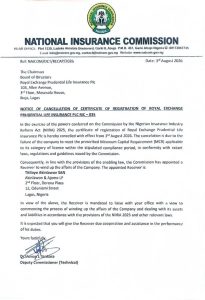
BY NKECHI NAECHE-ESEZOBOR—The National Insurance Commission (NAICOM), has revoked the certificate of registration for Royal Exchange Prudential Life Insurance PLC over its failure to meet the statutory minimum capital requirement under the Nigerian Insurance Industry Reform Act (NIIRA) 2025.
The cancellation, which took effect on Plc August 3, 2026, The regulator also ordered the immediate winding up of the firm’s operations.
The action was executed under the legal powers granted to the regulatory authority by the Nigerian Insurance Industry Reform Act (NIRA) 2025.
According to a notice signed by Deputy Commissioner (Technical) Decent Jankara, titled “Notice Of Cancellation Of Certificate Of Registration Of Royal Exchange Prudential Life Insurance Plc”, the regulator appointed Titilayo Akinlawon (SAN)as Receiver and Provisional Liquidator to oversee the winding up of its affairs.
The notice added that “The appointed Receiver is mandated to take control of the company’s affairs, liquidating its assets and settling its outstanding liabilities in strict accordance with NIRA 2025 regulations and extant insurance guidelines.”
“Relevant stakeholders and financial institutions have been instructed to cooperate fully with the Receiver during the official takeover and winding-up proceedings.”
This development comes days after NAICOM announced the completion of the insurance sector recapitalisation exercise and published a list of 43 insurance and reinsurance companies that met the July 31, 2026 compliance deadline.
The post Recapitalisation: NAICOM Revokes Royal Exchange Prudential Life Insurance License appeared first on Business Today NG.
-

 News2 days ago
Governor Mutfwang Begins Strategic Assessment to Restore Plateau’s Heritage, Boost Tourism
-
News3 days ago
Elon Musk repeatedly one-upped his execs on SpaceX’s first earnings call
-
Health3 days ago
Two deaths recorded as US battles Cyclosporiasis outbreak
-
News4 days ago
Osun political parties elect factional IPAC executive committee