Business
Heirs Insurance and United Capital Empower Women Through Yoga, Finance Meet-Up

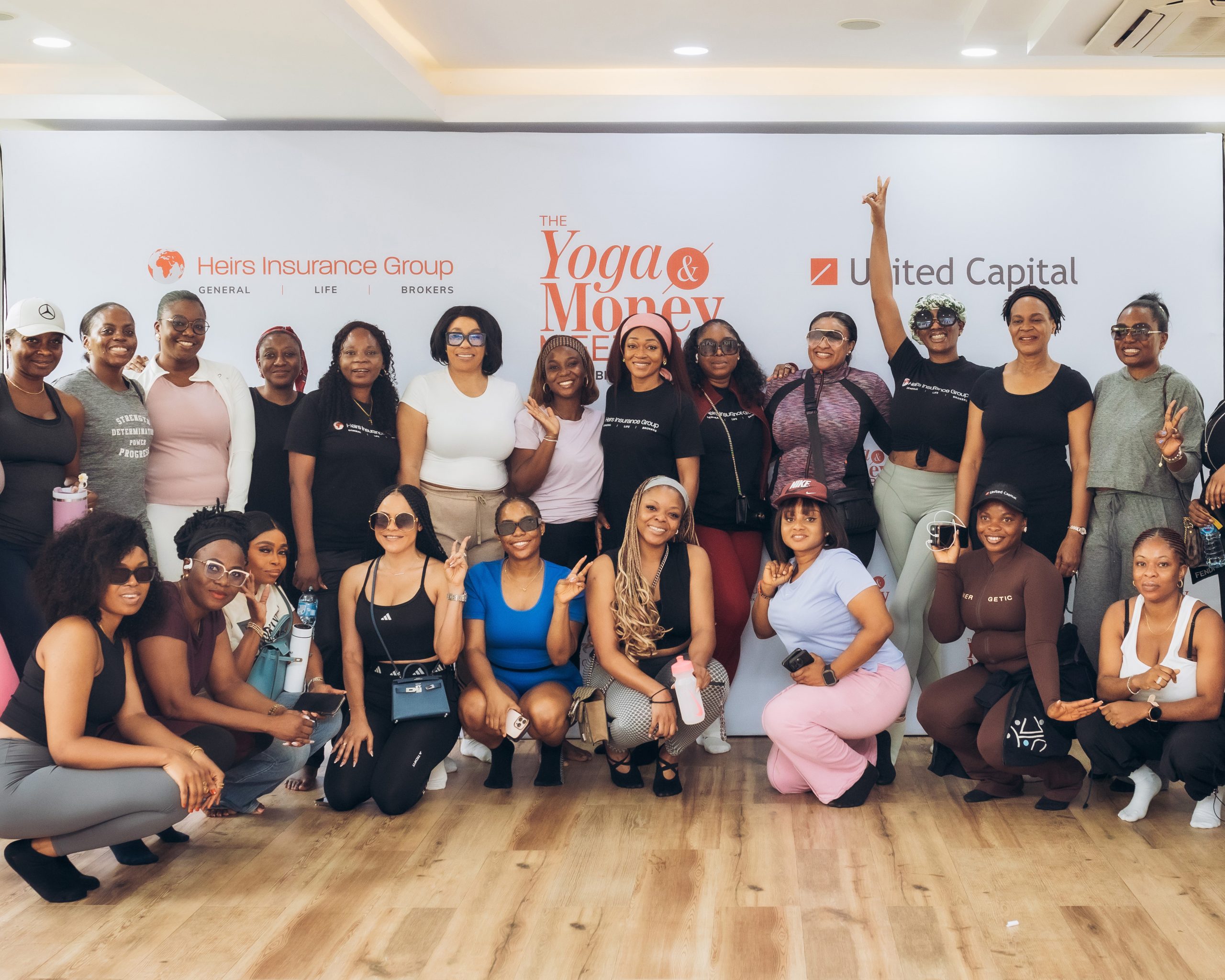
BY NKECHI NAECHE-ESEZOBOR—-Heirs Insurance Group and United Capital Plc have hosted the Yoga and Money Meet Up, an exclusive wellness and financial empowerment event for ambitious women.
The event, held in Lagos, offered a curated experience that combined guided yoga and stress management sessions with expert-led conversations on insurance, investment, and asset protection. It reinforced both companies’ commitment to making financial wellness relevant and accessible to Nigerian women.
Speaking on the initiative, Ifesinachi Okoli-Okpagu, Chief Marketing Officer at Heirs Insurance Group, underscored the strong link between insurance and wellness.
“Self-care is not just about indulgence; it is about making deliberate choices that safeguard one’s physical, mental, and financial well-being — and insurance is fundamental to that. For many women juggling careers, businesses, and family, this event addresses a significant pain point: how we protect our assets while still navigating life,” she said.
She also introduced the HerMotor insurance plan, designed for ambitious women who need more than just insurance.
The product offers comprehensive motor coverage against accidents, fire, theft, and other unforeseen incidents that may result in loss or damage to the policyholder’s car. An added benefit is the 24/7 emergency roadside assistance for female car owners during breakdowns caused by accidents or mechanical faults.
The first-of-its-kind solution in the industry is delivered in partnership with AA Rescue and includes a robust rewards programme through which customers can access discounts on spa services, wellness programmes, and more.
Dr Odiri Oginni, Managing Director of United Capital Asset Management, said the collaboration reflects a shared commitment to women’s empowerment.
“Empowerment is at the core of what we do, and co-creating an initiative that directly addresses the financial realities facing Nigerian women further emphasises this.
We recognise that financial independence and personal wellness are deeply interconnected, and by creating opportunities that bring both together, we are reinforcing our commitment to empowering women to confidently pursue and achieve their dreams. This vision informed the creation of our Wealth for Women Fund, which provides women with a secure and accessible avenue to invest smartly and build long-term financial security,” she said.
The Yoga and Money Meet Up reflects a joint vision to empower Nigerian women through financial education and protection.
Heirs Insurance Group is the insurance subsidiary of Heirs Holdings, which has investments across 24 countries and four continents. With a rapidly expanding retail footprint and an omnichannel digital presence, the group serves both corporate and individual customers across Nigeria.
United Capital Plc is a leading Pan-African financial and investment services group providing bespoke, value-added solutions to governments, corporations, and individuals across Africa.
With operations in Nigeria, Ghana, and Côte d’Ivoire, and a growing Pan-African footprint, the group leverages technology, specialist expertise, and retail-led platforms such as InvestNow to deliver cutting-edge financial solutions.
United Capital has been recognised by the Financial Times as one of Africa’s fastest-growing companies for three consecutive years.
The post Heirs Insurance and United Capital Empower Women Through Yoga, Finance Meet-Up appeared first on Business Today NG.

Artificial intelligence (AI) could help developing countries achieve in a decade what might otherwise take a century, according to the World Bank’s report.
The lender said governments must act swiftly to address gaps in electricity, connectivity, skills and institutional quality that could leave them behind.
The World Bank disclosed this in its latest World Development Report 2026, titled ‘The Promise of Artificial Intelligence’.
The report surveyed enterprises’ AI adoption in developing economies, sampling 777 firms in Nigeria.
The World Bank, in its report, urged developing economies to adopt an optimistic mindset, noting that AI could help governments reach billions of underserved people with medical, legal, educational, and agricultural services more quickly.

“AI could help extend otherwise costly medical, legal, educational, and agricultural services to the underserved billions—doing in a decade what might otherwise take a century,” the report stated.
It noted that jobs in high-income countries are more than three times as likely to be at risk of automation by generative AI as those in low- and middle-income countries, where 4.5 per cent of existing jobs are at risk, compared with 14.2 per cent in high-income countries.
At the same time, 16.2 per cent of jobs in developing economies could see their productivity meaningfully boosted by AI, close to the 18.7 per cent expected in high-income countries.
The greatest promise for developing countries lies not in replacing workers, but in amplifying what they can do, the report said.
“AI has thrown developing economies a lifeline, and they should seize it,” Indermit Gill, Senior Vice President and Chief Economist of the World Bank Group, added in the report.
He explained that developing economies do not need large models or big data centres to reap the benefits of AI adoption.
By adapting small, low-cost AI tools to local conditions, they can bring better medical care, education, judicial services and agricultural extension within reach of millions, the World Bank chief stated.
The report is the first comprehensive assessment of AI’s implications for developing countries, revealing how businesses and governments there have begun to use AI.
It revealed that AI is already helping people, businesses, and governments solve problems, analyse information, improve forecasts and deliver services on a larger scale.
These capabilities are especially valuable in countries where trained professionals, reliable records and public capacity are often limited.
According to the World Bank, AI tools can make it easier for doctors to diagnose patients, farmers to make better crop decisions, and businesses to become more productive.
Governments, too, could use AI to improve tax collection, social programmes, disaster response, healthcare, and education, it added.
The lender said AI could significantly boost the weak growth performance of developing countries before the end of the 2020s while delivering tangible benefits to people.
READ ALSO: Engaging the blackbox-glassbox paradox: Media imperatives in the era of artificial intelligence, By Omoniyi Ibietan
The report added that the opportunity is limited, noting that most developing economies still lack the power, internet access, data, skills and institutions needed to use AI effectively.
The report stated that, without deliberate action, AI could widen disparities between countries, increase inequality within them, concentrate market power, weaken trust in public institutions, and create new risks to safety, rights, and social cohesion.
The report outlines a clear three-stage approach: adopt available tools, tailor them to local circumstances, and gradually progress towards frontier AI development.
Discover more from Premium Times Nigeria
Subscribe to get the latest posts sent to your email.
-

 News4 days ago
Gagdi Mourns Former Plateau Speaker Peter Azi, Describes Him as a Man of Humility and Kindness
-
Business2 days ago
Plateau Strengthens Technical Education, Prepares NITT Centre for September Take-Off
-
Business3 days ago
NGX Trading Volume Surges 127% as Investors Exchange ₦176.06bn in One Week
-
Business4 days ago
EFCC recovers $60 million for Nestoil lenders in ongoing debt investigation