News
“Go All the Way and Clinch the Trophy” — NFF’s Emmanuel Ikpeme Raises the Target After Falconets Crush England


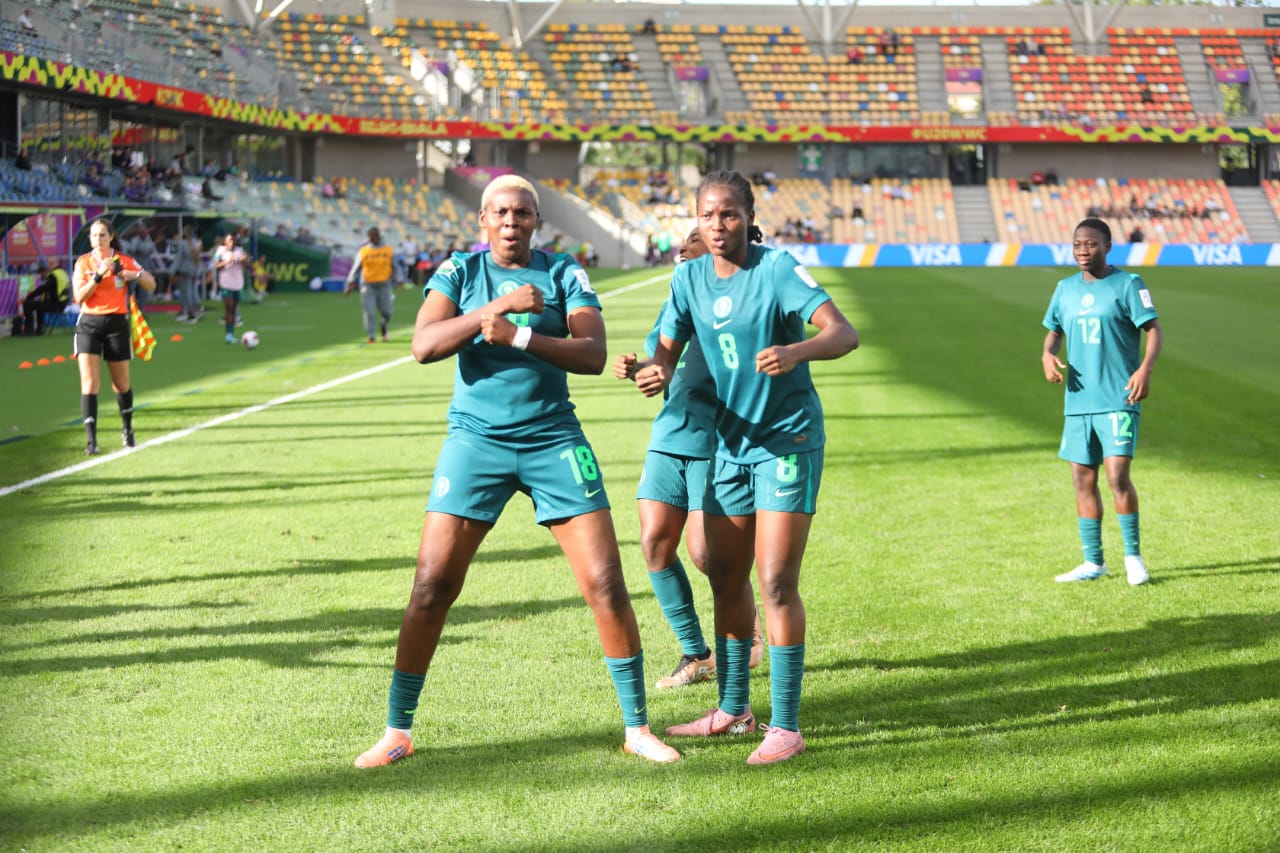
Nigeria Football Federation Acting General Secretary Dr Emmanuel Ikpeme has challenged the Falconets to go all the way and win the 2026 FIFA U-20 Women’s World Cup after their commanding 3-0 victory over England sent them into the quarter-finals in Poland.
Ikpeme hailed the result as a major achievement for Nigerian football but made it clear that reaching the last eight should not represent the end of the ambition for Moses Aduku’s side.
“This win is a great feat by the Falconets,” Ikpeme said after Thursday’s Round of 16 triumph.
“We are delighted at the dominant performance and we will continue to encourage and motivate the girls until they go all the way to clinch the trophy.”
His comments came after the Falconets produced arguably their biggest performance of the tournament to eliminate England and preserve Nigeria’s hopes of winning the U-20 Women’s World Cup for the first time.
Nigeria took control of the knockout encounter early, with Tosin Rafiu opening the scoring in the eighth minute.
England were presented with a major opportunity to equalise in the 36th minute, but Rachel Maltby failed to convert from the penalty spot, allowing the Falconets to carry their advantage into half-time.
Nigeria then struck almost immediately after the restart.
Janet Akekoromowei doubled the advantage in the 47th minute, putting England under enormous pressure before Mercy Mamudu added the third in the 73rd minute to effectively settle the contest.
The 3-0 victory was particularly impressive given England enjoyed more possession, but Nigeria were considerably more clinical in the decisive areas.
It also continued an extraordinary turnaround for the Falconets.
Aduku’s team collected only one point from their opening two Group F matches after losing 2-0 to Spain and drawing 0-0 with China PR.
With their tournament survival on the line, Nigeria responded by demolishing New Caledonia 10-1 in their final group fixture, the country’s biggest-ever victory at the competition, to qualify for the Round of 16.
They have now followed that 10-goal performance with three unanswered goals against England, meaning the Falconets have scored 13 goals without conceding across their last two matches.
Nigeria also entered the England encounter carrying the continent’s remaining hopes after becoming Africa’s last surviving representative in the tournament.
For Ikpeme, however, the journey should extend considerably further.
Nigeria have come agonisingly close to becoming world champions at this level before, reaching the FIFA U-20 Women’s World Cup final in 2010 and 2014 but finishing runners-up on both occasions.
The NFF acting general secretary now wants the current generation to take the additional steps required to finally bring the trophy home.
Head coach Aduku is equally looking ahead rather than dwelling on the England victory.
Following the match, he expressed satisfaction with his players’ performance before immediately turning attention towards the quarter-finals.
“I am happy they did that. We will go back to Łódź and aim for victory against either Poland or Colombia on Sunday,” Aduku said.
Nigeria will therefore return to Łódź knowing another victory will put them into the semi-finals and move them closer to the ultimate target Ikpeme has now publicly set.
The Falconets have already survived a difficult group stage, produced a record 10-goal victory and eliminated England without conceding.
But the message coming from the NFF is that none of those achievements should represent the finishing line.
For Ikpeme, the target has moved beyond reaching another round: keep winning, go all the way — and return from Poland as world champions.








The Federal Government has begun processes to clear the backlog of Export Expansion Grant (EEG) payments and reform the scheme for sustainability.
The Minister of Industry, Trade and Investment, Jumoke Oduwole, said this at a stakeholders engagement on the EEG scheme in Abuja on Thursday.
Mrs Oduwole said the scheme had faced difficulties, with payments outstanding since 2020, leaving the current administration with significant payment backlogs.
She said the backlog required validation and verification of claims submitted by exporters, involving several government agencies.
According to her, the Federal Ministry of Finance, Central Bank of Nigeria (CBN) and other relevant agencies are involved in the process.
The minister said the Federal Ministry of Industry, Trade and Investment anchored the EEG as an export promotion tool under the Nigerian Export Promotion Council (NEPC).


She said the government was pursuing two pathways: clearing outstanding payments and restructuring the scheme to make it sustainable.
The minister said the reforms aligned with President Bola Tinubu’s Renewed Hope Agenda and the goal of building a one trillion dollar economy.
She said the agenda prioritised economic diversification and non-oil exports as part of efforts to strengthen Nigeria’s productive capacity.
Mrs Oduwole said Nigerian non-oil exporters had recorded growth in both volume and value over the past two years.
She said the government would continue to incentivise exporters sustainably because the sector could create jobs and expand the global market for Nigerian products.
The minister said the government had also been working to improve market access through trade agreements, including the African Continental Free Trade Area (AfCFTA).
She said payments already approved in May 2023 would be transmitted to the 10th National Assembly for consideration and approval.
Mrs Oduwole explained that the National Assembly would carry out its duties legislative before the Federal Government could issue the necessary instruments for payment.
READ ALSO: CBN, trade ministry speak on AfCFTA trade reforms at Citibank forum
“President Tinubu has also approved earmarking 40 per cent of the NEST Fund toward a trade facilitation fund.
“The independently managed fund will provide a sustainable pathway for settling EEG obligations and supporting trade facilitation.
“Once the National Assembly approves the payments, government can issue promissory notes through the Debt Management Office to clear the backlog.
“The government will thereafter establish a reformed framework for export expansion incentives,” she said.
According to Mrs Oduwole, the current EEG structure is unsustainable because it is too expensive and has no closing date.
She said the reformed scheme would discourage the export of raw materials and place greater emphasis on value-added and finished products.
The minister said the scheme would also support emerging businesses and target sectors requiring assistance to improve their export competitiveness.
Mrs Oduwole said the government had engaged stakeholders, including the NEPC and the Manufacturers Association of Nigeria Export Group, to develop a sustainable way forward for the scheme.
(NAN)
Discover more from Premium Times Nigeria
Subscribe to get the latest posts sent to your email.
News
Nigeria’s fibre footprint crosses 101,000km as Lagos, Abuja and 6 states top deployment – Technology Times
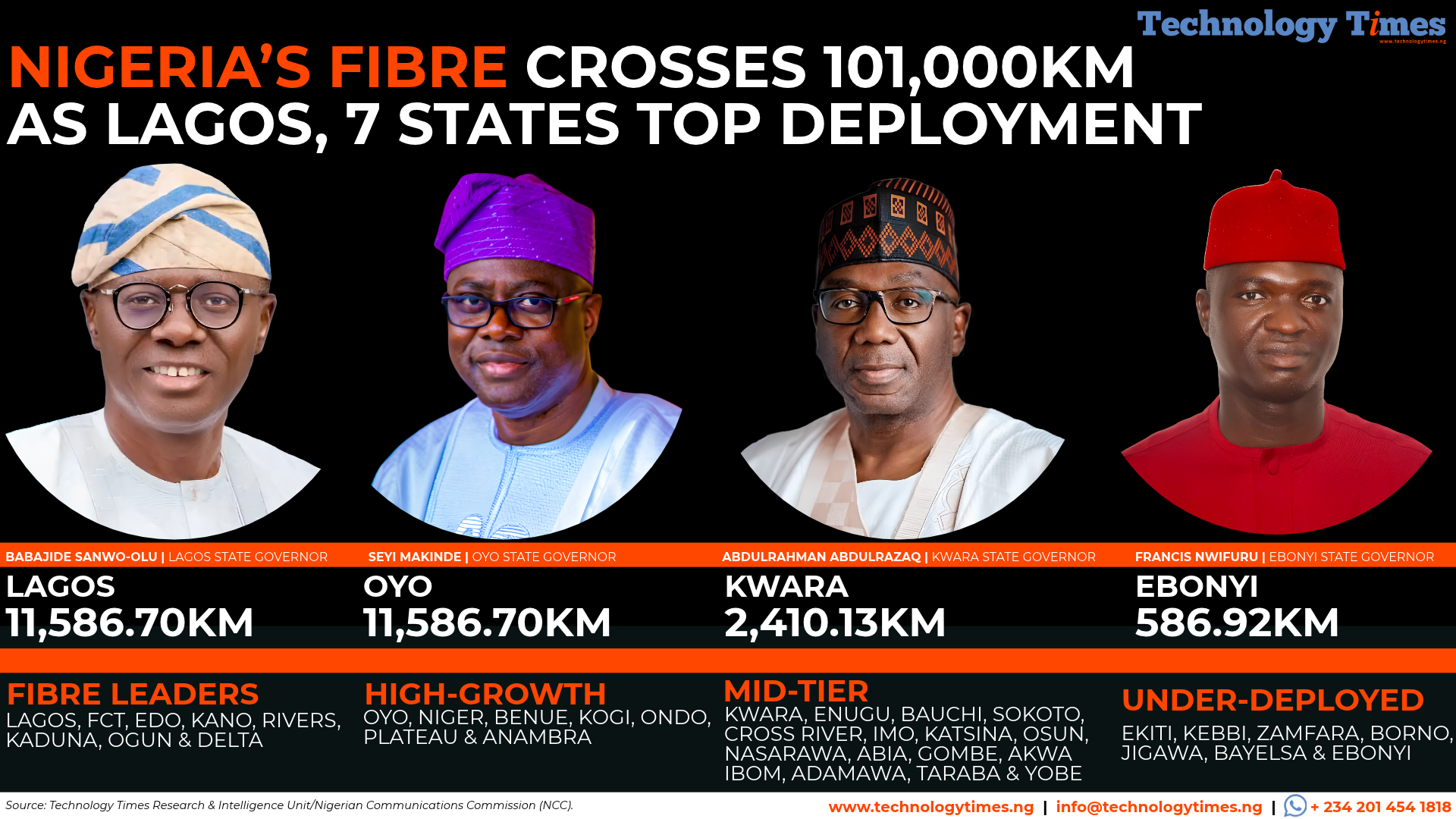
Nigeria’s fibre infrastructure deployment has crossed 101,000 kilometres, with Lagos, the Federal Capital Territory and six other states accounting for nearly 45% of the national footprint, according to state-level official data reviewed by Technology Times.
Nigeria’s digital infrastructure landscape is showing a broadening fibre footprint across the country, but the distribution of that infrastructure remains markedly uneven, with a relatively small group of states emerging as the country’s most extensively deployed markets.
An analysis of state-by-state digital infrastructure deployment data released by the Nigerian Communications Commission (NCC) shows 101,148.36 kilometres of fibre deployed across Nigeria’s 36 states and the Federal Capital Territory (FCT).
The data, which also tracks base transceiver station (BTS) sites and operators, provides a detailed picture of the geographical distribution of telecommunications infrastructure across the country.
Technology Times’ analysis segments the 37 jurisdictions into four categories based on fibre deployment: Fibre Leaders, High-growth markets, Established/mid-tier markets, and Emerging/under-deployed markets. The segmentation reveals a pronounced concentration at the top of the market.
| Category | Fibre Deployment Range | States | Number of Jurisdictions |
|---|---|---|---|
| Fibre Leaders | 4,000 KM and above | Lagos (11,586.70 KM); FCT, Abuja (6,973.13 KM); Edo (4,789.72 KM); Kano (4,616.71 KM); Rivers (4,616.01 KM); Kaduna (4,339.85 KM); Ogun (4,246.48 KM); Delta (4,202.62 KM) | 8 |
| High-Growth Markets | 3,000–3,999 KM | Oyo (3,585.15 KM); Niger (3,383.43 KM); Benue (3,187.34 KM) | 3 |
| Established/Mid-Tier Markets | 2,000–2,999 KM | Ondo (2,592.80 KM); Plateau (2,567.00 KM); Kogi (2,633.81 KM); Anambra (2,547.34 KM); Kwara (2,410.13 KM); Enugu (2,319.46 KM); Bauchi (2,161.51 KM); Sokoto (2,131.51 KM); Cross River (2,039.68 KM) | 9 |
| Emerging/Under-Deployed Markets | Below 2,000 KM | Imo (1,998.27 KM); Katsina (1,887.47 KM); Osun (1,825.63 KM); Nasarawa (1,725.96 KM); Abia (1,719.03 KM); Gombe (1,652.36 KM); Akwa Ibom (1,606.60 KM); Adamawa (1,556.39 KM); Taraba (1,549.50 KM); Yobe (1,526.82 KM); Ekiti (1,486.73 KM); Kebbi (1,355.83 KM); Zamfara (1,100.98 KM); Borno (1,012.52 KM); Jigawa (970.10 KM); Bayelsa (656.87 KM); Ebonyi (586.92 KM) | 17 |
| Total | — | 37 jurisdictions | 37 |
Eight jurisdictions classified as Fibre Leaders, each with at least 4,000km of fibre deployed, account for 45,371.22km, or approximately 44.9% of the national fibre footprint.
Eight jurisdictions classified as Fibre Leaders, each with at least 4,000km of fibre deployed, account for 45,371.22km, or approximately 44.9% of the national fibre footprint.
At the other end of the spectrum, seven jurisdictions classified as Emerging/under-deployed markets, each with less than 1,500km, collectively account for only 7,169.95km, representing about 7.1% of the national deployment.
The figures point to substantial progress in the expansion of Nigeria’s digital infrastructure while also highlighting the scale of the deployment gap that remains between the country’s strongest connectivity markets and its least-deployed states.

Lagos alone therefore accounts for more than one-tenth of the fibre deployed across the jurisdictions covered by the data.
The state also records 7,996 BTS sites, the highest figure in the dataset by a wide margin.
Its operator ecosystem is equally extensive, comprising Globacom, IHS, MTN, GBB, Airtel, MainOne, Fibreworld, EMTS, Phase3, Swiftnet, Broadbased, Layer3, Spectranet and ATC.
Lagos remains in a class of its own
Lagos is the dominant fibre market in the country, with 11,586.70km of deployed fibre, according to the dataset.
The figure places Lagos substantially ahead of every other jurisdiction. The FCT, which ranks second, has 6,973.13km, meaning Lagos has approximately 4,614km more fibre than the federal capital.
Lagos alone therefore accounts for more than one-tenth of the fibre deployed across the jurisdictions covered by the data.
The state also records 7,996 BTS sites, the highest figure in the dataset by a wide margin.
Its operator ecosystem is equally extensive, comprising Globacom, IHS, MTN, GBB, Airtel, MainOne, Fibreworld, EMTS, Phase3, Swiftnet, Broadbased, Layer3, Spectranet and ATC.
The combination of extensive fibre infrastructure, a large BTS footprint and the presence of numerous network and infrastructure providers underlines the exceptional density of Nigeria’s digital infrastructure in Lagos.
The figures indicate that Lagos remains the country’s primary connectivity hub, where multiple infrastructure networks have developed in response to concentrated demand from businesses, financial institutions, technology companies, consumers and other users of high-capacity digital services.
Abuja anchors the second pole of deployment
The FCT, Abuja, is the second-largest fibre market with 6,973.13km of deployment and 2,884 BTS sites.
Its fibre footprint is more than half that of Lagos but remains significantly ahead of every other jurisdiction except the commercial and industrial markets in the country’s top tier.
The FCT also has one of the broadest operator ecosystems in the dataset, with Globacom, BCN, IHS, MTN, Airtel, GBB, MainOne, EMTS, Phase3, IMBL, Layer3 and Spectranet represented.
Together, Lagos and the FCT account for 18,559.83km, representing approximately 18.4% of the entire fibre footprint in the dataset.
The concentration is significant because it means almost one-fifth of Nigeria’s recorded fibre deployment is located in just two jurisdictions.

The emergence of these states as fibre leaders suggests that deployment is not simply following population concentration. Commercial activity, regional connectivity, enterprise demand, industrial development and the strategic importance of particular cities and transport corridors are also likely to influence where infrastructure is concentrated.
Eight Fibre Leaders dominate the top tier
Beyond Lagos and Abuja, six states have crossed the 4,000km mark: Edo, Kano, Rivers, Kaduna, Ogun and Delta.
Edo records 4,789.72km, Kano 4,616.71km, Rivers 4,616.01km, Kaduna 4,339.85km, Ogun 4,246.48km, and Delta 4,202.62km.
Technology Times classifies these eight jurisdictions, including Lagos and the FCT, as Fibre Leaders.
Collectively, they account for 45,371.22km, equivalent to approximately 44.9 per cent of the national fibre deployment contained in the dataset.
The geographical composition of this group is also notable.
It includes major markets in the South-West, South-South, South-East/North-Central corridor and Northern Nigeria. Lagos and Ogun provide a powerful South-West concentration; Edo provides a major South-South and national corridor; Rivers and Delta reinforce connectivity in the oil-producing region; while Kano and Kaduna represent major northern markets.
The emergence of these states as fibre leaders suggests that deployment is not simply following population concentration. Commercial activity, regional connectivity, enterprise demand, industrial development and the strategic importance of particular cities and transport corridors are also likely to influence where infrastructure is concentrated.
| State | Fibre Deployed (KM) | BTS Sites |
|---|---|---|
| Abia | 1,719.03 | 1,230 |
| Adamawa | 1,556.39 | 738 |
| Akwa Ibom | 1,606.60 | 1,225 |
| Anambra | 2,547.34 | 1,765 |
| Bauchi | 2,161.51 | 932 |
| Bayelsa | 656.87 | 436 |
| Benue | 3,187.34 | 1,064 |
| Borno | 1,012.52 | 579 |
| Cross River | 2,039.68 | 917 |
| Delta | 4,202.62 | 2,145 |
| Ebonyi | 586.92 | 422 |
| Edo | 4,789.72 | 2,138 |
| Ekiti | 1,486.73 | 582 |
| Enugu | 2,319.46 | 1,321 |
| FCT, Abuja | 6,973.13 | 2,884 |
| Gombe | 1,652.36 | 491 |
| Imo | 1,998.27 | 1,345 |
| Jigawa | 970.10 | 565 |
| Kaduna | 4,339.85 | 1,815 |
| Kano | 4,616.71 | 1,813 |
| Katsina | 1,887.47 | 838 |
| Kebbi | 1,355.83 | 659 |
| Kogi | 2,633.81 | 895 |
| Kwara | 2,410.13 | 1,117 |
| Lagos | 11,586.70 | 7,996 |
| Nasarawa | 1,725.96 | 966 |
| Niger | 3,383.43 | 1,524 |
| Ogun | 4,246.48 | 3,472 |
| Ondo | 2,592.80 | 1,044 |
| Osun | 1,825.63 | 1,088 |
| Oyo | 3,585.15 | 2,345 |
| Plateau | 2,567.00 | 983 |
| Rivers | 4,616.01 | 2,593 |
| Sokoto | 2,131.51 | 606 |
| Taraba | 1,549.50 | 673 |
| Yobe | 1,526.82 | 433 |
| Zamfara | 1,100.98 | 362 |
Seven states form the high-growth market
The second category comprises states with 2,500km to 3,999km of deployed fibre.
Technology Times classifies Oyo, Niger, Benue, Kogi, Ondo, Plateau and Anambra as High-growth markets.
Oyo leads this group with 3,585.15km, followed by Niger at 3,383.43km and Benue at 3,187.34km.
Kogi has 2,633.81km, Ondo 2,592.80km, Plateau 2,567km, and Anambra 2,547.34km.
Together, the seven states account for 20,496.87km, or about 20.3% of the national deployment.
This is a strategically important segment because these states already have substantial fibre infrastructure but remain below the 4,000km threshold used to define the leading group.
Oyo, for instance, is only about 415km short of that threshold based on the dataset.
The high-growth category also provides one of the clearest indications that fibre deployment is spreading beyond Nigeria’s most established telecommunications markets.
The presence of Niger, Benue, Kogi and Plateau in this group indicates that substantial infrastructure deployment is taking place across central and northern corridors, while Oyo, Ondo and Anambra demonstrate strong fibre footprints in the southern part of the country.

Unlike the Fibre Leaders, whose deployment levels are concentrated in eight jurisdictions, the established/mid-tier category stretches across a much wider geographical area.
It includes states from the North-West, North-East, North-Central, South-East and South-South.
The data therefore suggests that Nigeria’s fibre infrastructure is no longer exclusively a story of Lagos, Abuja and a handful of major commercial centres.
Fifteen states form the established and mid-tier market
The largest segment comprises 15 jurisdictions with between 1,500km and 2,499km of fibre.
These are Kwara, Enugu, Bauchi, Sokoto, Cross River, Imo, Katsina, Osun, Nasarawa, Abia, Gombe, Akwa Ibom, Adamawa, Taraba and Yobe.
Kwara leads this category with 2,410.13km, followed by Enugu at 2,319.46km, Bauchi at 2,161.51km and Sokoto at 2,131.51km.
Cross River records 2,039.68km, while Imo has 1,998.27km.
The remaining states in the segment range from Katsina’s 1,887.47km to Yobe’s 1,526.82km.
Collectively, the 15 states account for 28,110.32km, or approximately 27.8% of the national fibre footprint.
This group is particularly important because it demonstrates the breadth of Nigeria’s infrastructure development.
Unlike the Fibre Leaders, whose deployment levels are concentrated in eight jurisdictions, the established/mid-tier category stretches across a much wider geographical area.
It includes states from the North-West, North-East, North-Central, South-East and South-South.
The data therefore suggests that Nigeria’s fibre infrastructure is no longer exclusively a story of Lagos, Abuja and a handful of major commercial centres.
A significant second layer of infrastructure has emerged across the country.
Seven jurisdictions remain below 1,500km
At the lower end of the deployment spectrum are Ekiti, Kebbi, Zamfara, Borno, Jigawa, Bayelsa and Ebonyi.
Technology Times classifies these jurisdictions as Emerging/under-deployed markets, reflecting their fibre footprints of less than 1,500km.
Ekiti records 1,486.73km, Kebbi 1,355.83km, Zamfara 1,100.98km, Borno 1,012.52km, Jigawa 970.10km, Bayelsa 656.87km, and Ebonyi 586.92km.
The seven states collectively account for 7,169.95km, or only about 7.1% of the fibre deployed across the 37 jurisdictions.
The gap is most visible at the bottom of the table.
Ebonyi’s 586.92km is just over 5% of Lagos’ 11,586.70km. Bayelsa’s 656.87km is also substantially below the footprint recorded in the leading markets.

However, Technology Times wishes to indicate that the classification should not be interpreted as a measure of broadband quality or Internet usage in those states. Fibre kilometres measure physical deployment; they do not independently establish how much of the infrastructure is active, where it is located, how many users it serves, network capacity, service affordability or the quality of the resulting broadband experience.
Fibre deployment and BTS sites reveal different infrastructure patterns
The table also provides an interesting comparison between fibre deployment and BTS infrastructure.
Lagos leads both measures, with 11,586.70km of fibre and 7,996 BTS sites.
But the relationship is not uniform across the country.

Ogun, for example, has 4,246.48km of fibre and 3,472 BTS sites, while Edo has more fibre at 4,789.72km but records 2,138 BTS sites.
Rivers has 4,616.01km of fibre and 2,593 BTS sites, while Oyo has 3,585.15km of fibre and 2,345 BTS sites.
These variations suggest that fibre deployment is serving a broader infrastructure role than simply connecting mobile base stations.
Fibre can support mobile backhaul, enterprise connectivity, fixed broadband, data centres, Internet service providers, cloud infrastructure and other high-capacity digital services.
The data therefore points to a telecommunications infrastructure ecosystem in which fibre and wireless infrastructure are complementary rather than interchangeable.

The next phase of Nigeria’s connectivity story will consequently be defined not merely by adding more kilometres to the national fibre map, but by narrowing the distance between the leaders and the least-deployed markets.
Operator diversity is another defining feature
The NCC data also reveals significant variation in the number of infrastructure operators present across states. The leading markets generally have multiple providers.
Lagos has the largest operator ecosystem in the table, while the FCT, Kano, Ogun, Edo, Kaduna, Delta and Rivers also show significant operator representation.
At the other end, some of the under-deployed markets have fewer providers.
This difference matters because the depth of an infrastructure market can influence the availability of alternative routes, competition, network resilience and the ability of businesses and institutions to obtain connectivity services.
The data does not, however, establish the market share or utilisation of individual operators, so conclusions about competitive dominance would require additional information.
Nigeria’s next fibre challenge is distribution
The overall picture from the NCC fibre deployment across Nigeria is therefore one of significant infrastructure expansion accompanied by persistent geographical concentration.
The country has crossed the 100,000km mark in the dataset, but almost 45% of the fibre footprint is concentrated in the eight Fibre Leaders.
Meanwhile, 15 established/mid-tier states account for another 27.8%, while the seven high-growth markets contribute 20.3%. This leaves just over 7% of the national deployment in the seven Emerging/under-deployed markets.
The implication is that Nigeria’s fibre challenge is becoming increasingly less about whether fibre exists and more about where it exists, how deeply it penetrates local markets, and how effectively it is converted into usable connectivity.
The Nigerian telecoms regulator, NCC, has continued to emphasise faster fibre and Fibre-to-the-Home deployment as critical to expanding broadband access and supporting Nigeria’s digital economy.
For the states already in the Fibre Leaders category, the next challenge may increasingly involve utilisation, redundancy, resilience, last-mile connections and capacity expansion.
For the High-growth markets, the priority is likely to be sustaining deployment momentum and moving infrastructure deeper into secondary cities and economic clusters.
For the Established/mid-tier markets, the opportunity lies in converting existing infrastructure into broader economic participation.
And for the Emerging/under-deployed markets, the central issue is closing the physical infrastructure gap.
The significance of this distinction will become more pronounced as digital services become increasingly dependent on reliable high-capacity networks.
Nigeria’s digital economy cannot be built solely on infrastructure concentrated in its largest commercial centres. The ability of businesses, schools, hospitals, government institutions, financial services providers and households in less-connected markets to participate in the digital economy will increasingly depend on the availability and quality of local connectivity infrastructure.
The data reviewed by Technology Times therefore presents a two-sided picture.
On one side, Nigeria has built a substantial fibre infrastructure footprint extending across all 36 states and the FCT. On the other hand, the distribution of that infrastructure remains highly uneven.
Lagos and Abuja remain the dominant poles, eight jurisdictions have established themselves as Fibre Leaders, seven are moving into the High-growth category, 15 occupy the Established/mid-tier space, while seven remain Emerging/under-deployed.
The next phase of Nigeria’s connectivity story will consequently be defined not merely by adding more kilometres to the national fibre map, but by narrowing the distance between the leaders and the least-deployed markets.
-

 News1 day ago
Nigeria Takes on the World! Chess Stars Begin 2026 Olympiad Battle in Samarkand
-
News2 days ago
Felix Arome Assumes Office as Director-General of Front Line Alliance Network
-
Health3 days ago
97% of PHCs in 16 states fail national staffing standards – Report
-
Health3 days ago
Nigerian senator receives Health Champion 2026 award, calls for stronger health financing