Connect with us

Business

Leadway Backs ISSP to Deepen Insurance Penetration, Consumer Trust

info

Published

on

Leadway Assurance Limited has launch Insurance Sector Strengthening Programme (ISSP), a five-year initiative.

The programme, held in Abuja, was designed to address key challenges limiting insurance growth in Nigeria, including low public awareness, weak consumer confidence, inadequate distribution, capacity constraints, and limited insurance adoption among women, young people, and Micro, Small and Medium Enterprises (MSMEs).

Speaking at the launch in Abuja, the Commissioner for Insurance and Chief Executive of NAICOM, Mr Olusegun Ayo Omosehin, said the programme would provide a coordinated framework to translate industry reforms into measurable improvements in insurance coverage and consumer confidence.

 “The ISSP initiative will focus on six key areas: advocacy and policy, awareness and education, capacity building, gender inclusion, youth engagement, and MSME and value-chain development. Efforts to expand insurance coverage must be supported by strong underwriting standards, good corporate governance, effective claims administration, transparency and adequate policyholder protection. Regulation must serve as both a shield for policyholders and a compass for responsible market development.”

Also, the Head, Commercial Division, Leadway Assurance, Mr. Olawale Alao, described the ISSP as a timely intervention capable of tackling both the structural and perception-related challenges confronting the industry.
Alao said the programme offered stakeholders a structured platform to identify market gaps and develop practical solutions to improve public understanding and participation.

He said its success would largely depend on changing the perception of insurance from an optional financial product to an essential part of everyday life and financial planning.’

“Over the next five years, we believe this initiative can deepen awareness, particularly among young Nigerians, build stronger trust in the sector and encourage more people to see insurance as an essential tool for protection and financial resilience,” he said.

”Increasing the number of policyholders alone would not be sufficient, stressing that Nigerians must also understand the value of insurance and be able to incorporate it into their everyday financial decisions. He added that stronger awareness and confidence in insurance would be particularly important among younger Nigerians, who represent a major part of the country’s future consumer and investment base.Also speaking on this initiative, Team Lead of the ISSP Design Team and Managing Director of EMDI Capacity Development Ltd., Bukola Ifemade, called for urgent and coordinated action to unlock the trillion-naira potential of Nigeria’s insurance sector.

“This flag-off marks the beginning of this mobilisation. Success will require strong partnerships and a sustained commitment to innovation and inclusion,” he said.

The ISSP executive summary estimates that only about five per cent of Nigeria’s population currently has insurance coverage, while 78 per cent lack basic insurance knowledge. Women account for 32 per cent of policyholders, people aged 18 to 35 make up less than 20 per cent of the industry’s customer base, and insurance penetration among MSMEs is estimated at eight per cent. To address these gaps, the programme will target five million members of the general population, two million women entrepreneurs and decision-makers, 1.5 million young Nigerians and 250,000 MSMEs across Nigeria.

For Leadway, supporting the ISSP aligns with its commitment to building a formidable insurance industry by enhancing awareness, building consumer confidence, and making financial protection more accessible to individuals, families, and businesses.

About Leadway Assurance

Leadway Assurance is one of Nigeria’s foremost non-banking financial services groups, offering diversified solutions across insurance, pensions, health, and asset management. Founded in 1970, the company has built a legacy of trust and innovation, serving millions of individuals and businesses across Nigeria and West Africa.

The post Leadway Backs ISSP to Deepen Insurance Penetration, Consumer Trust appeared first on Business Today NG.
Continue Reading
Click to comment

Leave a Reply

Your email address will not be published. Required fields are marked *

Business

Finance must break developing countries from ‘debt and disaster’ loop – UN climate chief

info

Published

on

WhatsApp Image 2026 11 13 at 21.43.24.jpeg

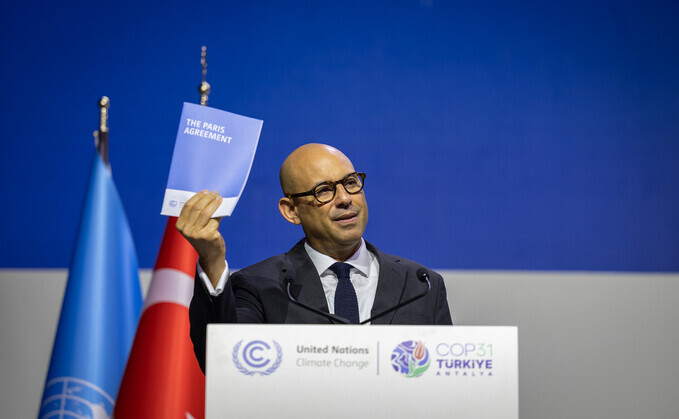
The executive secretary of UN Climate Change, Simon Stiell, told the ministers at COP31 that climate finance must be redesigned to lift developing countries out of a cycle of debt and disaster, adding that meeting a headline figure will not do it.

“Meeting a financial target does not always meet countries’ needs. To do that, we need to look at how finance is delivered,” Mr Stiell said on Friday at the opening of a high-level ministerial dialogue on climate finance in Antalya, Turkey.

Countries agreed at COP29 that developed nations would lead in providing $300 billion a year by 2035, as part of a wider effort to raise $1.3 trillion annually from all sources.

Mr Stiell said the roadmap for reaching those sums “must become reality”, but that the terms of the money mattered as much as the amount.

“Many developing countries are trapped in a downward loop of debt, disaster, and devastating capital costs,” he said. “The threat of floods, fires, storms and droughts hangs over them, pushing up the price of borrowing even before disaster strikes.”

He stated that the terms of finance should reflect each country’s debt position.

PT WHATSAPP CHANNEL
Dangote Refinery AD

“Private finance, loans and guarantees are essential to achieving our collective goals. But grant-based and highly concessional finance will remain critical, particularly for Least Developed Countries, Small Island Developing States and other very vulnerable economies,” he said.

According to him, broader action on debt is also needed to prevent countries from being forced to choose between repayments and resilience.

International climate finance for developing countries reached about $137 billion in 2024, and almost 70 per cent of it came in the form of loans, according to a UN Women flagship report released on Tuesday in Antalya.

Countries in sub-Saharan Africa paid more than twice as much in external debt service between 2021 and 2023 as they received in climate finance, according to an analysis published by the Heinrich Böll Foundation.

The analysis found that interest payments consumed more than 10 per cent of government revenue in 27 African countries in 2024.

The chair of the African Group of Negotiators, Nana Antwi-Boasiako Amoah, has said that a transition could not be called just if poorer countries have to “mortgage their futures” to pay for it.

The group lost a bid on Monday for a separate agenda item on tripling adaptation finance. It now wants the target prioritised in the summit’s cover decision.

Nigeria is not on the UN’s list of least developed countries, which places it among the states the UN climate chief expects to rely more on loans, guarantees and private capital.

It needs about $337 billion between 2026 and 2035 to implement its climate commitments, according to the National Council on Climate Change.

Omotenioye Majekodunmi, the agency’s director-general, said more than 80 per cent of that will have to come from private investment, commercial debt, and international carbon finance.

About $2.5 billion a year went to climate action in Nigeria in 2021 and 2022, counting domestic and international sources, according to the Climate Policy Initiative’s tracking.

The dialogue was the last in a series that began in 2013, and its conclusions will go to COP32 in Ethiopia next year, Mr Stiell said.


Discover more from Premium Times Nigeria

Subscribe to get the latest posts sent to your email.

Continue Reading

Business

FRSC Reaffirms Commitment to Stronger Insurance Partnerships, Better Staff Welfare

info

Published

on

The Federal Road Safety Corps (FRSC) on Thursday held its 2026 Second Bi-Annual Meeting with Corps Underwriters and Brokers,

The Federal Road Safety Corps (FRSC), has reaffirmed its commitment to strengthening insurance partnerships and improving welfare for its personnel.

It disclosed this  at the 2026 Second Bi-Annual Meeting with Corps Underwriters and Brokers, held at the FRSC National Headquarters, Abuja.

Present at the event were members of the Corps Management and representatives of insurance companies and brokerage firms.

The engagement was aimed at reviewing existing insurance partnerships, strengthening collaboration, enhancing service delivery and ensuring prompt and seamless processing of insurance claims.

Deliberations focused on promoting transparency, operational efficiency and accountability in the management of the Corps’ insurance schemes, as well as improving the welfare of personnel.

The Corps Marshal, Shehu Mohammed, who was represented by Deputy Corps Marshal in charge of Training, DCM Aboidun Akinlade.

Discussions centred on openness, streamlined operations and answerability in how the agency runs its cover arrangements, alongside better conditions for its staff.

Attendees also looked at how to strengthen the ties already in place between the FRSC and the firms that supply its cover, so that policy benefits reach officers more smoothly.

The agency restated its dedication to a professional approach, sound handling of its coverage plans and reforms driven by joint efforts that seek to make the organisation run better.

It added that continued cooperation with insurers and intermediaries is vital to improving the wellbeing of its workforce, while backing its duty of making highways safer for every Nigerian.

The post FRSC Reaffirms Commitment to Stronger Insurance Partnerships, Better Staff Welfare appeared first on Business Today NG.

Continue Reading

Trending