Business
FG instructs telcos to provide standard service or face regulatory actions

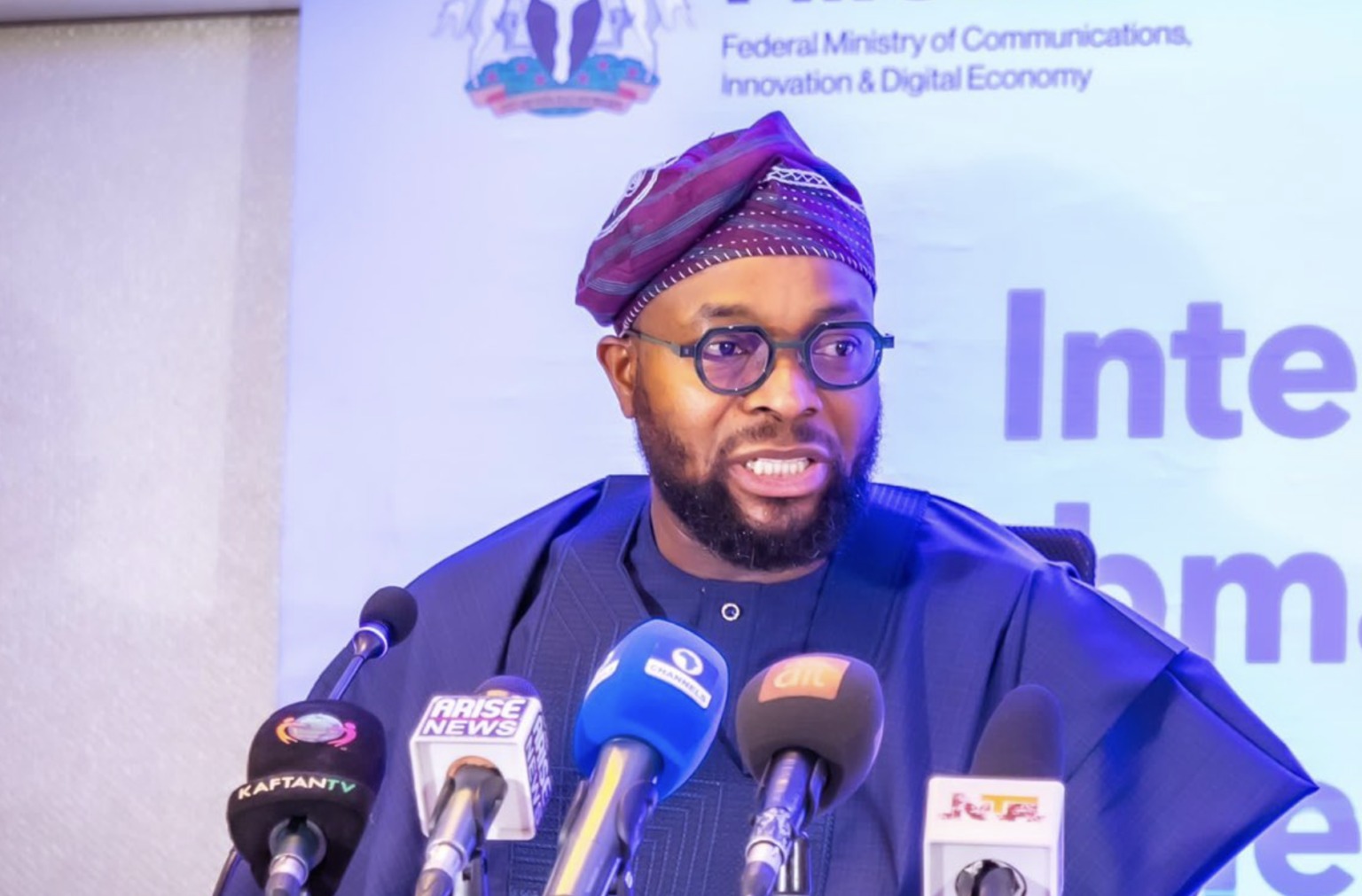
The federal government has instructed telecommunications operators to improve the quality of service to Nigerians, saying the conditions required for improved service delivery have been established by the government.
The instruction was issued in a statement signed by the Minister of Communications, Innovation and Digital Economy, Bosun Tijani, on Sunday, stating that the operators now have both the capacity and the resources to fix outstanding issues within their networks.
Mr Tijani explained that the Nigerian government has invested in projects addressing foundational gaps in the country’s digital infrastructure, such as ‘Project Bridge’, which are capable of permanently transforming connectivity across Nigeria.
The ‘Project Bridge’ was unveiled in August 2025 as an initiative to achieve nationwide connectivity by extending Nigeria’s national fibre backbone from around 30,000 km to about 120,000 km, connecting all 774 Local Government Areas.
Since then, the project has secured approved investments of $200 million from the African Development Bank (AfDB) Group, $500 million from the World Bank, and $100 million from the European Bank for Reconstruction and Development (EBRD).

According to the minister, the project will translate into small business owners being able to access reliable, high-speed fibre internet directly at their homes or shops, rather than relying solely on dongles or unstable mobile connections.
“When we assumed office, it was clear that Nigeria’s connectivity challenges were structural, driven by years of underinvestment in infrastructure and constraints that limited the ability of operators to deliver quality service. We have addressed this on two fronts. First, the long term structural solution.
“We have secured funding, led by the World Bank, and established the framework for a special purpose vehicle with Project BRIDGE, to deliver nationwide open access fibre infrastructure. Deployment of fibre will commence, alongside new tower rollouts through NUCAP, before the end of the year even as we also expand our satellite capability.
“These investments will address the foundational gaps in our digital infrastructure over the next two to five years and permanently transform connectivity across Nigeria,” Mr Tijani said.
Sustainability
To further address Nigeria’s connectivity challenges, Mr Tijani said the government has embarked on sustainability efforts to remove limitations affecting operators’ ability to deliver quality service.
He said the efforts include allowing tariff adjustments, alongside broader reforms and efforts to harmonise taxes, as well as macroeconomic reforms including the floating of the naira and the removal of fuel subsidies.
He added that the reforms have now enabled operators to function in a more stable, transparent, and market-driven environment and have returned to profitability.
“Second, the immediate stabilisation of the sector. We took a hard look at the sustainability of the telecommunications sector and made the necessary decisions to restore it.
“This included allowing tariff adjustments, alongside broader reforms such as the designation of telecom infrastructure as critical national infrastructure, efforts to harmonise taxes, and macroeconomic reforms including the floating of the naira and the removal of fuel subsidies,” the minister noted.
Regulations
Mr Tijani stated that the efforts imply that operators now have both the capacity and the resources to fix outstanding issues within their various networks and improve the quality of service delivered to Nigerians.
He said the conditions required for the sector to ensure service standards have been established by the government, noting that operators’ performance will now be monitored by the Nigerian Communications Commission (NCC) to ensure compliance.
READ ALSO: Nigeria needs AI-Skilled civil service to drive productivity – Bosun Tijani
“Let me therefore be clear, the conditions required for improved service delivery have now been established.
“It is now the responsibility of telecom operators such as MTN Nigeria, Airtel Nigeria, Globacom, and T2 to take all necessary steps to resolve network challenges and deliver the level of service Nigerians expect.
“At the same time, the Nigerian Communications Commission, NCC, has been fully empowered, without interference, to carry out its mandate of monitoring performance, enforcing service standards, and ensuring compliance across the industry,” Mr Tijani said.
He added that the communications ministry will continue to rely on the NCC’s periodic reports to track network performance, as well as feedback from Nigerians.
The NCC will also monitor complaints and experiences shared by Nigerians across public platforms, noting that the communications ministry will also engage both the NCC and operators more actively in the days, weeks, and months ahead.
The minister, however, warned that telecom operators that fail to ensure measurable improvements in their services will face appropriate regulatory action.
“Going forward, we expect to see clear and measurable improvements in call quality, data performance, and coverage. Where operators deliver, it will be recognised.
“Where they do not, the commission is expected to take appropriate regulatory action. Nigerians should begin to see improvements in Quality of Service and get value that they paid for now, and in the future. And we will ensure that the sector delivers,” Mr Tijani said.







The Auditor-General of the Federation flagged an alleged ₦345.5 million duplicate payment by the Federal Ministry of Communications, Innovation, and Digital Economy to a contractor handling the Abuja ICT Park project.
The finding was contained in the Auditor-General’s Annual Report on Non-Compliance and Internal Control Weaknesses in Ministries, Departments and Agencies of the Federal Government for the year ended 31 December 2024.
The special audit of the communication ministry covered the period from 1 January to 31 December 2021 and raised 14 issues concerning the planning, funding, procurement and implementation of the ICT Park project.
At the time the project was being implemented, Isa Ali Pantami, who was appointed by former President Muhammadu Buhari, served as Minister of Communications and Digital Economy from 2019 to 2023. He was succeeded by Bosun Tijani, who was appointed by President Bola Tinubu.
₦345.5 million duplicate payment
In Issue 13 of the findings, titled “Loss of Fund Due to Duplicated Payments to Contractor,” the Auditor-General said the ministry processed and approved two separate payments of ₦345,499,262.74 each as the third tranche of the 15 per cent mobilisation advance to the contractor.
The payment was intended to establish the Information and Communication Technology (ICT) Park, Abuja.

The Permanent Secretary approved the first payment on 19 January 2022 through payment voucher No. FMCDE/CAP/606/2021 dated 24 January 2022.
The same accounting officer approved the second payment on 17 January 2023 through payment voucher No. FMCDE/CAP/149/2022 dated 8 February 2023.
The report said the two paid vouchers had identical contract references, amounts, and narrative descriptions, which it said indicated duplicate payment.
It added that no record showed the first payment had been reversed, adjusted, or treated as an accounting error.
“There was also no journal entry, refund, or internal memo linking the 2023 approval to any prior transactions. These omissions demonstrate a failure of supervisory review, record reconciliation, and payment verification within the Ministry,” the findings stated.
The Finance and Accounts Department also failed to justify the repeated authorisation or the lack of reconciliation between the Cash Book and Vote Book, according to the report.
The findings said the contractor, while claiming it received only one payment in 2023, submitted a bank statement that excluded the critical period between 2 January 2022 and 8 February 2023, preventing independent verification of its claim.
The audit said the payments posed risks of fund diversion and loss of public funds, attributing this to weaknesses in the ministry’s internal control system.
The audit said the ministry’s management did not respond to the alleged duplicate payment under the contract.
The Auditor-General recommended that ₦345.499 million be recovered and remitted to the Treasury, and that evidence of remittance be forwarded to the Public Accounts Committee of the National Assembly.
₦447.67m from undisclosed funding sources
In Issue 11, the auditors questioned ₦447.67 million in payments to the ICT Park contractor, which they said could not be traced to the Government Integrated Financial Management Information System (GIFMIS).
The amount comprised ₦102,166,730 and ₦345,499,262.74 paid to the contractor, vide paid vouchers, Ref. No. FMCDE/CAP/061/2021 and FCMDE/606/2022 on 11 June 2021 and 19 February 2022, respectively.
According to the report, the payments appeared in the cash book. The contractor acknowledged them in the progress report and bank statement, but they did not appear in GIFMIS records, indicating they were processed off the system.
The audit said officials in the ministry’s Finance and Accounts Department could not explain the existence or authorisation of the alternative funding sources.
The report said the ministry also failed to provide documentation showing lawful appropriation, supplementary approval, or an external funding agreement for the payments.
The audit said the action posed a risk of misappropriation of funds and diversion of public property.
It said the ministry’s management did not respond to questions about the history of the payments in the GIFMIS records.
The Auditor-General recommended recovering and remitting ₦447.67 million to the Treasury, with sanctions under paragraphs 3106 and 3129 of the Financial Regulations (2009) if the ministry fails to comply.
₦396.65 million project funds used for unrelated items
In Issue 9, the findings showed that N396.65 million from the ICT Park project fund was used to pay for consultancy services, office consumables, furniture, and stationery printing.
The audit said approvals had been processed for consultancy services relating to the ICT Park. Still, payments were made to unrelated suppliers for consumables and office furniture that were not contained in the project’s Bill of Quantities.
The report said this reduced funds meant for the mobilisation and execution of the ICT Park project.
It also said the ministry failed to provide evidence of approval for the virement from the Minister of Finance, Budget and National Planning and the National Assembly.
It said the actions posed a risk of misappropriation of funds and undue delay in completion of the project, noting that the ministry failed to respond to the question on the use of the project funds for unrelated items.
The Auditor-General recommended recovering and remitting ₦396.655 million to the Treasury, with sanctions under paragraphs 3106 and 3129 of the Financial Regulations (2009) if the ministry fails to comply.
₦1.85bn paid without performance bond
In Issue 10, the auditors also found that N1.848 billion was paid to the contractor without securing a valid Performance Bond.
The report said the Bureau of Public Procurement had directed in December 2020 that a minimum 10 per cent Performance Bond be secured for major contracts before payment of mobilisation fees.
However, the ministry first released ₦1.348 billion in mobilisation payments between March 2021 and February 2023 without obtaining the required bond.
The report said that nearly three years after the contract award, the contractor submitted a commitment letter dated 29 December 2023, promising to furnish a Performance Bond upon receiving an additional N500 million. This amounts to ₦1.848 billion.
It said the actions exposed public funds to loss, noting that the ministry failed to respond to the question on the payment.
The Auditor-General recommended recovering and remitting ₦1.848 billion to the Treasury, and imposing sanctions under paragraphs 3106 and 3129 of the Financial Regulations (2009) if the ministry fails to comply.
₦500 million paid without interim performance certificate
In Issue 12, the Auditor-General said the ministry released an additional ₦500 million to the contractor on 29 December 2023 without an Interim Performance Certificate or verified progress report.
The report said the payment was made after the contractor received the 15 per cent mobilisation fee.
Instead of an Interim Performance Certificate, the ministry relied on a commitment letter from the contractor promising to provide project vehicles and undertake overseas technical trips upon receipt of the additional funds.
The audit said the actions posed a risk of diverting public funds and losing government funds. It said that the ministry failed to respond to the question on the payment.
The Auditor-General recommended recovering and remitting N500 million to the Treasury and imposing sanctions under paragraph 3106 of the Financial Regulations (2009) if the ministry fails to comply.
Premature foreign trips of ₦90 million
In Issue 8, the auditors questioned a ₦90 million provisional sum for foreign trips to inspect technical equipment for the ICT Park.
According to the findings, the sum of ₦90 million was included and described as “Allow a provisional sum of N90 million to cater for Client’s and Consultants’ representatives for foreign trips for the inspection of technical equipment to be deployed for the project,” in the priced Bill of Quantities (BOQ) for the contract for the ICT Park project, with a contract sum of ₦8.984 billion.
The report said the expenditure was being planned while the project was still at foundation level, before structural works, equipment procurement or installation had commenced.
It said no evidence was provided to justify the technical need, approved schedule, or cost-benefit assessment supporting the timing of the proposed trips.
The audit said the action demonstrated weak expenditure prioritisation and poor sequencing of project activities, noting that it posed a risk of undue delay in completion of the project and diversion of public funds.
Again, the ministry did not respond to questions about the premature foreign trip.
The Auditor-General recommended recovering and remitting the N90 million. It also recommended sanctions under paragraphs 3106 and 3115 of the Financial Regulations (2009) if the ministry fails to comply.
Denial of access to project documents
The audit also raised concerns about the ministry’s failure to give auditors access to project documents.
In Issue 14, the report said auditors were denied access to documents including needs assessment reports, bank mandates for ICT project payments, payment vouchers, due diligence reports on the contractor and the Environmental and Social Impact Assessment report.
READ ALSO: How Nigeria’s Population Commission mismanaged N245 billion on undelivered products, other controversial contracts – Auditor-General
The report said several requests for project-related documents made between March and June 2025 were not answered by the ministry.
It said the denial of access to procurement documents contravened the Constitution and risked concealing financial information, diverting government revenue, and the loss of public funds.
The Auditor-General asked the Permanent Secretary to justify the denial of access and produce all documents relating to the ICT Park project.
The report stated that the ministry did not respond to the issues raised in the audit and that the findings remained valid until the recommendations were implemented.
Other issues
Other issues included a ₦94.05 million cost overrun attributed to the failure to conduct feasibility studies and an Environmental Impact Assessment before the ICT Park project began.
The Auditor-General also flagged ₦19.47 million in costs linked to delayed site handover, while questioning the absence of resident technical supervision despite a ₦160 million provision for it.
The report further cited inadequate budgetary provisions that contributed to project delays and the ministry’s failure to conduct or document a needs assessment before procurement.
Discover more from Premium Times Nigeria
Subscribe to get the latest posts sent to your email.
-

 News4 days ago
Lucid Motors’ EV output falls to lowest level in almost 2 years
-
News3 days ago
Mirror Particle is building a ‘world model’ of human behavior
-
News3 days ago
I Never Prayed for Tinubu, Shettima to Win 2027 Election – Plateau Cleric
-
News3 days ago
FCCPC reviews rules for Nigeria’s online sales promotions, giveaways – Technology Times