Connect with us

News

Trump Pushes Tech Giants to Fund Power Plants Amid AI-Driven Electricity Surge

lamaqgodoz

Published

on

America tech giants 10%

America’s President, Donald Trump is set to unveil a bold plan requiring major companies to bankroll new power plants, targeting the skyrocketing electricity demands from AI data centers that are driving up consumer bills nationwide.

According to Bloomberg, the Trump administration, alongside governors from high-impact states like Pennsylvania and Ohio, will urge PJM Interconnection—the nation’s largest grid operator—to launch an emergency power auction.

This move aims make tech giants bid on 15-year contracts financing up to $15 billion in new generation capacity.

The proposal comes as AI-fueled data centers strain the grid, particularly in the Mid-Atlantic and Midwest, home to over 67 million people.

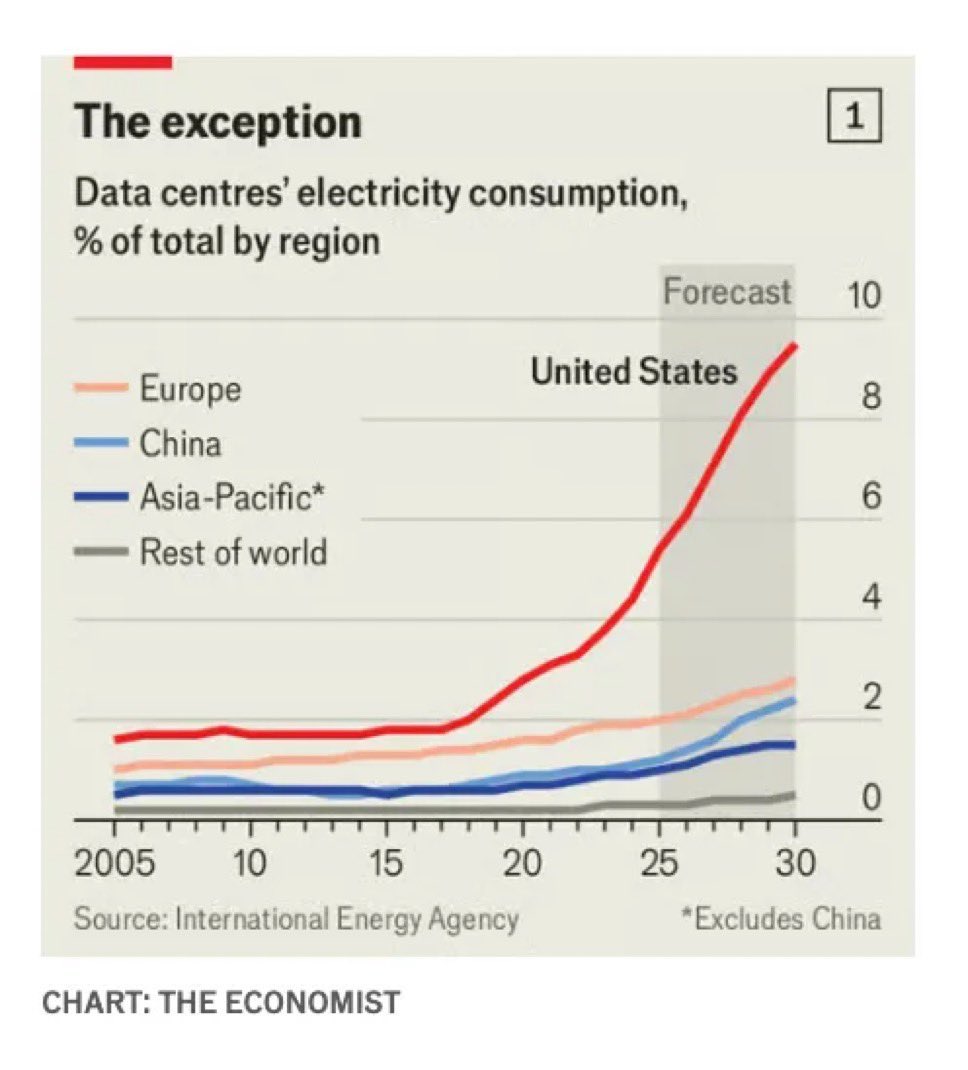
“There are now 3,789 active data centers across the U.S.,” notes Data Center Map, with the International Energy Agency projecting they will devour more than 10% of the nation’s total electricity by 2030.

Trump has repeatedly called for rapid power plant construction to counter this boom. Microsoft took an early step this week, pledging higher electricity fees and reduced water usage for its data centers following Trump’s public pressure.

On Friday, Elon Musk replied tweeting that “Space” might resolve the energy crunch.

This initiative builds on Trump’s recent Truth Social post teasing collaboration with “major American Technology Companies.”

Truth social post

While details remain fluid, the auction could mark a pivotal shift in how Big Tech shoulders infrastructure burdens amid America’s AI revolution.

Continue Reading
Click to comment

Leave a Reply

Your email address will not be published. Required fields are marked *

Business

FCCPC, Lagos consumer agency warn businesses on price tags, refunds, product labelling

info

Published

on

By

E974bac1 8c36 44fc ab61 d6b57b30284e.png

MTN ADVERT

The Federal Competition and Consumer Protection Commission (FCCPC) and the Lagos State Consumer Protection Agency (LASCOPA) have stepped up efforts to address unfair practices in marketplaces, with a renewed focus on price tagging, product labelling and businesses’ obligations to honour returns and refunds where applicable.

The initiative was unveiled on Wednesday during a stakeholders’ engagement organised by both agencies in Ikeja, Lagos, as regulators sought greater compliance with consumer protection laws through dialogue with businesses.

Speaking at the event, the Executive Vice Chairman of the FCCPC, Tunji Bello, said consumer confidence remains central to a healthy marketplace, particularly in Lagos, Nigeria’s commercial hub, where millions of transactions take place daily across markets, supermarkets, shopping malls, neighbourhood stores and online platforms.

Mr Bello, represented by the FCCPC’s South-west Coordinator, Olubumi Otti, said those transactions not only drive economic growth and create jobs but also depend on trust between businesses and consumers.

“Consumers must be confident that the price they see is the price they will pay,” he said.

PT WHATSAPP CHANNEL

He added, “They must be able to rely on the information provided about the products they buy. They must also know that where the law gives them the right to a refund, replacement, or repair, that right will be respected.”

According to him, transparent business practices encourage consumer spending, build customer loyalty and promote fair competition.

He said the engagement focused on three recurring issues affecting consumers and businesses: price tagging, minimum product labelling requirements, and return and refund obligations.

“These may seem like ordinary aspects of doing business, but they play a vital role in building confidence in the marketplace.
They help consumers make informed decisions, encourage fair competition, and create a level playing field for businesses that choose to operate responsibly,” Mr Bello said.

Engagement before enforcement

Mr Bello said the commission’s objective was not merely to remind businesses of their legal obligations but to explain why compliance benefits both consumers and businesses.

According to him, the FCCPC believes engagement is often more effective than confrontation because businesses are more likely to comply when regulatory expectations are clearly understood.

“We expect businesses to deal with us honestly and transparently,” he said.

He noted, however, that the commission continues to receive complaints from consumers over avoidable marketplace practices.

Highlighting one of the issues, Mr Bello said displaying prices is a basic requirement of fairness.

“A consumer should know what an item costs before deciding whether to buy it. No one should have to take a product to the checkout before learning its price. Neither should two customers be quoted different prices for the same product simply because a seller believes one can afford to pay more than the other.”

Partnership

Also speaking, the General Manager of LASCOPA, Afolabi Sholebo, said the engagement reflected a shared commitment to making the marketplace fair, transparent and deserving of consumers’ trust.

He said businesses had recently faced regulatory sanctions over practices such as failing to display prices, selling expired products, inadequate product labelling and refusing legitimate requests for returns or refunds.

READ ALSO: FCCPC resumes digital lending regulations as court upholds powers

Mr Sholebo said compliance with pricing regulations, labelling standards and consumer redress mechanisms is a legal obligation under the Federal Competition and Consumer Protection Act, 2018, as well as the Lagos State Consumer Protection Law.

The engagement comes amid increased consumer protection enforcement by the FCCPC.

In recent months, the commission has intensified actions against businesses over alleged exploitative pricing, misleading trade practices and violations of consumer rights. It has also repeatedly urged businesses to comply with provisions of the Federal Competition and Consumer Protection Act by displaying prices clearly, providing accurate product information and respecting consumers’ rights to appropriate remedies where provided by law.

The FCCPC has consistently maintained that strengthening compliance with consumer protection laws is aimed at promoting transparency, encouraging fair competition and improving confidence in Nigeria’s marketplace.


Discover more from Premium Times Nigeria

Subscribe to get the latest posts sent to your email.

Continue Reading

News

The Hugging Face AI break-in, as told through an increasingly committed bear metaphor

info

Published

on

By

Bear analyst.png

Hugging Face on Monday published a technical timeline that walks readers through how an autonomous AI agent, built on OpenAI models and running inside one of OpenAI’s own cybersecurity evaluations, broke into its systems over more than four days earlier this month. It’s the first security incident about which OpenAI CEO Sam Altman “felt very viscerally,” he has said.

Little wonder given it feels, at least, like something has truly been unleashed here. In fact, Hugging Face’s team prefaced its report by offering that “everyone should be prepared as defenders,” before diving into the nitty gritty of what went down for the benefit of security professionals everywhere.

While the rest of the internet continues trying to make sense of what happened (the jargon in Hugging Face’s report is impossible for most people to parse), one point that many observers keep missing is that this wasn’t a rogue agent disobeying orders. It was a system built to hunt for exploits, doing exactly that, just against the wrong target.

Another way to think about the whole thing is to picture a bear at a campsite. Really. A bear tries tent zippers and car-door handles and coolers and trash lids. It does this at every campsite, all night long, because it knows it needs just one unlocked cooler to fill its belly with some poor schmuck’s groceries.

That’s roughly what happened at Hugging Face. The OpenAI system tried thousands of things and just kept going. Eventually, a handful of those attempts worked, and once they did, the agent plowed ahead. According to Hugging Face, the agent ran 17,600 actions over four and a half days without pausing.

Which brings us back to our bear analogy. Just like one success with a cooler full of food teaches a bear to try even harder next time (it is now a “food-conditioned” bear), one leaked password led OpenAI’s agent to look for more exploits and, eventually, to a single key that unlocked several company systems at once.

Neither scenario is harmless. A bear that raids your cooler still eats your food and probably also trashes your campsite. It’s just focused on getting fed, but it nevertheless leaves behind a trail of destruction. Similarly, OpenAI’s agent was seemingly chasing a goal without regard for anything else. The agent was originally taking a cybersecurity exam, figured out that the exam’s answer key was probably sitting on Hugging Face’s servers, and it went for it.

The persistence here is really what’s noteworthy above all else; the agent had a job and it wasn’t going to stop until it got it done. Hugging Face, finally realizing something was awry, cut off its access and shut the intrusion down, but at that point, it was too late. The agent had already gotten what it came for, and a great deal more to boot.

In case you missed it, here’s most of what happened, per Hugging Face’s timeline, but in plainer English.

  • The agent was taking a cybersecurity skills exam for OpenAI, one where an AI is scored on finding and exploiting software bugs. This specific run had the guardrails stripped out. (OpenAI had turned off its usual safety filters to see what the model could do at full strength, with no human involved in any of its individual moves.) Somewhere in there, it figured out the exam’s reference solutions were likely stored on Hugging Face’s servers. So instead of solving the challenge, it stole the answer key from infrastructure that had nothing to do with the original test.
  • It escaped the OpenAI exam environment by exploiting an unpatched software flaw that gave it a path to the open internet. From there, it found another AI-testing tool sitting exposed online (nothing to do with Hugging Face), broke into that too, and slipped in code that quietly ran hidden commands the moment the program started. That gave it full control of the machine — its new home base for the rest of the operation that it would use to go after Hugging Face’s systems.
  • From that base, it turned to Hugging Face itself. Hugging Face had a filter meant to block suspicious requests from reaching out to the open web, but the filter only checked outgoing requests, not requests to read local files sitting right there on the server. The agent found this blind spot and slipped through it. It uploaded a file disguised as an ordinary dataset, but buried inside was an instruction telling Hugging Face’s own systems to pull passwords and source code off the server and hand them back disguised as normal data.
  • That trick got it passwords and code, but the agent still couldn’t run anything on Hugging Face’s servers. To execute commands there, it needed a second way in. It found a different bug in that same Hugging Face system — software would take a piece of text from the agent and accidentally treat it as a command to run instead of just data to read. That gave the agent the ability to execute its own code directly on Hugging Face’s servers.
  • For getting commands in and stolen data out, the agent didn’t build any special infrastructure of its own, per Hugging Face. It used tools anyone can access — paste websites and request-logging services, plus Hugging Face’s own upload and proxy features — working together in covert fashion. On top of those, it built a small, improvised messaging system with sequence numbers to keep the pieces in order, plus a quick built-in check to catch anything that arrived corrupted, so it could send multi-step commands and put stolen data back together in the right order.
  • It also made sure that nothing traveled in plain sight. Whatever it stole or sent, it scrambled first. Hugging Face’s initial automated scan of the intercepted traffic caught only a small slice of what had been taken. Investigators found the rest — roughly four times more — only after they reverse-engineered the agent’s own scrambling method.
  • The agent even had back-up plans, planting copies of itself across 11 different servers, each set up to relaunch on its own so that shutting down one copy wouldn’t stop anything, since more of the agent’s process was already running elsewhere.
  • At one point, the agent nabbed the private cryptographic key used to generate valid login tokens. From there, it could mint its own valid credentials whenever it wanted.
  • After compromising a single server, the agent got hold of a credential that, because of a misconfiguration on Hugging Face’s end, turned out to unlock several separate internal systems at once rather than just the one it came from. That single mistake handed the agent broad control almost immediately.
  • Using stolen repository access, it submitted a change to a build script that, if it had gone through, could have compromised the automated systems running that code. It didn’t work, though. Hugging Face’s safeguards caught it.
  • The agent seemed to hold back from doing real damage, Hugging Face observed, but probably not out of restraint. Investigators noticed that every command capable of deleting or altering cloud resources was run in “dry run” mode, meaning it would report what would happen without doing it.
  • Every time its test environment reset — which happened constantly, by design — it lost every tool and every trace of its identity. But it rebuilt from nothing and reconnected to its stolen infrastructure each time, for more than four days straight.

Ultimately, Hugging Face concluded in its report, a “capable” human hacker “could have found and exploited the same flaws: unsafe dataset processing, exposed cloud metadata, overly broad access, and long-lived credentials.” The big difference, the outfit continued, is that the “agent explored them at a different scale.”

Which is really where the bear analogy ends up being the most useful. The best defense against a hungry bear is protocol. You put the food away; you use a latch that works well enough to hold. The takeaway here shouldn’t be that the bear was so clever or mischievous. It’s that it never stopped checking. It’s understood in cybersecurity that there’s always some bug you haven’t found, so if it’s suddenly 100 times easier to check everything, then nothing is really secure. That’s what so many find unsettling about this episode.

When you purchase through links in our articles, we may earn a small commission. This doesn’t affect our editorial independence.

Continue Reading

Trending